
Alocasia Black Velvet Identification Guide
A practical guide to recognizing Alocasia reginula 'Black Velvet' by its compact, dark velvety leaves and silver-white veining.
Read the full Alocasia Black Velvet encyclopedia entry →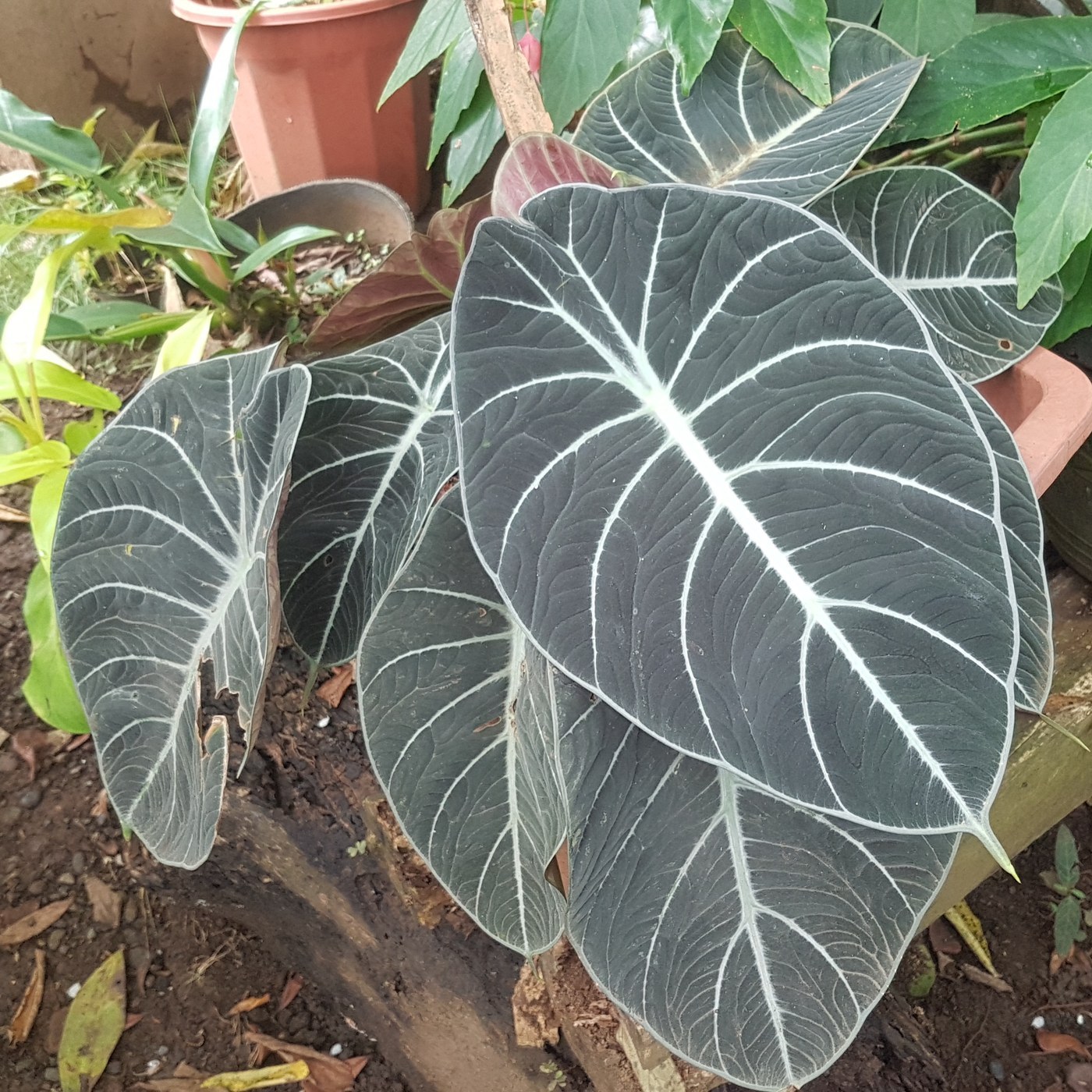
Key Identifying Features
Alocasia Black Velvet (Alocasia reginula) is a small, slow-growing jewel Alocasia prized for its dramatic foliage. Look for these signatures:
- Deep blackish-green, matte velvety leaves that absorb rather than reflect light
- Bright silver-white to pale green veins forming a bold contrast against the dark blade
- Compact, low-growing habit rarely exceeding 12-18 inches tall
- Thick, leathery, almost stiff leaf texture
Leaves & Stems
The leaves are broadly arrowhead (sagittate) to heart-shaped, typically 3-6 inches long, held nearly upright on short, sturdy petioles. The upper surface has a distinctive suede-like, light-absorbing nap that gives the near-black appearance its name. Prominent primary lateral veins run in a contrasting silvery-white, dividing the leaf into bold panels. The underside is purple-green to maroon, a useful confirming trait. Petioles are short, pale green and slightly mottled, keeping leaves clustered close to the soil rather than spreading wide.
Flowers & Fruit
Like other Alocasia, it produces an arum-type inflorescence: a pale green-to-cream spathe wrapping a slender spadix. Flowers are infrequent indoors and largely insignificant compared to the foliage. Most growers remove the bloom to redirect energy to leaves. Fruit (small berries) is rarely seen in cultivation.
How to Tell It Apart from Look-Alikes
- Alocasia 'Frydek': also velvety dark green with white veins, but much larger, elongated arrow-shaped leaves and a taller habit. Black Velvet stays small and rounded.
- Alocasia 'Dragon Scale': similar size but leaves are green with quilted, scale-like texture, not blackish velvet.
- Alocasia 'Bambino': narrow, glossy (not velvety) arrow leaves.
- Anthurium clarinervium: superficially similar veining but has a leathery, non-velvet matte surface and belongs to a different genus.
The combination of small size + matte black velvet texture + silver veins + purple underside is diagnostic.
Where You'll Find It
Native to the rainforest floor of Borneo, it grows as a terrestrial understory plant in humid, shaded, well-drained leaf litter. As a houseplant it is sold as a compact tabletop specimen and thrives in high humidity (60%+), bright indirect light, and a chunky, fast-draining mix. You will encounter it indoors, in terrariums, and in collectors' jewel-Alocasia displays rather than outdoors in temperate regions.
Quick ID Checklist
- Small, compact plant (under ~18 in)
- Near-black, matte velvety leaf surface
- Bold silvery-white veins
- Arrowhead-to-heart leaf shape, held upright
- Purple-green underside
- Short petioles, clustered leaves
If all boxes are checked, you are almost certainly looking at Alocasia Black Velvet.
Frequently asked questions
How do I tell Black Velvet from Alocasia Frydek?
Both are velvety dark green with white veins, but Black Velvet stays small (under ~18 inches) with rounded, heart-to-arrow leaves, while Frydek grows much taller with long, narrow, deeply pointed arrowhead leaves.
Why do the leaves look black?
The surface has a fine velvety nap that absorbs light rather than reflecting it, making the deep green blade appear almost black, especially in lower light.
Is the velvety texture real or just a coating?
It is genuine plant tissue. Tiny surface cells (papillae) give the leaf its matte, suede-like feel. Avoid wiping it hard, as the nap can be damaged.
What color is the underside of the leaf?
Purple-green to maroon, which is a helpful confirming feature when distinguishing it from other dark Alocasia.