
Apache Pine Identification Guide
Recognize Apache Pine (Pinus engelmannii) by its very long, drooping needles in threes and grass-like juvenile stage in the Southwest's sky islands.
Read the full Apache Pine encyclopedia entry →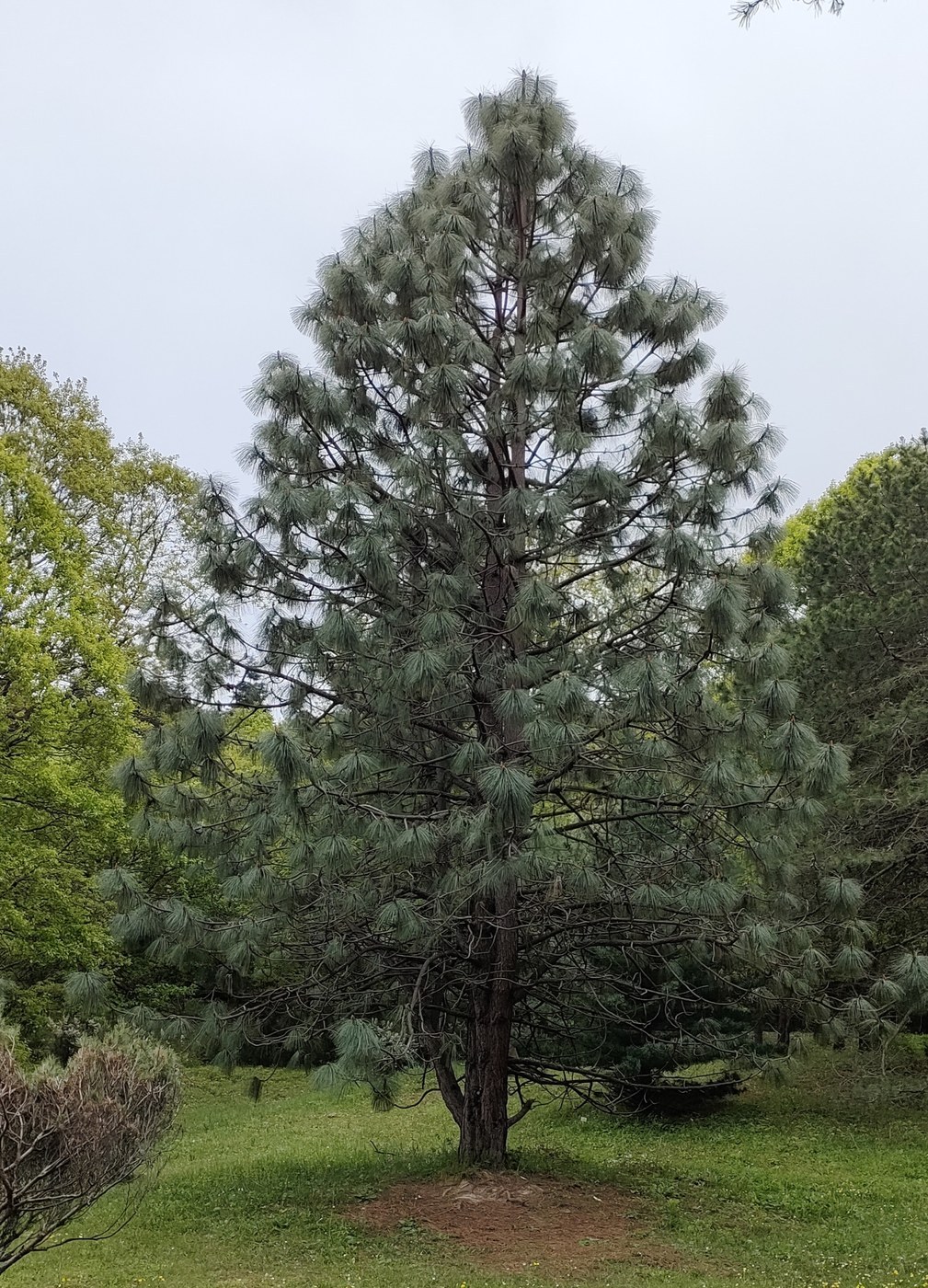
Key Identifying Features
Apache Pine (Pinus engelmannii) is a southwestern pine of the "sky island" mountains, notable for its exceptionally long needles and a striking juvenile "grass stage" similar to Longleaf Pine. Mature trees have a relatively open crown of coarse, drooping foliage.
- Very long needles (often 8–17 in) that droop and cluster at branch tips
- A grass-stage seedling that looks like a tuft of long needles with no stem
- Stout twigs and a sturdy, single trunk
- Reddish-brown, deeply furrowed bark
Leaves & Stems
Needles are usually in bundles of three (occasionally 4–5), and are remarkably long — commonly 8 to 15+ inches — giving the foliage a coarse, shaggy, drooping look. The very long needles concentrated at the ends of stout branchlets are the best field mark. Young trees pass through a grass stage, sitting low with a dense fountain of needles before the trunk elongates — a fire adaptation. Bark is thick, dark reddish-brown, and furrowed into plates.
Flowers & Fruit
Cones are ovoid to conical, 3–6 inches long, woody, and slightly curved, with a small prickle on each scale. They open at maturity to release winged seeds. Pollen cones are small, clustered near branch tips in spring.
How to Tell It Apart from Look-Alikes
- Chihuahua Pine grows in the same ranges but has needles in fives (not threes) and small cones on long stalks — an easy separation.
- Ponderosa Pine overlaps in range but has shorter needles (5–10 in) and lacks the grass stage.
- Longleaf Pine also has a grass stage but is an eastern U.S. species, so geography rules it out in the Southwest.
- The combination of very long drooping 3-needle fascicles + grass-stage juveniles in Arizona/New Mexico sky islands points to Apache Pine.
Where You'll Find It
Apache Pine occurs in the mountains of southeastern Arizona, southwestern New Mexico, and northern Mexico, typically at 4,900–8,200 ft in pine-oak woodland of the sky islands. It favors well-drained slopes and is fire-adapted.
Quick ID Checklist
- Very long needles (8–15+ in), mostly in 3s
- Coarse, drooping foliage at branch tips
- Juveniles in a grass stage
- Cones 3–6 in, ovoid, with small prickle
- Sky-island pine-oak woodland of AZ/NM/Mexico
Frequently asked questions
What makes Apache Pine stand out?
Its very long, drooping needles (often well over a foot) bundled in threes, plus a grass-stage seedling phase, make it distinctive among southwestern pines.
How is it different from Chihuahua Pine?
Apache Pine has needles in bundles of three and stalkless cones, while Chihuahua Pine has needles in fives and small cones on long stalks.
What is the grass stage?
A juvenile phase where the seedling stays low to the ground as a dense tuft of long needles before the trunk grows upward — a fire-survival adaptation also seen in Longleaf Pine.
Where does Apache Pine grow?
In the sky-island mountains of southeastern Arizona, southwestern New Mexico, and adjacent Mexico, in pine-oak woodland roughly between 4,900 and 8,200 feet.