
Arizona Cypress Identification Guide
Identify Arizona Cypress (Cupressus arizonica) by its blue-gray scale foliage, small round woody cones, and shaggy or smooth red-brown bark.
Read the full Arizona Cypress encyclopedia entry →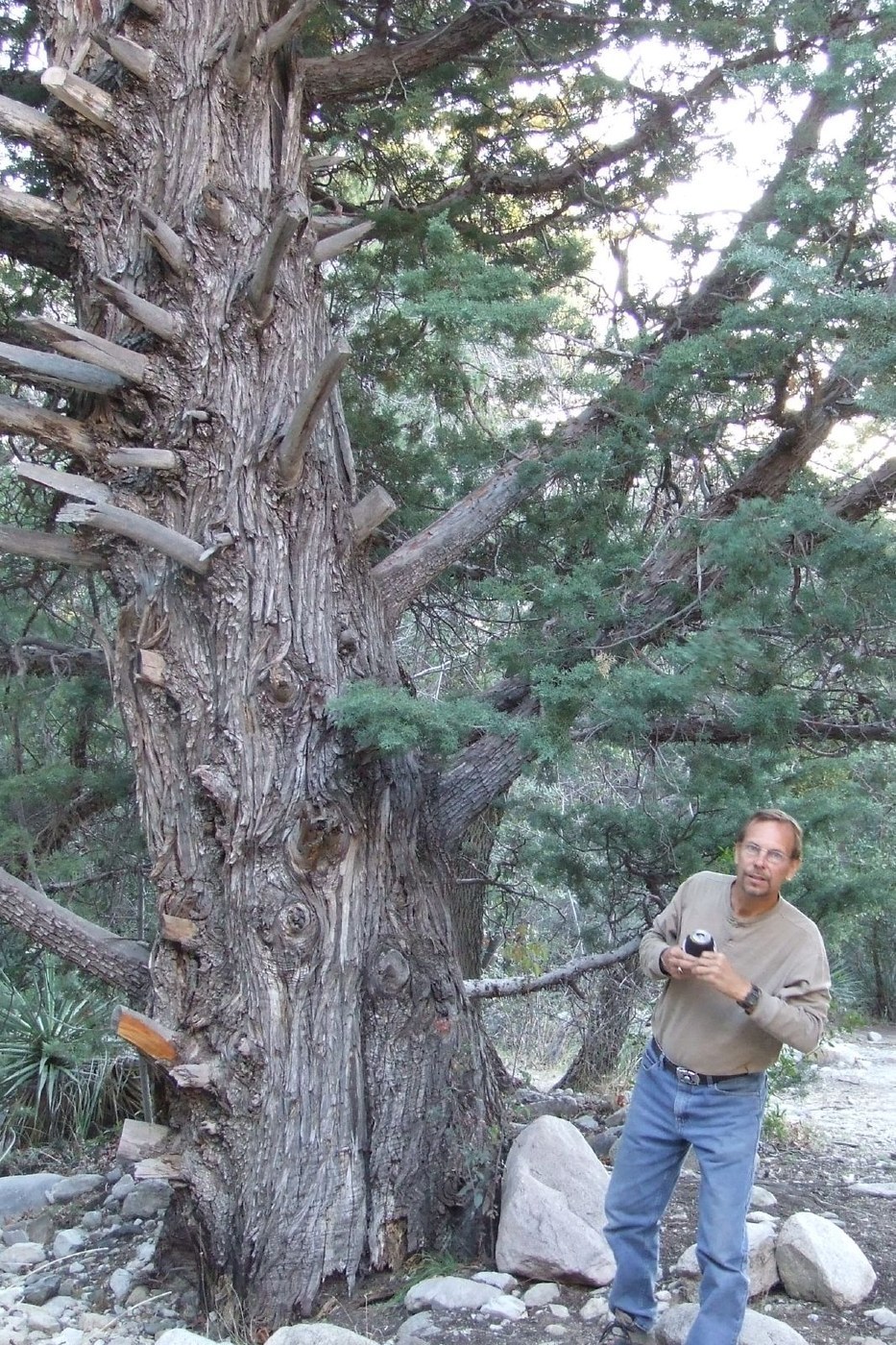
Key Identifying Features
Arizona Cypress (Cupressus arizonica) is a drought-hardy evergreen conifer of the southwestern US, often grown as a Christmas tree, windbreak, and ornamental. Recognize it by its fine, blue-gray to silvery scale-like foliage, small round woody cones, and aromatic, often reddish, peeling or fibrous bark.
- Dense, conical to pyramidal crown
- Blue-gray / glaucous scale foliage with a pungent resinous scent
- Round, hard, golf-ball-sized seed cones
- Bark either smooth cherry-red (var. glabra) or stringy gray-brown
Leaves & Stems
Leaves are tiny scale-like leaves pressed against the twig in opposite pairs, clothing the branchlets so they look like rounded cords rather than flat sprays. The foliage color ranges from gray-green to a striking silvery blue, the basis for popular cultivars like 'Blue Ice' and 'Carolina Sapphire'. Crush the foliage for a sharp, resinous, slightly grapefruit-like odor. Unlike Thuja (arborvitae), the branchlets are not flattened into ferny sprays but are more three-dimensional and cord-like.
Flowers & Fruit
Male pollen cones are small and yellowish at branch tips. The female seed cones are round, woody, about 0.75-1 inch across, with 6-8 shield-shaped scales each bearing a small central point (umbo). Cones start grayish-green, ripen brown, and often remain closed and attached to the branch for years, opening after fire or heat.
How to Tell It Apart from Look-Alikes
- Arborvitae (Thuja): flat, fan-like ferny sprays of foliage and small elongated cones — Arizona Cypress foliage is cord-like and rounded with round cones.
- Eastern Red Cedar (Juniperus virginiana): produces soft blue berry-like cones, not hard round woody cones.
- Leyland / Monterey Cypress: greener foliage; Arizona Cypress is notably bluer and more drought-adapted.
- Lawson Cypress: flattened foliage with white X-marks beneath and tiny cones.
Blue cord-like scale foliage plus hard, round, woody cones and a desert-southwest origin point to Arizona Cypress.
Where You'll Find It
Native to the mountains and canyons of Arizona, New Mexico, west Texas, and northern Mexico, on dry rocky slopes from about 3,000-7,000 ft. Extremely drought- and heat-tolerant, it is widely planted across the southern US for screens, windbreaks, and ornamental blue foliage.
Quick ID Checklist
- Blue-gray scale-like foliage in cord-like branchlets
- Pungent resinous scent when crushed
- Round woody cones about 1 inch across
- Reddish peeling or stringy bark
- Southwestern US / hot dry sites
Fine blue scale foliage with hard round cones on a heat-loving conifer is Arizona Cypress.
Frequently asked questions
Why is Arizona Cypress so blue?
Its scale leaves carry a waxy bloom (glaucous coating) that reflects light blue-gray, an adaptation to intense sun and drought. Selected cultivars like 'Blue Ice' intensify this color.
How is it different from arborvitae?
Arborvitae foliage forms flat, ferny, fan-shaped sprays, while Arizona Cypress branchlets are rounded and cord-like. Arizona Cypress also bears round woody cones rather than small elongated ones.
Is Arizona Cypress good for dry climates?
Yes. It is exceptionally drought and heat tolerant, native to dry southwestern mountain slopes, making it a popular windbreak and screen in hot regions.