
Bacopa Identification Guide
Identify trailing Bacopa (Sutera) by its cascading stems covered in small five-petaled white or lavender star flowers and tiny scalloped leaves.
Read the full Bacopa encyclopedia entry →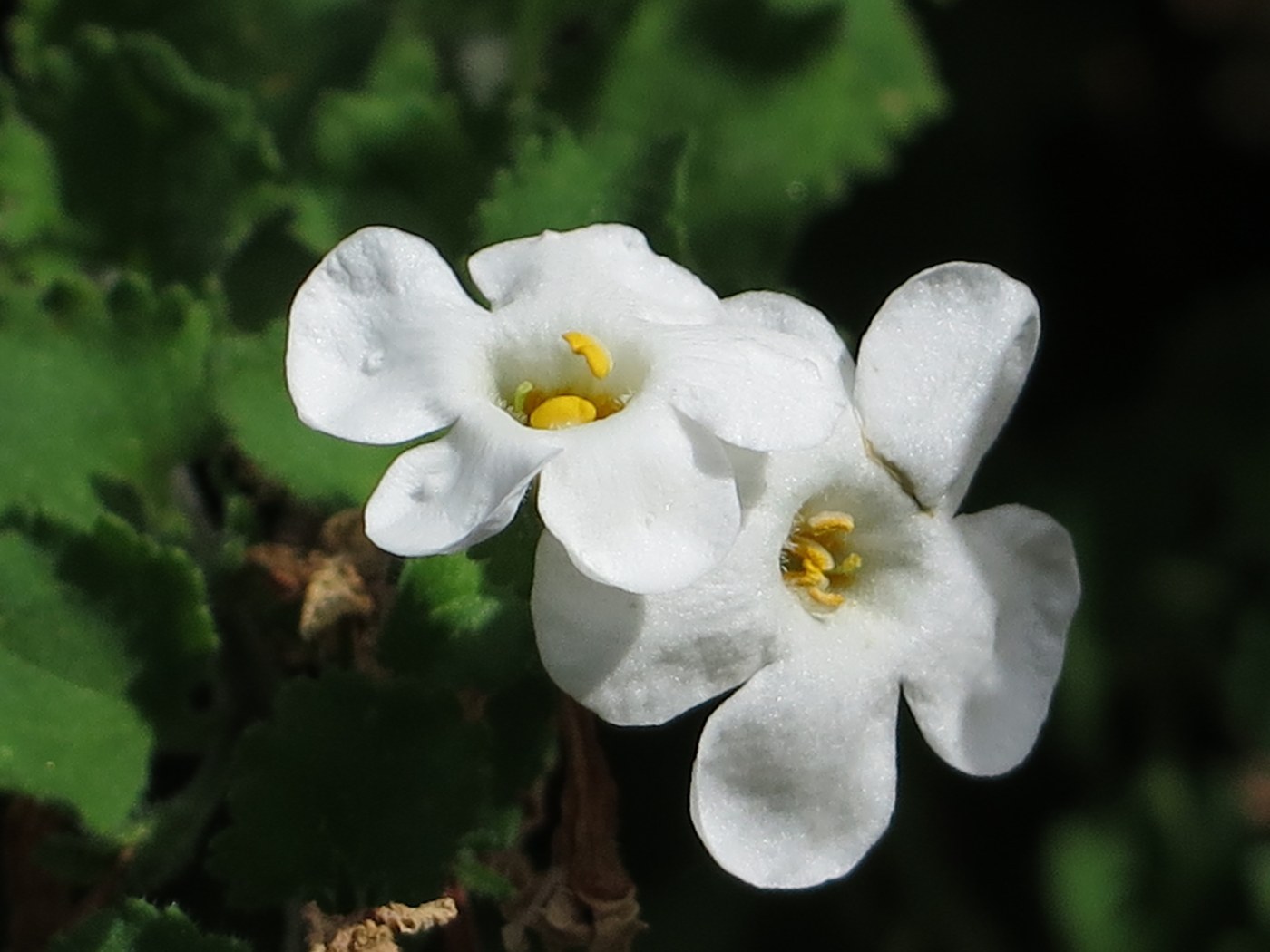
Key Identifying Features
Bacopa (Sutera cordata, sold horticulturally as bacopa) is a delicate trailing tender perennial grown as an annual, used mainly as a "spiller" in baskets and containers. It is recognized by fine cascading stems dotted with masses of small five-petaled flowers.
- Trailing, mat-forming habit, cascading 10-24 in (25-60 cm)
- Flowers small, about 0.5 in (1 cm) across, five-petaled and star/saucer-shaped
- Most often white, also lavender-blue and pink, with a small yellow eye
- Tiny, neat foliage gives a fine-textured, lacy look
- Blooms continuously, self-cleaning
Leaves & Stems
Leaves are small (0.5-1 in), oval to roundish, opposite, with shallowly scalloped or toothed edges and a soft green color. They clothe thin, wiry, much-branched trailing stems that drape and root where they touch moist soil. The whole plant has a delicate, airy texture quite different from heavier basket fillers.
Flowers & Fruit
Each flower has five rounded petals fused at the base into a short tube, opening into a flat star or saucer with a small yellow center. Flowers are borne singly in the leaf axils all along the stems, so a healthy plant looks speckled with tiny blooms. Bacopa is in the figwort/plantain family (Plantaginaceae). Fruit is a small inconspicuous capsule.
How to Tell It Apart from Look-Alikes
- Million Bells (Calibrachoa): also a trailing basket plant, but its flowers are trumpet-shaped with a fused funnel, not flat five-petaled stars.
- Lobelia: trailing too, with small flowers, but lobelia blooms are two-lipped and irregular, not symmetric five-petaled stars.
- Sweet alyssum: tiny flowers as well, but alyssum has four petals (mustard family) and a honey scent, while bacopa has five petals and no scent.
- The flat five-petaled star flowers borne singly along fine trailing stems + small scalloped leaves confirm bacopa.
Where You'll Find It
Bacopa is almost exclusively a cultivated container and hanging-basket plant, prized as a delicate cascading filler around showier flowers. It prefers consistent moisture (it sulks and drops flowers if it dries out) and does best in part sun to filtered light. You'll find it in window boxes, mixed baskets, and combination patio pots.
Quick ID Checklist
- Fine, cascading trailing stems
- Many small five-petaled star/saucer flowers
- White, lavender, or pink with a small yellow eye
- Tiny oval leaves with scalloped edges, opposite
- Delicate airy texture; self-cleaning bloom
- Needs steady moisture, common in baskets
Frequently asked questions
How do I tell bacopa from million bells in a basket?
Look at flower shape. Bacopa has flat, five-petaled star or saucer flowers with a yellow eye, while million bells (Calibrachoa) has small trumpet-shaped flowers fused into a funnel.
Why did my bacopa suddenly drop all its flowers?
Bacopa is sensitive to drying out. If it misses water even briefly it often drops blooms and pauses flowering. Consistent moisture usually brings it back, and this sensitivity is a behavioral clue to its identity.
What color are bacopa flowers usually?
Most commonly white, though lavender-blue and pink cultivars exist. All have five rounded petals and a small yellow center, helping distinguish them from four-petaled alyssum.