
Banana Plant Identification Guide
Identify the banana plant (Musa species) by its tall trunk-like pseudostem of rolled leaf bases, huge paddle-shaped leaves, drooping purple flower bract, and hanging hands of fingered fruit.
Read the full Banana Plant encyclopedia entry →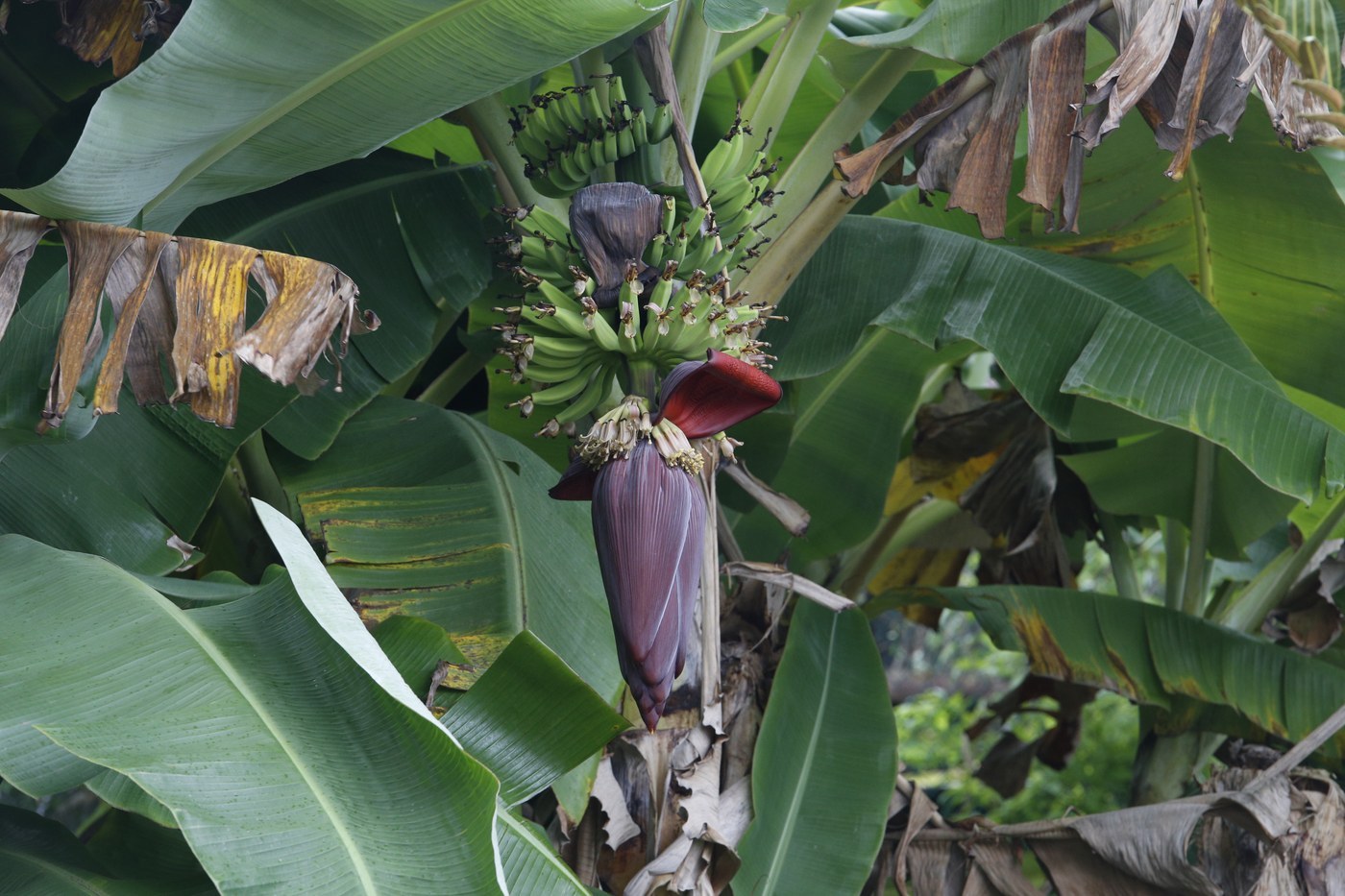
Key Identifying Features
The banana plant (Musa species) is a giant herbaceous perennial — not a true tree — growing 2-9 m tall. Its trunk, called a pseudostem, is made of tightly rolled leaf bases, juicy and soft rather than woody. Identify it by the enormous paddle-shaped leaves that often tear into ribbons in the wind, the large drooping flower spike with a purple-red bract, and the upturned hanging clusters ('hands') of fingered fruit. The whole plant arises from an underground corm and produces suckers (pups) at the base.
Leaves & Stems
- The pseudostem is smooth, green to maroon-blotched, and soft — cutting it reveals concentric leaf-sheath layers, not wood.
- Leaves are huge (up to 2-3 m long, 60 cm wide), oblong/paddle-shaped, bright green, with a stout midrib and parallel side veins.
- Leaves tear easily along the veins into fringed strips — a normal, characteristic look.
- New leaves emerge as a tightly rolled spear from the center.
- The base produces suckers/pups, forming a clump.
Flowers & Fruit
- A single flowering stalk emerges from the top center and bends downward.
- It ends in a large purple-red teardrop-shaped bud (the 'banana heart') whose bracts peel back to reveal rows of tubular cream-yellow flowers.
- Flowers develop into 'hands' of fruit, each fruit a finger-shaped berry that curves upward; clusters hang in a large bunch.
- Cultivated bananas are usually seedless; wild types have hard black seeds.
How to Tell It Apart from Look-Alikes
- Bird-of-paradise / Strelitzia: Similar large paddle leaves but rigid woody-ish stalks and orange/blue crane-like flowers, no soft pseudostem or fruit hands.
- Canna lily: Smaller, true stems, colorful flowers, no pseudostem.
- Ensete (false banana): Very stout single stem and no suckers.
- Palms: Have a woody trunk and fan/feather fronds, not a soft rolled pseudostem.
The soft pseudostem of rolled leaf bases + giant tearing paddle leaves + drooping purple flower bract + hanging hands of fingered fruit is unmistakable.
Where You'll Find It
Bananas grow in tropical and subtropical regions (USDA zones 9-11), in plantations, home gardens, and as ornamental foliage plants. They need heat, abundant water, rich soil, and shelter from wind. Even where fruit won't ripen, the plant is grown for its dramatic leaves; it dies back in frost but can resprout from the corm.
Quick ID Checklist
- Tall soft 'trunk' (pseudostem) of rolled leaf bases, not woody
- Giant paddle-shaped leaves that tear into strips
- New leaves emerge as a rolled spear
- Suckers/pups at the base forming a clump
- Drooping purple-red flower bract (banana heart)
- Hanging hands of upturned fingered fruit
Frequently asked questions
Is a banana plant a tree?
No. Despite its size, the banana is a giant herbaceous perennial. Its 'trunk' is a pseudostem made of tightly packed rolled leaf bases, soft and watery rather than woody, growing from an underground corm.
Why are banana leaves always torn and ragged?
The large leaf blades naturally split along their parallel veins in the wind. This tearing is normal and even helps the plant survive gusts; ragged leaves are not a sign of damage or disease.
What is the big purple bud hanging below the bananas?
That is the banana heart, the flower bract. Its purple-red bracts peel back to expose rows of tubular flowers that develop into the hands of fruit above it.
Why don't store bananas have seeds?
Cultivated bananas are parthenocarpic (seedless) selections. Wild Musa species produce fruit packed with hard black seeds, but commercial varieties were bred to set seedless fruit.