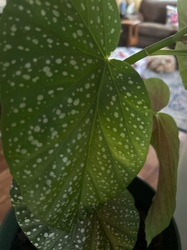
Begonia Maculata Identification Guide
Recognize Begonia maculata, the Polka Dot Begonia, by its angel-wing leaves with silver-white spots on top and red undersides, jointed bamboo-like stems, and clusters of white flowers.
Read the full Begonia Maculata encyclopedia entry →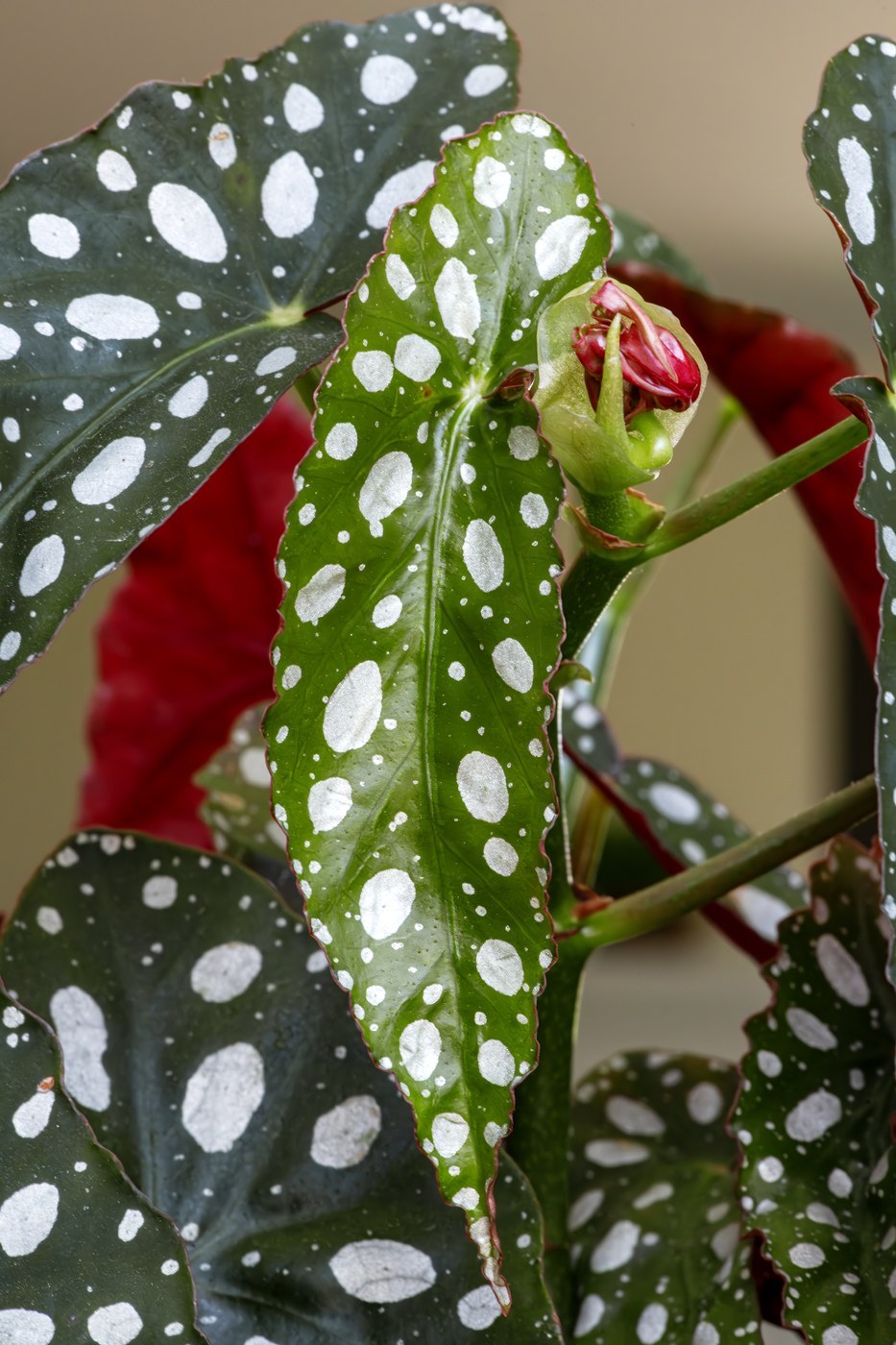
Key Identifying Features
Begonia maculata, the Polka Dot Begonia or Spotted Begonia, is an instantly recognizable cane begonia. Its signature is the olive-green, angel-wing leaf studded with silvery-white polka dots on top and a deep red-maroon underside, held on jointed, bamboo-like stems.
- Asymmetric, wing-shaped leaves with one lobe larger than the other
- Rows of distinct silver-white dots scattered across the dark green upper surface
- Burgundy-red leaf undersides
- Upright, segmented cane stems with swollen nodes
Leaves & Stems
The leaves are elongated and pointed, shaped like an angel's wing, with a strongly asymmetric base typical of begonias. The upper surface is a rich olive to dark green with a metallic-matte finish, decorated with evenly spaced rounded silver spots. Flip a leaf and the underside is a striking oxblood red.
Stems are the other dead giveaway: thick, green, bamboo-like canes with clearly visible nodes (joints) spaced along their length, growing upright and arching with age. This cane structure separates it from rhizomatous and tuberous begonias.
Flowers & Fruit
In the warmer months it produces hanging clusters of small white (sometimes blush-pink) flowers with bright yellow centers, dangling on red-tinged stalks. The cheerful white blooms against dark spotted foliage are a strong confirming feature, though the plant is grown mainly for its leaves.
How to Tell It Apart from Look-Alikes
- Other angel-wing begonias: many cane begonias have silver-spotted leaves, but maculata's spots are unusually large, round, and evenly distributed, with a uniformly red underside.
- Begonia 'Wightii': a popular maculata cultivar; essentially the same look with especially bold white dots and red backs.
- Rex begonias: grown from rhizomes with spiraled, metallic, multicolored leaves and no upright bamboo canes.
- Polka-dot plant (Hypoestes): unrelated; small leaves flecked pink/white all over, no wing shape or red underside.
The combo of angel-wing shape + crisp silver dots + red underside + jointed canes is unmistakable.
Where You'll Find It
Native to the rainforests of southeastern Brazil, it grows in warm, humid, shaded conditions. As a houseplant it favors bright indirect light (which keeps spots vivid), warmth, and good humidity.
Quick ID Checklist
- Leaves are asymmetric angel-wing shaped
- Top surface has large silver-white polka dots
- Underside is deep red-maroon
- Stems are upright, jointed, bamboo-like canes
- Drooping clusters of white flowers with yellow centers
Spotted wing-shaped leaves with red backs on bamboo canes? That's Begonia maculata.
Frequently asked questions
Why does my Begonia maculata have red undersides?
The maroon-red underside is a natural, defining trait of the species, thought to help reflect light back through the leaf in shaded rainforest understory. If a leaf lacks the red back, it may not be a true maculata.
What causes the silver dots to fade?
Too little light dulls the contrast and can cause the silver spots to look muted. Bright indirect light keeps the polka dots crisp and the leaf color rich without scorching the foliage.
Is Begonia maculata the same as 'Wightii'?
'Wightii' is a widely sold cultivar of Begonia maculata selected for especially bold white spots and strong red undersides. For ID purposes they look essentially the same.
Begonia Maculata identified by the community
Recent Begonia Maculata specimens identified with Plant Identifier.