
Black Medic Identification Guide
How to identify black medic (Medicago lupulina) by its clover-like trifoliate leaves with a spur-tipped center leaflet, tight yellow flower clusters, and coiled black seed pods.
Read the full Black Medic encyclopedia entry →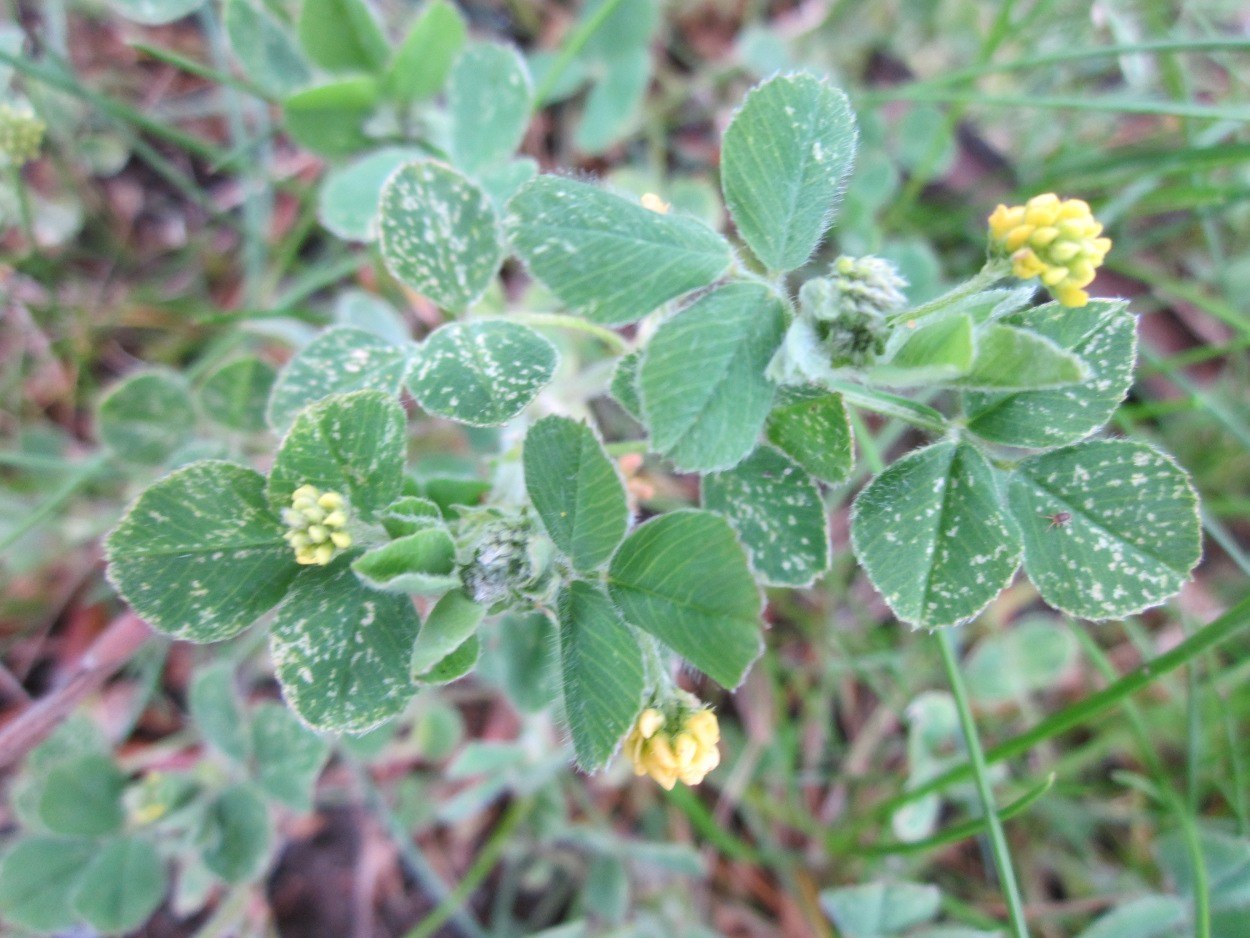
Key Identifying Features
Black medic (Medicago lupulina) is a low, sprawling legume weed closely related to alfalfa. Identify it by:
- Three small oval leaflets (clover-like), the central leaflet on a short stalk
- A tiny pointed spur (mucro) at the very tip of each leaflet
- Compact, round clusters of small bright-yellow flowers
- Tightly coiled black seed pods when mature
It usually grows flat along the ground, 6-24 inches across.
Leaves & Stems
Leaves are trifoliate (three leaflets) and finely toothed near the tip. A key feature separating it from clover and wood sorrel is that the center leaflet sits on a small distinct stalk while the two side leaflets are nearly stalkless, and each leaflet ends in a tiny projecting point. Stems are slender, wiry, and often sprawl (prostrate) along the ground, sometimes with fine hairs. Black medic has a taproot and behaves as an annual or short-lived perennial, often greening up where soil is poor and compacted.
Flowers & Fruit
Flowers are small, bright yellow, packed into dense rounded or short cylindrical clusters about ¼ inch wide, resembling tiny yellow clover heads. After flowering, each produces a distinctive kidney-shaped pod that coils tightly and turns black when ripe — the source of the name and a near-diagnostic feature. Each pod contains a single seed.
How to Tell It Apart from Look-Alikes
- White/red clover: Larger leaflets, often with a pale chevron, and white or pink flower heads; clover lacks the tiny leaflet spur and black coiled pods.
- Wood sorrel (Oxalis): Has heart-shaped notched leaflets and a sour taste; black medic leaflets are oval with a spur tip and not sour.
- Yellow woodsorrel: Five-petaled yellow flowers and okra-like pods, versus black medic's clover-like clustered flowers and coiled pods.
- Hop clover (Trifolium species): Very similar yellow heads, but hop clover pods are straight/papery, not the coiled black pod of black medic.
The stalked center leaflet, spur tip, yellow clover-like heads, and coiled black pods together confirm black medic.
Where You'll Find It
Black medic thrives in poor, compacted, dry soils: lawns, sidewalks, driveways, roadsides, fields, and waste ground. As a legume it fixes nitrogen and often signals low-fertility soil. It tolerates drought and mowing and is common worldwide in disturbed areas.
Quick ID Checklist
- Three oval leaflets, center on a short stalk
- Tiny pointed spur at each leaflet tip
- Round clusters of small yellow flowers
- Coiled black seed pods when ripe
- Low sprawling habit on poor, compacted soil
- Not sour-tasting (vs. wood sorrel)
A low, sprawling clover-like plant with small yellow flower clusters and tightly coiled black seed pods is black medic.
Frequently asked questions
How is black medic different from clover?
Black medic has a center leaflet on a short stalk, a tiny spur at each leaflet tip, small yellow flower clusters, and coiled black seed pods. True clover has stalkless leaflets often with a pale chevron, white or pink rounded flower heads, and lacks the black coiled pod.
Does black medic indicate poor soil?
Often, yes. As a nitrogen-fixing legume it tolerates and thrives in low-fertility, compacted, dry soils, so a flush of black medic in a lawn can be a sign that the soil is poor or compacted.
How did black medic get its name?
From its ripe seed pods, which coil tightly and turn black, and from its relation to the medicks (Medicago genus, which includes alfalfa). The black coiled pods are a key identification feature.
Is black medic an annual or perennial?
It is usually an annual but can behave as a short-lived perennial. It reproduces mainly by seed and germinates readily in disturbed, compacted ground.