
Blue Flag Iris Identification Guide
Identify the native Blue Flag Iris by its violet-blue beardless flowers with yellow-veined falls, flat sword-shaped leaves, and wetland habitat, and distinguish it from invasive yellow iris.
Read the full Blue Flag Iris encyclopedia entry →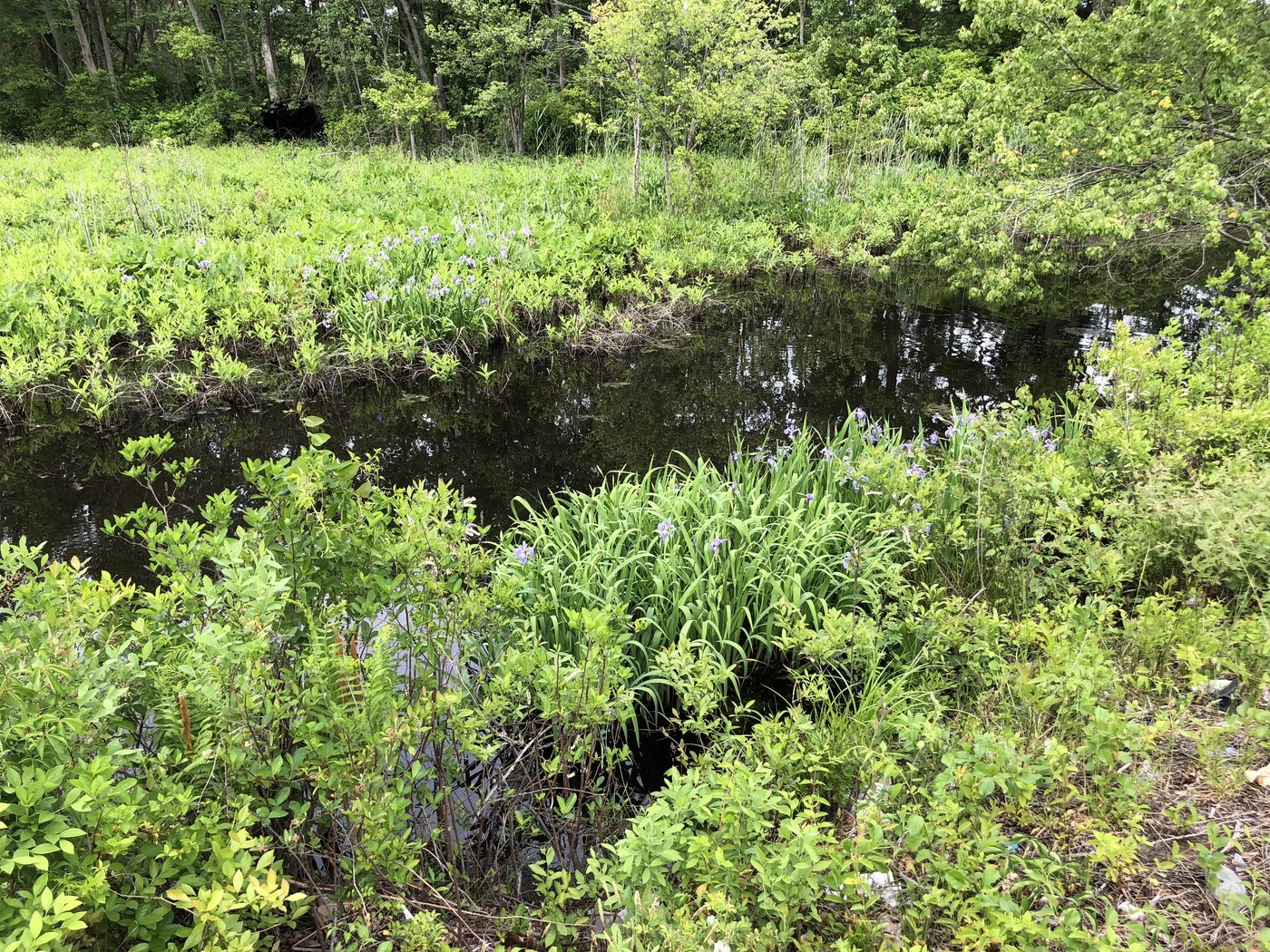
Key Identifying Features
Blue Flag Iris (Iris versicolor in the Northeast; Iris virginica in the Southeast) is a native wetland iris of eastern North America. Look for:
- Violet-blue to purple flowers about 3-4 inches across
- Drooping outer petals (falls) marked with yellow-and-white patches and dark purple veins
- No fuzzy beard on the falls (it is a beardless iris)
- Flat, sword-shaped leaves fanning from the base
- Plants 2-3 feet tall growing in or beside water
Leaves & Stems
The leaves are the classic iris form: stiff, flat, sword- or blade-shaped, 1-3 feet long, arranged in a flattened fan and overlapping at the base. They are gray-green and often slightly arching. The flower stalk is round and sometimes branched, rising to the height of the leaves or just above. Plants spread by thick creeping rhizomes, forming clumps along shorelines.
Flowers & Fruit
Each iris flower has three sets of parts: three downward-arching falls (the showy yellow-veined petals insects land on), three upright standards, and three petal-like style branches arching over the falls. The signature is the bright yellow-to-greenish blotch and net of dark veins at the base of each fall, which serves as a nectar guide for bees. Blooming runs late spring to midsummer (May-July). After flowering, a plump, three-chambered green seed capsule forms, ripening brown and splitting to release flat, stacked seeds.
How to Tell It Apart from Look-Alikes
- Yellow Flag Iris (Iris pseudacorus): an aggressive invasive with bright yellow flowers; same wetland habitat but a different color and not native, often forming dense mats to be reported/removed.
- Bearded garden irises (Iris germanica): have a fuzzy "beard" strip on the falls and grow in drier garden beds; Blue Flag is beardless and lives in wet ground.
- Blue-eyed grass (Sisyrinchium): tiny six-pointed blue flowers on grassy plants, not large iris blooms.
- Cattails/sweet flag before bloom: similar leaves but lack the iris fan and flowers.
The combo of wet habitat + beardless blue flower + yellow-veined falls confirms Blue Flag.
Where You'll Find It
Blue Flag thrives in marshes, wet meadows, pond and stream margins, swamps, and ditches, in full sun to part shade with consistently wet or saturated soil. It is a common native of the eastern and central U.S. and adjacent Canada.
Quick ID Checklist
- Violet-blue flower, ~3-4 in wide, beardless
- Falls marked with yellow/white and dark purple veins
- Flat, sword-shaped leaves in a basal fan
- 2-3 ft tall, growing in or beside water
- Three-chambered seed capsule after bloom
- Blooms late spring to midsummer; not bright yellow (that's invasive Yellow Flag)
Frequently asked questions
How do I tell Blue Flag from invasive Yellow Flag Iris?
Color is the quickest cue: native Blue Flag has violet-blue flowers, while invasive Yellow Flag Iris (Iris pseudacorus) has bright yellow flowers. Both grow in wetlands, but Yellow Flag forms aggressive mats and should be reported or removed.
Why is it called a beardless iris?
Unlike bearded garden irises that have a fuzzy strip of hairs on the falls, Blue Flag's falls are smooth with only a yellow patch and veins, so it belongs to the beardless iris group.
Where should I look for Blue Flag Iris?
Search wet, sunny places: marsh edges, wet meadows, pond and stream banks, swamps, and ditches with saturated soil throughout the eastern and central regions of North America.
What do the leaves and stems of Blue Flag look like?
The flower stalk is round and sometimes branched, and the plant spreads by thick creeping rhizomes that form clumps along shorelines, with stiff sword-shaped leaves in a flattened fan.