
Blue Flame Cactus Identification Guide
Identify the Blue Flame Cactus (Myrtillocactus geometrizans 'Blue Flame') by its branching blue-frosted columnar stems with flame-like ribbing.
Read the full Blue Flame Cactus encyclopedia entry →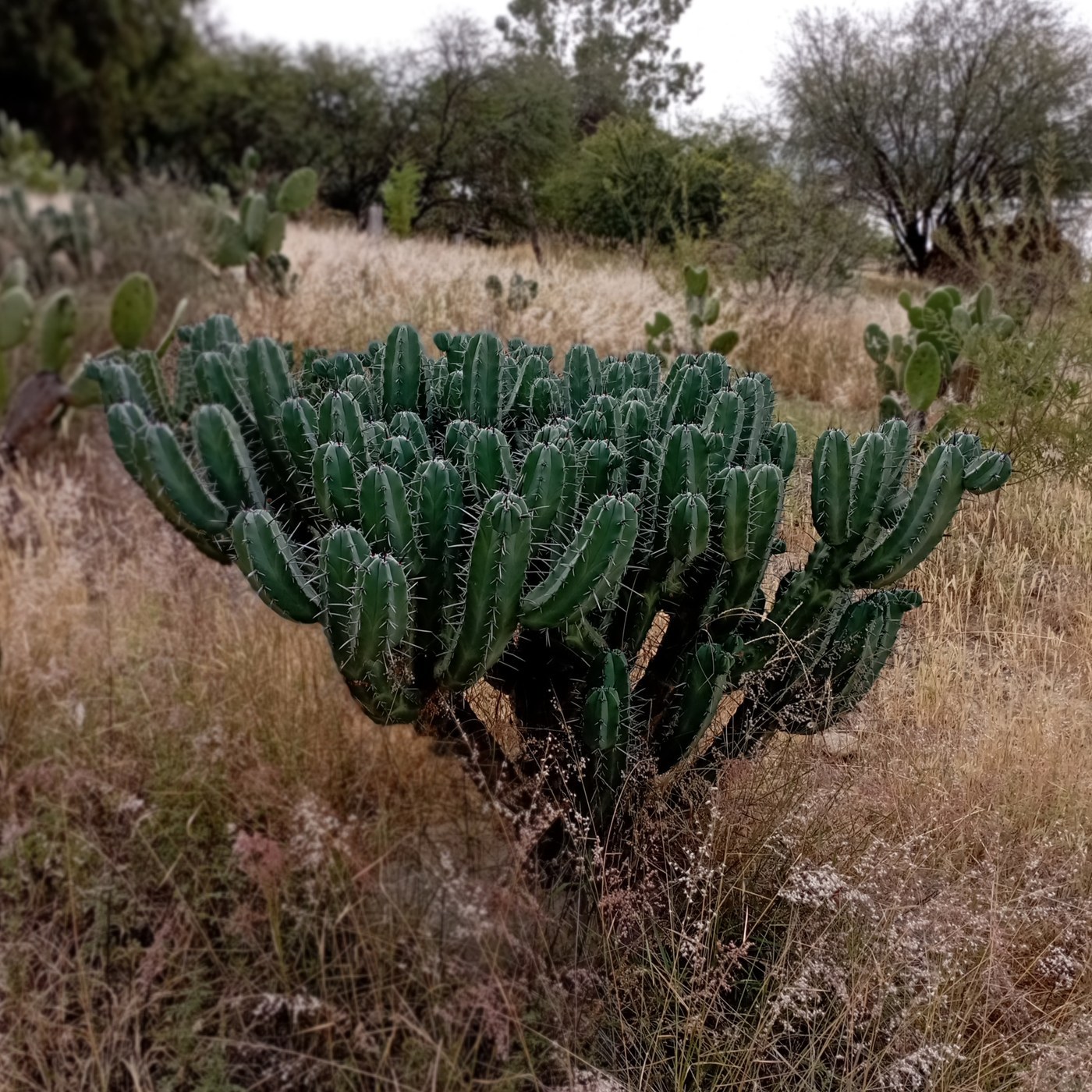
Key Identifying Features
Blue Flame Cactus (Myrtillocactus geometrizans, often the 'Blue Flame'/'Blue Candle' selection) is a fast, branching columnar cactus prized for its blue color. Look for:
- Powdery blue to blue-green columnar stems with a frosted, waxy bloom.
- Multiple upright branches rising from the base like blue candles or flames.
- Prominent vertical ribs with small, short, dark spines.
Stems & Spines
Stems are stout, upright columns 2-4 in (5-10 cm) thick that branch freely from low on the plant, forming a candelabra of blue spires. The defining color is a glaucous, chalky blue-gray from a heavy waxy bloom that intensifies in sun. Each stem has 5-6 broad, well-defined ribs giving a geometric cross-section (hence geometrizans). Along the rib edges sit areoles with short, stiff, dark spines — typically a few small radials and one short black-to-reddish central. The spines are modest, not the dominant feature; the blue color is.
Flowers & Fruit
Mature plants bear small greenish-white to cream flowers along the rib edges in spring, followed by small, round, deep-purple berries resembling blueberries — the source of the genus's nickname 'blue myrtle'.
How to Tell It Apart from Look-Alikes
- Myrtillocactus 'Fukurokuryuzinboku' (Booby/Boob Cactus): a mutant crest/monstrose form with rounded bumpy stems lacking normal ribs; Blue Flame has clean straight ribs.
- Pilosocereus pachycladus (Blue Torch): also blue and columnar but taller, with golden spines and woolly areoles; Blue Flame branches lower and has short dark spines.
- Cereus / blue Cereus: greener and more sharply ribbed with longer spines.
- Euphorbia (e.g. E. ammak): has milky sap and paired thorns, not true cactus areoles.
Where You'll Find It
Native to central and northern Mexico, it is a landscape and large-container cactus in warm dry climates (USDA 9-11) and a popular grafting stock. It is one of the faster-growing columnar cacti, needing full sun and excellent drainage; protect from hard frost.
Quick ID Checklist
- Chalky blue-gray columnar stems with waxy bloom
- Branching candelabra of upright spires
- 5-6 clean vertical ribs, geometric cross-section
- Short dark spines, not dominant
- Greenish-white flowers, small purple berries
Frequently asked questions
Why is the Blue Flame Cactus so blue?
Its stems are coated in a glaucous waxy bloom that reflects light as chalky blue-gray. The color is strongest in full sun and is a natural sunscreen for the plant.
How do I tell it from a Blue Torch (Pilosocereus)?
Blue Torch is taller and narrower with conspicuous golden spines and woolly white areoles. Blue Flame branches lower, has short dark spines, and a flatter blue tone.
Does it grow fast?
For a columnar cactus, yes. It is vigorous and branches readily in full sun with good drainage, which is why it is also used as grafting stock.
How many ribs and spines does it have?
Each stem has 5-6 broad, well-defined ribs giving a geometric cross-section, with areoles bearing a few short, stiff, dark spines along the rib edges.