
Browallia Identification Guide
Recognize browallia (amethyst flower) by its mounded shade-loving form and star-shaped blue, violet, or white five-lobed flowers with pale throats.
Read the full Browallia encyclopedia entry →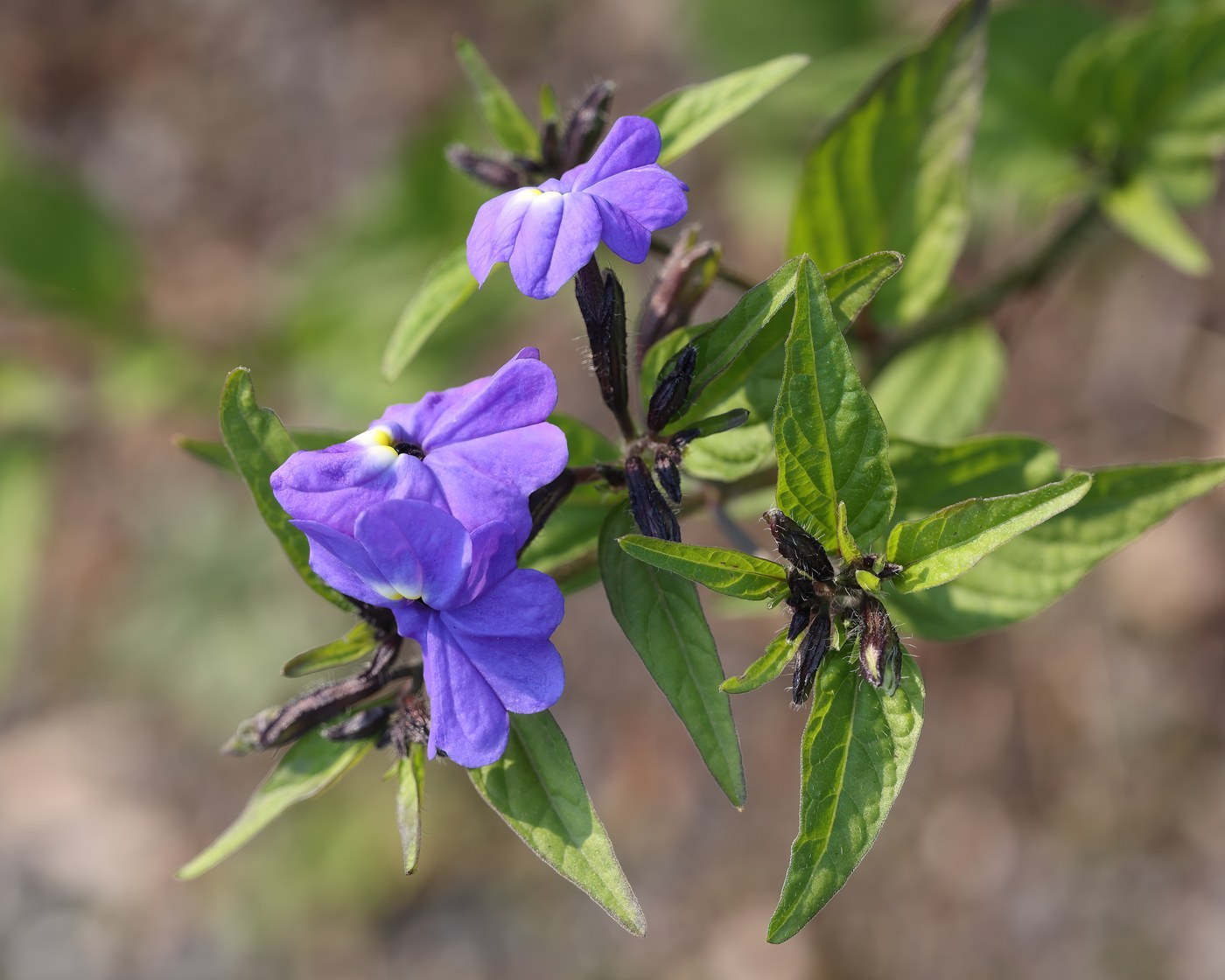
Key Identifying Features
Browallia (Browallia speciosa), known as amethyst flower or bush violet, is a tender annual in the nightshade family (Solanaceae) prized as a shade-tolerant bloomer. Its signature is the star-shaped, five-lobed flower in rich blue, violet, or white, with a small white or pale 'eye' at the throat. Plants form soft, bushy mounds 10–18 inches tall, flowering generously in part shade where many annuals struggle.
- Mounded, slightly trailing bushy annual
- Star-shaped, five-petaled flowers with a pale throat
- Blue, violet-purple, or white coloring
- Performs well in shade to part shade
Leaves & Stems
Stems are soft, green, and well-branched, sometimes slightly sticky-hairy. Leaves are alternate, oval to lance-shaped, with pointed tips, smooth or faintly wavy margins, and visible veins, and a fresh medium-green color. The foliage is somewhat delicate and lush, giving the plant a tidy, mounded texture that sets off the abundant flowers.
Flowers & Fruit
Flowers emerge from the leaf axils singly on short stalks. Each is a slender tube flaring into five rounded, slightly asymmetrical lobes, roughly 1–2 inches across, with a contrasting white center. The bloom's gentle five-pointed star outline is distinctive. Flowering runs from late spring through frost. Fruit is a small dry capsule containing many tiny seeds.
How to Tell It Apart from Look-Alikes
- Lobelia also offers blue shade flowers but they are much smaller, two-lipped, and borne on thin trailing stems; browallia flowers are larger and star-shaped.
- Petunia flowers are bigger, trumpet-shaped, and sun-loving; browallia is daintier and shade-tolerant.
- Exacum (Persian violet) has yellow-centered flowers but glossier, opposite leaves; browallia leaves are alternate with a pale (not yellow) throat.
Where You'll Find It
Browallia is grown as a summer bedding and container plant for shady spots, including porches, hanging baskets, and woodland-edge borders. It prefers moist, well-drained soil and protection from hot afternoon sun. In frost-free climates it can behave as a short-lived perennial, but it is treated as an annual in most gardens.
Quick ID Checklist
- Mounded, bushy, shade-loving annual
- Star-shaped five-lobed flowers with white throat
- Blue, violet, or white coloring
- Alternate, oval, pointed leaves on soft stems
- Blooms late spring to frost in part shade
A shade-happy mound dotted with starry blue-violet flowers that have a pale eye is browallia.
Frequently asked questions
Does browallia grow in shade?
Yes, browallia is one of the better flowering annuals for part shade, blooming reliably where sun-loving annuals like petunias underperform.
How do I tell browallia from lobelia?
Browallia flowers are larger, star-shaped, and five-lobed with a white throat, while lobelia flowers are tiny and two-lipped on very thin trailing stems.
What is the white spot in the center of the flower?
That pale or white throat 'eye' is a normal and distinctive feature of browallia, contrasting against the blue or violet petals.
Is browallia an annual or perennial?
It is a tender perennial native to tropical South America but is grown as a warm-season annual in most temperate gardens.