
Brunnera Identification Guide
How to identify brunnera (Siberian bugloss) by its large heart-shaped leaves, often silver-frosted, topped with airy sprays of true-blue forget-me-not flowers.
Read the full Brunnera encyclopedia entry →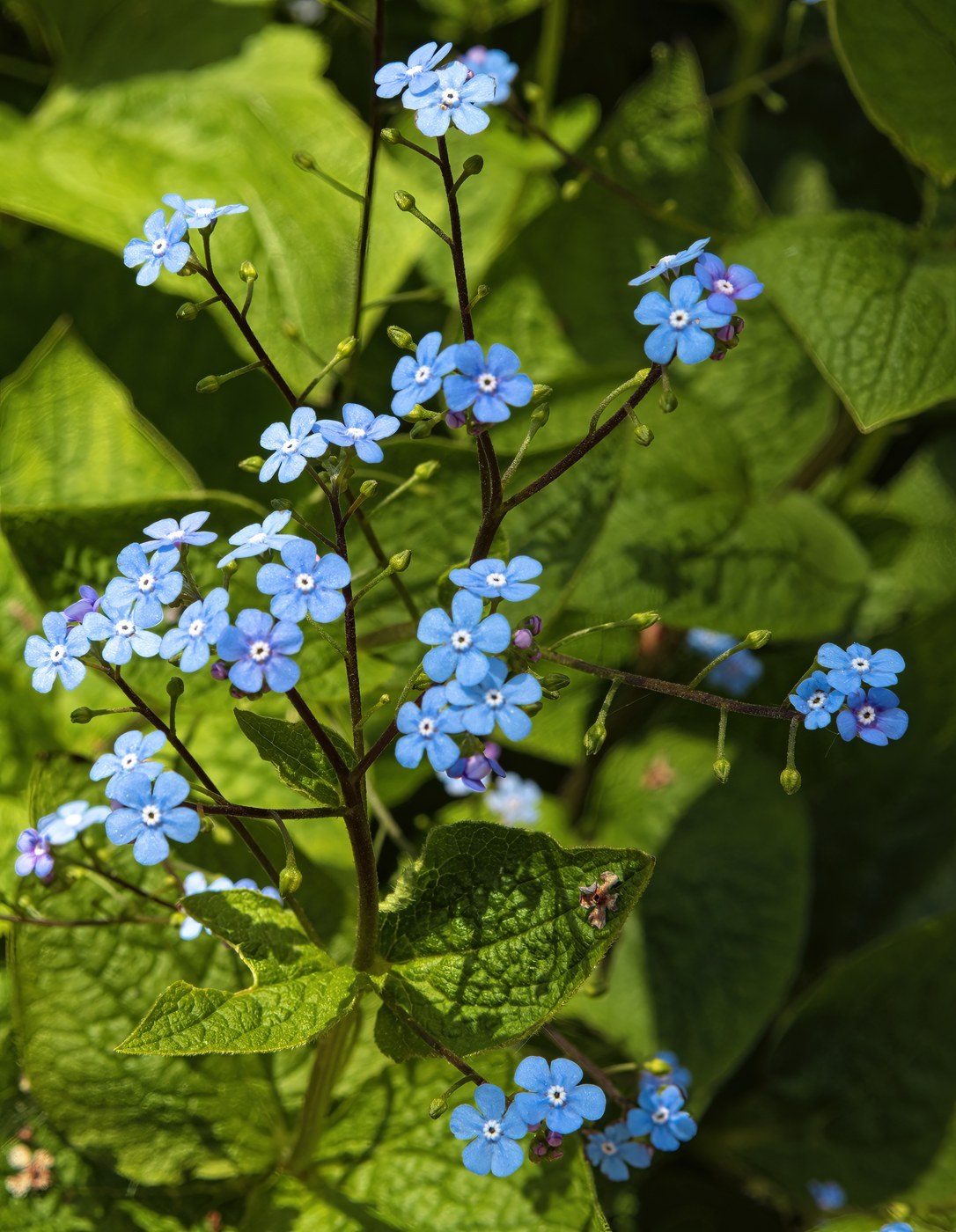
Key Identifying Features
Brunnera (Brunnera macrophylla), or Siberian bugloss, is a shade perennial in the borage family (Boraginaceae). It pairs large, heart-shaped basal leaves — often dramatically silver-frosted or silver-veined in cultivars — with airy sprays of small, true-blue, forget-me-not flowers in spring.
- Large heart-shaped (cordate) basal leaves on long stalks
- Leaves often silvered, veined, or frosted in named cultivars
- Flowers small, flat, 5-lobed, sky-blue with a tiny white/pale eye
- Airy, branching flower sprays above the foliage in spring
Leaves & Stems
The basal leaves are broad, heart-shaped, pointed-tipped, and roughly hairy, becoming quite large (up to 15–20 cm) after flowering. Popular cultivars ('Jack Frost', 'Looking Glass') have leaves heavily overlaid with silver between green veins. Stem leaves are smaller. The flower stems are slender, branched, and bristly, rising above the leaf mound. The plant forms a slowly spreading clump from a rhizome, 30–45 cm tall.
Flowers & Fruit
Flowers are small (around 5 mm), flat and starry with five rounded lobes, in clear blue with a small paler center — essentially forget-me-not flowers but on a much bigger-leaved plant. They appear in loose, branching panicles in mid-spring. Fruit are small nutlets (four per flower), the borage-family signature. The combination of bold heart-shaped (often silver) leaves and dainty blue sprays is the clincher.
How to Tell It Apart from Look-Alikes
- Forget-me-not (Myosotis): nearly identical flowers, but a much smaller plant with small, narrow, hairy leaves — not the big heart-shaped basal leaves of brunnera.
- Lungwort (Pulmonaria): also shade-loving with silver-spotted leaves, but flowers are funnel-shaped and shift pink-to-blue, and leaves are oval, not broadly heart-shaped.
- Hosta: similar leaf scale and shade habit, but hosta has parallel-veined, hairless leaves and lily-like flowers — no blue forget-me-not sprays.
- Heuchera: mounded leaves but palmately lobed, with tiny bell flowers, not flat blue stars.
Where You'll Find It
Brunnera is grown in shade and woodland gardens, under trees and shrubs, and at the front of shady borders, in moist, humus-rich soil. It is valued both for spring flowers and for season-long foliage, especially the silver-leaved forms. Native to woodlands of the Caucasus and Siberia.
Quick ID Checklist
- Large heart-shaped basal leaves, often silver-frosted
- Sky-blue, flat 5-lobed forget-me-not flowers
- Airy branching flower sprays in spring
- Bristly/hairy leaves and stems; borage family
- Shade-loving clump, 30–45 cm tall
Frequently asked questions
How is brunnera different from a forget-me-not?
The flowers look almost identical, but brunnera is a much larger perennial with big heart-shaped basal leaves (often silvered), whereas forget-me-not is a small plant with little narrow leaves.
Why do some brunnera have silvery leaves and others plain green?
The wild species has plain green hairy leaves, but popular cultivars like 'Jack Frost' and 'Looking Glass' were selected for heavy silver frosting between the veins, prized for shade-garden foliage.
Is brunnera related to lungwort?
Yes, both are in the borage family and both grow in shade with sometimes silvery leaves. Brunnera has flat blue forget-me-not flowers, while lungwort has funnel-shaped flowers that change from pink to blue.
When does brunnera bloom?
It flowers in mid-spring, sending up airy sprays of small blue flowers above the leaf mound. The bold foliage, especially silver-leaved forms, remains attractive through summer after the flowers fade.