
Burro's Tail Identification Guide
Recognize Sedum morganianum by its long trailing stems packed with plump blue-green leaves resembling a braided tail, and learn how it differs from similar trailing sedums.
Read the full Burro's Tail encyclopedia entry →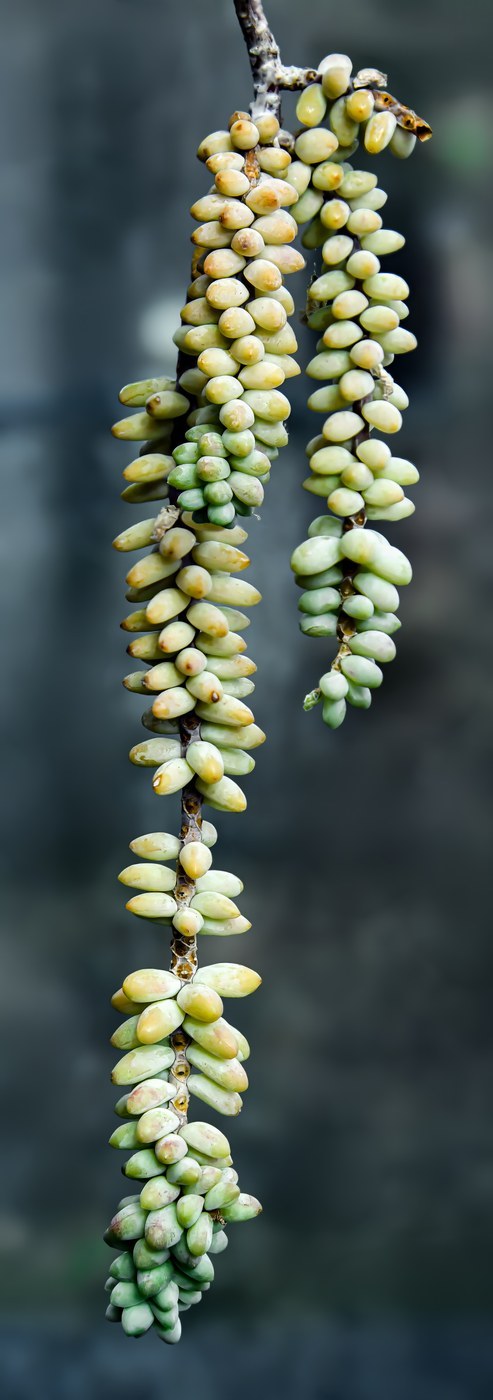
Key Identifying Features
Burro's Tail (Sedum morganianum), also called donkey's tail, is a trailing succulent whose stems are densely covered in fat, overlapping blue-green leaves, giving each stem the look of a plump braid or animal's tail.
- Long trailing/pendant stems, often 30-60 cm or longer
- Leaves plump, teardrop or banana-shaped, 1.5-2 cm long, packed tightly and overlapping
- Color blue-green to grey-green with a powdery waxy bloom (farina)
- Leaves detach very easily at the lightest touch
Leaves & Stems
The individual leaves are fleshy, plump, and pointed, curving slightly upward like little bananas, and spiral densely around the stem so that the stem itself is hidden. A chalky glaucous coating rubs off if handled, leaving fingerprints, which is normal. The stems are soft and flop downward under their own weight, making this a classic hanging-basket plant.
The leaves are notoriously fragile and shatter off with the slightest bump; each fallen leaf can root and grow a new plant. A true S. morganianum has stems that look solid and rounded like a tail because of how tightly the leaves overlap.
Flowers & Fruit
Mature plants may produce clusters of small star-shaped flowers at the tips of trailing stems, usually in summer. Flowers are pink, red, or maroon, about 1 cm across, hanging in terminal cymes. Flowering is uncommon indoors. Fruit is an insignificant dry follicle; the plant is far more often identified by foliage alone.
How to Tell It Apart from Look-Alikes
- Sedum 'Burrito' (baby burro's tail) has shorter, rounder, beadier leaves that point outward less and are less pointed; stems look chunkier and the leaves cling more firmly.
- Donkey's tail vs. similar trailing sedums: true burro's tail has long, plump, pointed banana-leaves; if leaves are short and rounded it is likely 'Burrito'.
- String of bananas (Curio radicans) has glassy, curved banana leaves but they are spaced along a thin visible stem, not densely overlapping.
- The waxy blue-grey bloom plus overlapping plump leaves on a heavy hanging stem confirms burro's tail.
Where You'll Find It
Native to southern Mexico and Honduras, growing on rocky cliffs and ledges. As a houseplant it is almost always grown in hanging baskets or elevated pots where its tails can cascade. It needs bright light and very well-drained, gritty soil.
Quick ID Checklist
- Long trailing stems like braided tails
- Plump, pointed banana-shaped blue-green leaves
- Powdery waxy bloom that rubs off
- Leaves overlap densely and detach easily
- Pink/red star flowers at stem tips in summer
Frequently asked questions
Why do leaves fall off when I touch it?
Burro's tail leaves are very loosely attached and shatter off at the slightest bump. This is completely normal and even useful, since each dropped leaf can root into a new plant.
What is the powdery coating on the leaves?
It is a natural waxy bloom called farina that protects the succulent from sun and water loss. It rubs off when handled and leaves marks, which does not harm the plant.
How is it different from 'Baby Burro's Tail'?
The cultivar 'Burrito' has shorter, rounder, beadier leaves that hold on more firmly, while true Sedum morganianum has longer, plumper, pointed banana-shaped leaves.
Does burro's tail flower?
Yes, mature plants can produce clusters of small pink to red star-shaped flowers at the stem tips in summer, though this is uncommon indoors.