
Canadian Hemlock Identification Guide
Recognize Canadian (Eastern) Hemlock, Tsuga canadensis, by its short flat white-banded needles, tiny pendant cones, drooping leader, and graceful feathery form.
Read the full Canadian Hemlock encyclopedia entry →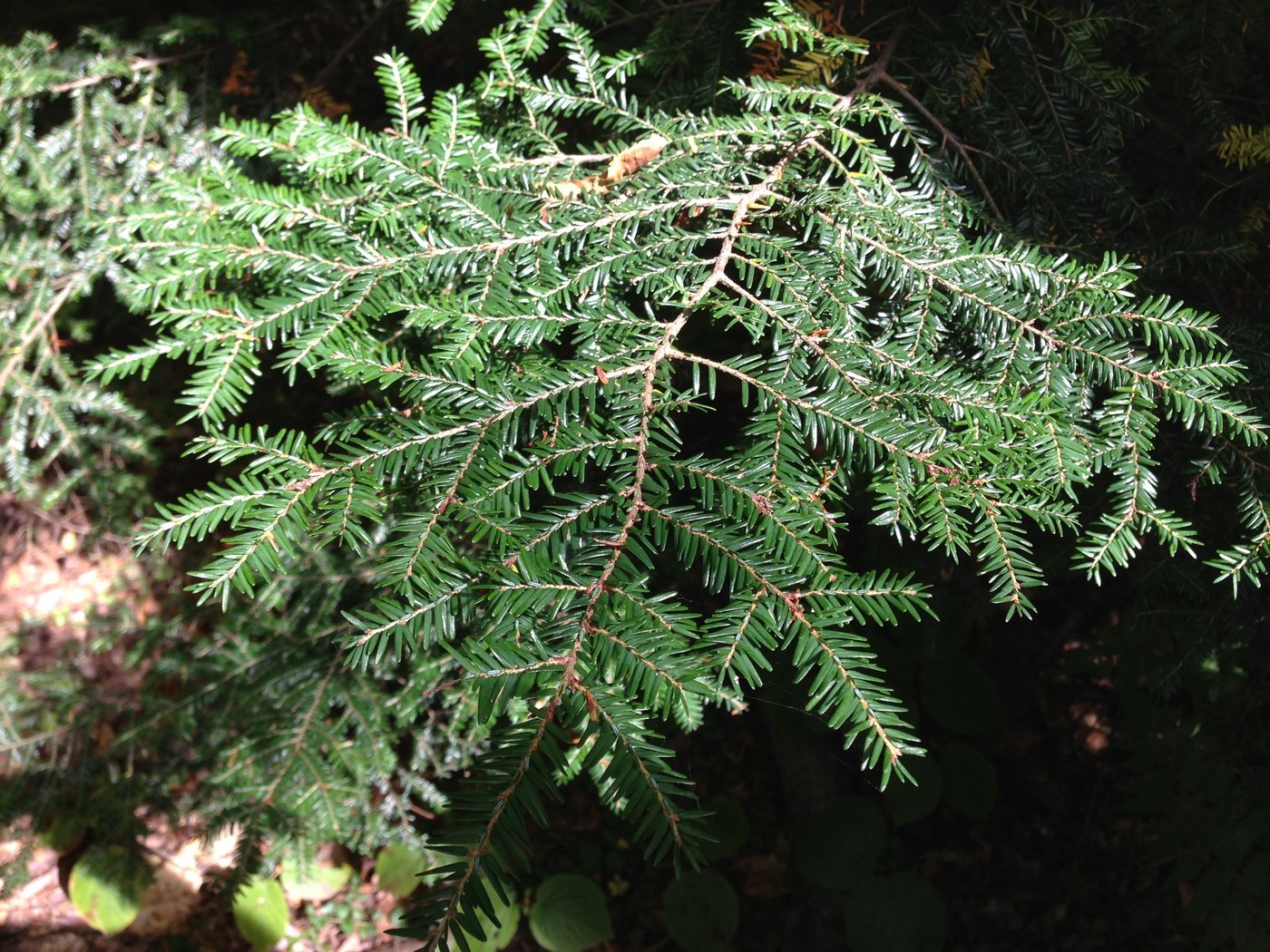
Key Identifying Features
Canadian Hemlock (Tsuga canadensis), also called eastern hemlock, is a graceful evergreen conifer of cool, shady forests, growing 40-70 ft tall (much larger in old growth) with a soft, feathery, pyramidal crown and gently drooping branch tips and a nodding leader at the very top - a signature trait. It is shade-tolerant and often dominates cool ravines and north slopes.
- Form: delicate, feathery pyramid; drooping top shoot
- Needles: short, flat, two-ranked with white underside bands
- Cones: very small, pendant
Leaves & Stems
Needles are short (1/3 to 2/3 inch), flat, soft, and rounded or blunt at the tip, arranged in two flat rows (two-ranked) along the twig. Each needle is dark green above with two distinct white (silvery) bands on the underside. A key clue: there is usually a tiny extra row of needles lying upside-down along the top of the twig, showing their white undersides. Needles attach by short, slender stalks to small woody pegs. Twigs are slender and finely hairy; bark is reddish-brown to gray, scaly and furrowed.
Flowers & Fruit
Cones are tiny and dainty. Seed cones are only about 1/2 to 3/4 inch long, oval, light brown, and hang down from the tips of twigs on short stalks - among the smallest of any northeastern conifer. They mature in one season and often persist into winter. Pollen cones are small and yellowish in spring.
How to Tell It Apart from Look-Alikes
- Balsam fir (Abies balsamea): also flat white-banded needles, but they are longer, the cones stand upright and disintegrate, the tree has resin blisters on smooth bark, and there's no drooping leader.
- Yews (Taxus): flat needles but undersides are dull green (no bright white bands) and they bear red arils, not cones.
- Spruces: 4-sided sharp rolling needles - quite different.
The short flat white-banded needles + minute pendant cones + drooping top + tiny upside-down needle row on twigs confirm Canadian hemlock.
Where You'll Find It
Native to eastern North America, it thrives in cool, moist, shaded ravines, north-facing slopes and stream banks, often forming dense pure stands. It is widely planted as a hedge and screen (tolerates shearing). Note: many native stands are threatened by the invasive hemlock woolly adelgid - look for white woolly masses at needle bases.
Quick ID Checklist
- Short, flat needles in two rows, blunt-tipped
- Two white bands on the needle underside
- A row of small upside-down needles on top of the twig
- Very small (1/2-3/4 in) pendant cones
- Drooping top leader; soft feathery pyramidal form in shady, moist sites
Frequently asked questions
What's the easiest way to recognize eastern hemlock?
Look for short flat needles with two white bands underneath, arranged in flat sprays, plus its tiny hanging cones and the gently drooping top leader of the tree.
How is it different from a fir?
Hemlock cones are tiny and hang downward, while fir cones are larger, stand upright, and fall apart on the branch. Hemlock also has a distinctive nodding top and a row of small inverted needles along the twig.
What are the white woolly spots on the needles?
Those are the hemlock woolly adelgid, an invasive sap-feeding insect that forms white woolly masses at needle bases and seriously threatens eastern hemlock stands.
Does it grow in sun or shade?
It is highly shade-tolerant and naturally grows in cool, moist, shaded ravines and north slopes, though it also performs well as a sheared hedge in part shade.