
Carpetweed Identification Guide
Identify carpetweed by its flat circular mats of smooth leaves arranged in whorls and clusters of tiny white flowers. Includes look-alikes and habitat tips.
Read the full Carpetweed encyclopedia entry →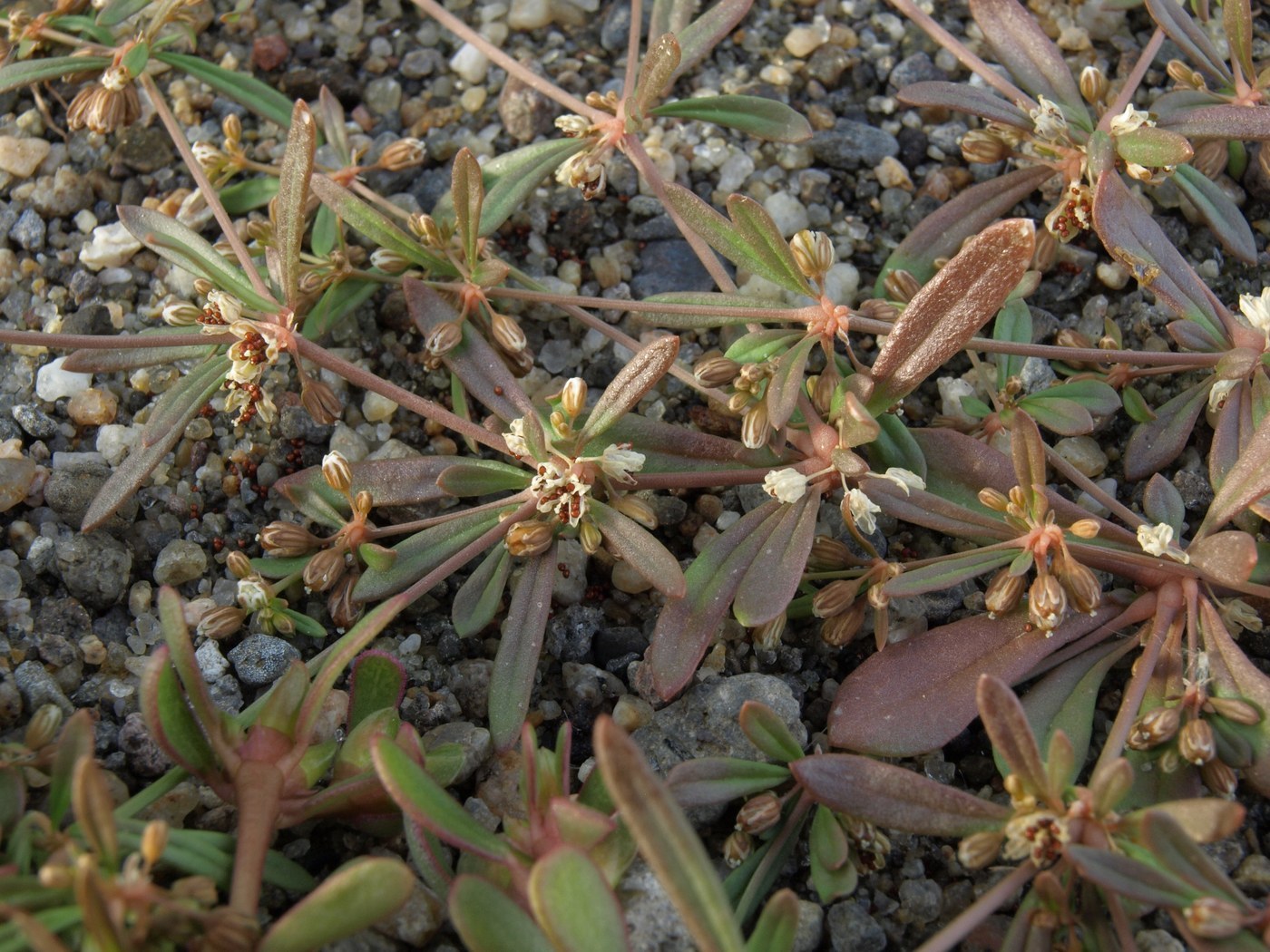
Key Identifying Features
Carpetweed (Mollugo verticillata) is a low-growing summer annual that spreads into flat, circular carpet-like mats over the soil surface. Its signature feature is the arrangement of leaves in whorls of 3 to 8 radiating from each stem node, like spokes on a wheel. The plant is smooth (hairless) and bright green, with tiny white flowers, and it germinates late once soil is warm.
- Flat, circular mat radiating from a central point
- Smooth, hairless leaves in whorls at each node
- Small clusters of tiny white flowers in the leaf whorls
- Late-germinating summer annual
Leaves & Stems
Leaves are small, smooth, spoon-shaped to narrowly oblong, widest near the tip, and unstalked, gathered in whorls of several leaves around each joint of the prostrate stems. The stems are slender, smooth, branch freely, and lie flat along the ground forming the spreading mat. There are no hairs anywhere on the plant — a useful check against hairy mat-forming weeds.
Flowers & Fruit
Small clusters of two to five tiny white flowers arise on thin stalks from the leaf whorls. Each flower has five white-to-greenish sepals (it lacks true petals) and is only a few millimeters across. These mature into small egg-shaped capsules holding numerous tiny seeds. Flowering runs through summer into early fall.
How to Tell It Apart from Look-Alikes
- Prostrate spurge: Also mat-forming, but has opposite (paired) leaves and bleeds milky white sap; carpetweed has whorled leaves and clear sap.
- Purslane: Has thick fleshy succulent leaves and stems; carpetweed leaves are thin and not succulent.
- Knotweed: Has alternate leaves and a papery sheath at the nodes; carpetweed has clean whorls with no sheath.
Where You'll Find It
Carpetweed favors warm, disturbed, often sandy or poor soils — gardens, crop fields, lawns, sidewalk edges, gravel, and waste ground across much of North America. Because it germinates late (when soil is warm), it often appears after other spring weeds, filling bare patches in mid to late summer.
Quick ID Checklist
- Flat circular mat on the soil surface
- Smooth leaves in whorls of 3-8 at each node
- Tiny white flowers in clusters from the whorls
- No hairs and no milky sap
- Found in warm disturbed soil, mid to late summer
Whorled smooth leaves plus a flat mat and clear sap confirm carpetweed.
Frequently asked questions
How do I tell carpetweed from prostrate spurge?
Both form flat mats, but carpetweed has smooth leaves arranged in whorls and clear sap, while prostrate spurge has opposite leaf pairs and bleeds milky white sap when broken.
Why is it called carpetweed?
It grows outward in a flat, circular, spreading mat that hugs the soil like a small green carpet, which is exactly how it covers bare patches of ground.
When does carpetweed appear?
It is a late-germinating summer annual that emerges once the soil is thoroughly warm, so it often shows up after spring weeds, filling in bare ground in mid to late summer.
What kind of soil does carpetweed prefer?
It thrives in warm, disturbed, often sandy or poor soils with little competition, which is why it commonly appears in gardens, crop fields, gravel, and the bare edges of lawns and walkways.