
Cast Iron Plant 'Milky Way' Identification Guide
Identify the Cast Iron Plant 'Milky Way' (Aspidistra elatior 'Milky Way') by its dark, upright lance-shaped leaves sprinkled with creamy-white star-like speckles. Covers spotting pattern and look-alikes.
Read the full Cast Iron Plant 'Milky Way' encyclopedia entry →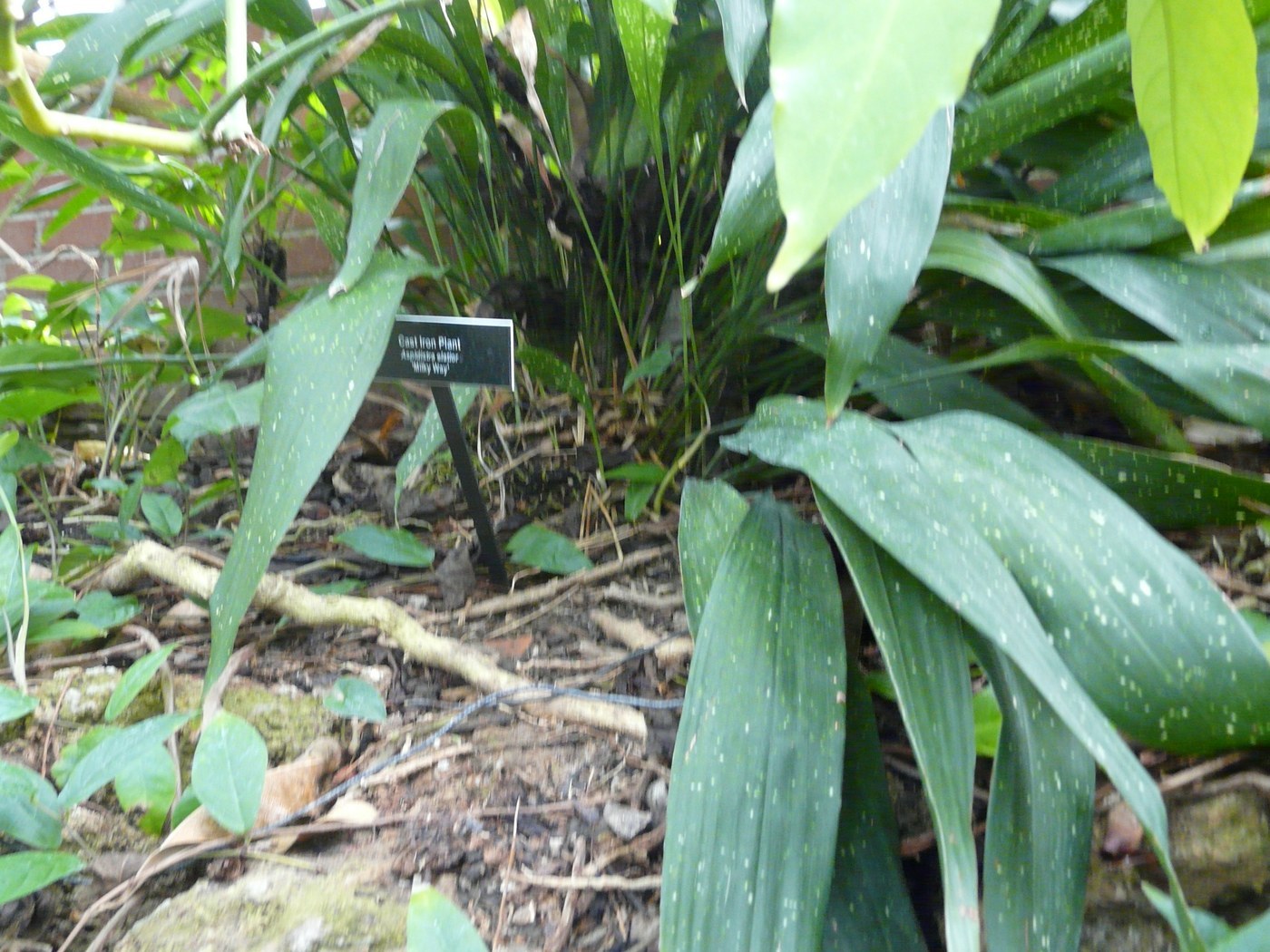
Key Identifying Features
'Milky Way' is a speckled cultivar of the Cast Iron Plant (Aspidistra elatior), in the family Asparagaceae. It's famed for toughness and shade tolerance. Identify it by:
- Tall, upright, lance-shaped (sword-like) leaves rising directly from the soil
- Dark glossy green blades dotted with small creamy-white to yellow speckles like stars in a night sky
- A clumping habit with leaves emerging individually from a creeping underground rhizome
- No central trunk leaves arise separately on their own stalks
Leaves & Stems
The leaves are the identifier. Each is a broad, lance-shaped blade roughly 12-24 inches long, tapering to a point, leathery, arching, and deep glossy green. The 'Milky Way' feature is the scattering of tiny pale cream, white, or pale-yellow spots across the upper surface, sometimes accompanied by larger blotches, evoking a starfield (some forms with bolder bands are sold as 'Milky Way' too). Each leaf grows on its own short stalk straight from the soil there is no above-ground stem or trunk and the plant slowly spreads via a thick underground rhizome into a dense clump.
Flowers & Fruit
A famously curious feature: Cast Iron Plants produce small, fleshy, dull purple-brown flowers at soil level, hidden among the leaf bases and easily missed (historically thought to be pollinated by tiny ground-dwelling creatures). They rarely appear indoors. Fruit is a small berry, also rare in cultivation. Don't rely on flowers for ID look to the leaves.
How to Tell It Apart from Look-Alikes
- Plain Cast Iron Plant (A. elatior): identical leaf shape and habit but solid green, with no spots the cream speckling defines 'Milky Way.'
- 'Variegata' Aspidistra: has lengthwise white/cream stripes, not scattered dots.
- Aspidistra 'Spek-tacular' / 'Lennon's Song': other spotted/streaked cultivars compare spot density and pattern; 'Milky Way' is finely star-speckled.
- Dracaena / Sansevieria: can have spotted upright leaves but grow from a visible stem or rosette Aspidistra leaves each rise singly from soil on their own stalk.
Where You'll Find It
Native to the shaded forest floors of Japan and China, it's grown as a houseplant and shade-garden groundcover, legendary for surviving deep shade, low light, dust, drought, and neglect (hence 'cast iron'). It's hardy outdoors in mild climates (roughly USDA zones 7-11) under trees and on the north side of buildings, and is a classic indoor plant for dim rooms.
Quick ID Checklist
- Upright, lance-shaped leathery leaves from soil level
- Dark glossy green with scattered creamy-white star-like speckles
- Each leaf on its own stalk (no trunk or central stem)
- Clumping from a creeping underground rhizome
- Tiny dull purple flowers at soil level (rare)
- Extremely shade- and neglect-tolerant
Frequently asked questions
What makes 'Milky Way' different from a regular Cast Iron Plant?
The leaves are sprinkled with small creamy-white to pale-yellow speckles, resembling stars, whereas the standard Aspidistra elatior has solid dark-green leaves with no spots.
Where are the flowers?
Cast Iron Plants produce small, dull purple-brown flowers right at soil level among the leaf bases, where they are easily overlooked. They rarely bloom indoors, so identification relies on the leaves.
How is 'Milky Way' different from the striped 'Variegata' Aspidistra?
'Milky Way' has scattered dots/speckles across the blade, while 'Variegata' has lengthwise cream or white stripes running along the leaf.
Why is it called the Cast Iron Plant?
Because it tolerates deep shade, low light, dust, irregular watering, and general neglect better than almost any other houseplant essentially indestructible, like cast iron.