
Cigar Plant Identification Guide
Identify the cigar plant by its small tubular orange-red flowers tipped with dark and white rings, resembling a lit cigar. This guide covers leaves, flowers and look-alikes.
Read the full Cigar Plant encyclopedia entry →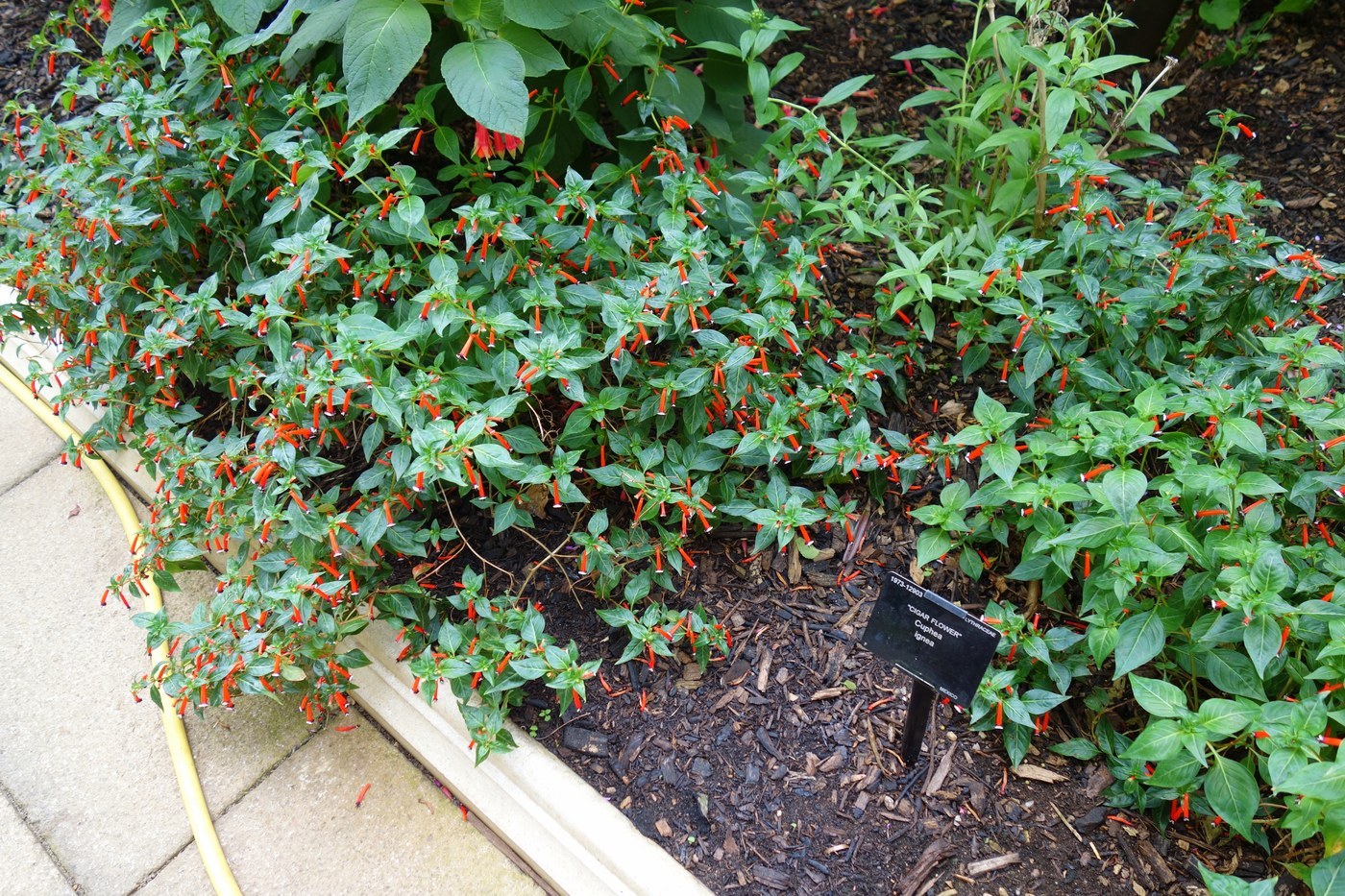
Key Identifying Features
Cigar plant (Cuphea ignea) is a small bushy subshrub named for its tubular flowers that look like tiny lit cigars.
- Flowers: slim tubular blooms about 2-3 cm long, bright orange to red, with a dark band and a white or pale ring at the tip, mimicking ash and a glowing ember
- Petals: notably the flower has no spreading petals (or only minute ones); the colorful tube is the calyx
- Habit: dense, rounded, twiggy shrublet, 30-60 cm tall
- Bloom: nearly continuous in warm weather
Leaves & Stems
Leaves are opposite, lance-shaped, glossy green, untoothed (entire), and pointed, usually 2-5 cm long on short stalks. Stems are slender, branching, often reddish, and may be slightly sticky-hairy. The fine-textured foliage gives a neat mounded appearance. (The related bat-faced cuphea, Cuphea llavea, has broader leaves and two flared red petal "ears.")
Flowers & Fruit
The defining feature is the floral tube: a brightly colored, hairless to slightly hairy tube formed by the fused sepals, with the dark mouth ringed in white producing the cigar illusion. Flowers emerge singly from leaf axils along the stems. Stamens and style are largely enclosed. The fruit is a small capsule containing several seeds. Hummingbirds and butterflies frequently visit.
How to Tell It Apart from Look-Alikes
- Bat-faced cuphea (Cuphea llavea): same genus, but flowers have a dark purple tube with two bright red flaring petals like bat ears, not the plain cigar tube
- Firecracker plant (Russelia equisetiformis): has rush-like, nearly leafless weeping green stems and longer red tubular flowers
- Cigar flower confusion with cestrum or correa: those are larger shrubs with clustered tubular flowers and lack the white-ringed dark tip
- Mexican heather (Cuphea hyssopifolia): same genus but tiny lavender/white flat flowers, not tubular cigars
The small orange-red tube tipped with a dark-and-white ring + opposite glossy lance leaves + neat shrublet form confirms cigar plant.
Where You'll Find It
Native to Mexico and the West Indies, cigar plant is grown worldwide as a container, bedding and border plant, often as a tender perennial or annual. It thrives in full sun to light shade and warm conditions, blooming much of the year in frost-free climates and through summer elsewhere.
Quick ID Checklist
- Slim orange-red tubular flowers ~2-3 cm long
- Dark band and white ring at the flower tip (cigar look)
- Tube formed by the calyx, petals tiny or absent
- Opposite, glossy, lance-shaped entire leaves
- Dense, mounded, twiggy shrublet 30-60 cm
- Visited by hummingbirds and butterflies
Frequently asked questions
Why is it called the cigar plant?
Its slim orange-red tubular flowers end in a dark band tipped with a white ring, looking just like the ash and glowing ember of a lit cigar.
What part of the flower is colorful?
Unusually, the showy colored tube is the calyx (fused sepals); the true petals are tiny or absent, which is a helpful identifying detail.
How is it different from bat-faced cuphea?
Bat-faced cuphea (Cuphea llavea) has a dark purple tube with two flaring bright red petals resembling bat ears, whereas the cigar plant's tube is plain with a white-ringed dark tip.
Does it attract pollinators?
Yes, the tubular flowers are favored by hummingbirds and butterflies, a behavioral clue that supports identification.