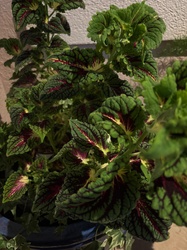
Coleus Identification Guide
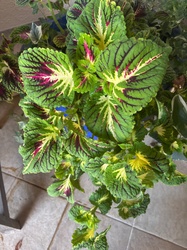
Identify coleus (Coleus scutellarioides) by its vividly colored, patterned leaves, square stems, and toothed leaf margins.
Read the full Coleus encyclopedia entry →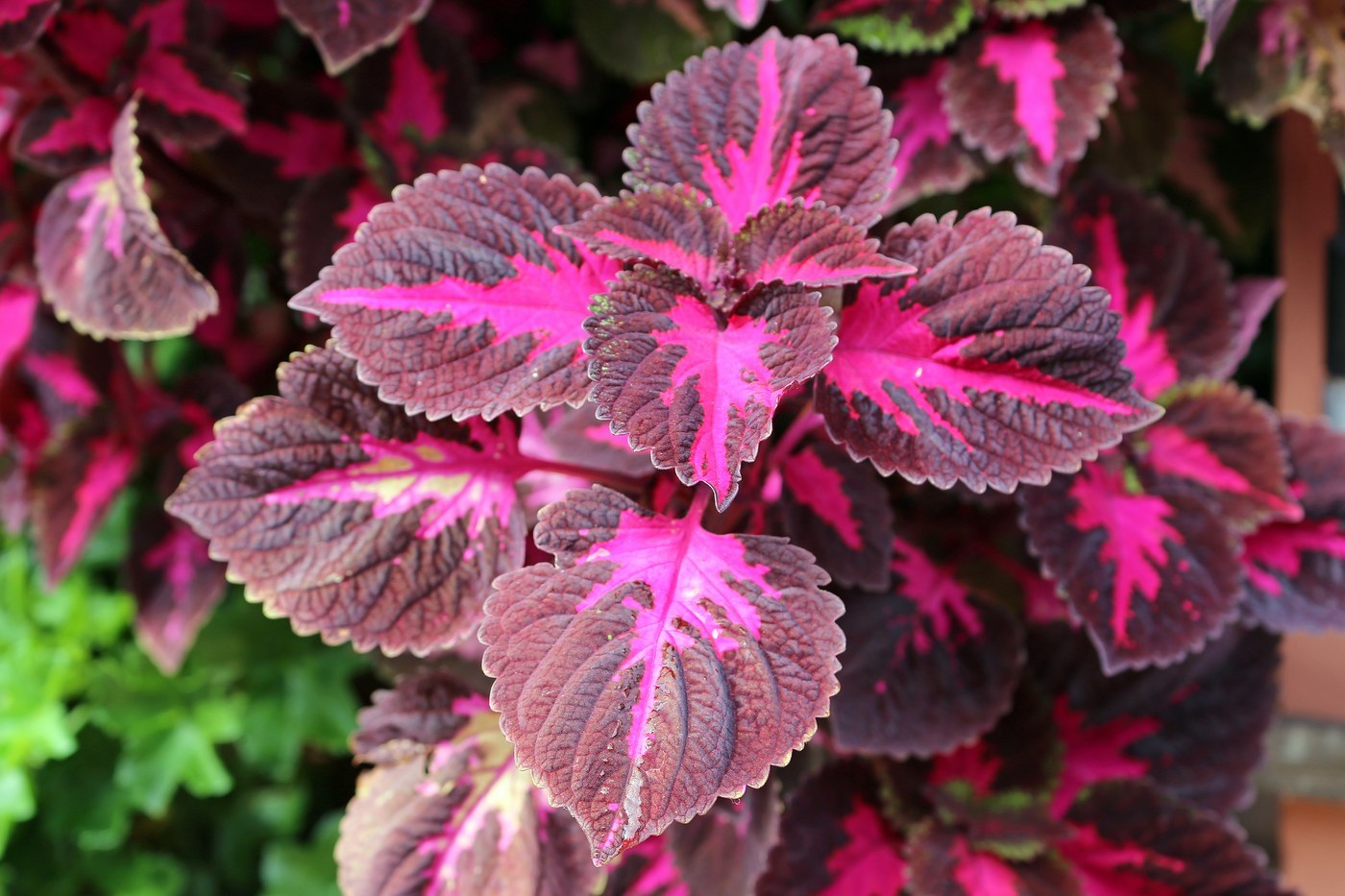
Key Identifying Features
Coleus (Coleus scutellarioides, formerly Plectranthus scutellarioides / Solenostemon) is a tender foliage plant in the mint family, grown for its riotously colored leaves. Look for:
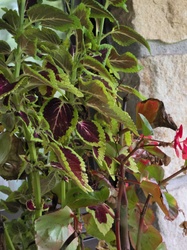
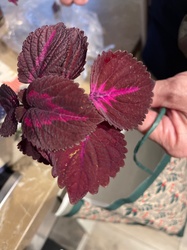
- Boldly patterned, multicolored leaves in combinations of green, chartreuse, red, burgundy, pink, orange, and cream
- Square (four-sided) stems — the classic mint-family clue
- Opposite leaves with scalloped or toothed margins, often a pointed tip
- Small, insignificant blue-purple flower spikes
Leaves & Stems
The leaves are the entire show: typically broadly egg-shaped to heart-shaped, 2-6 in long, with toothed or scalloped (sometimes ruffled or deeply cut) edges and a pointed tip. Patterns are strikingly variegated — often a contrasting central blotch, margin, and veining. Stems are square in cross-section (roll one between your fingers to feel the four sides) and somewhat succulent/brittle. Leaves are arranged in opposite pairs. Crushed foliage may have a faint herbal mint-family scent, though much milder than true mints.
Flowers & Fruit
Coleus flowers are secondary and often removed by growers. When they appear, they form slender terminal spikes (racemes) of small, tubular, two-lipped flowers in pale blue to violet — typical of the mint family. Gardeners often pinch off the flower spikes to keep the plant bushy and focused on foliage. Tiny nutlet seeds follow if flowers are left.
How to Tell It Apart from Look-Alikes
- Iresine (bloodleaf) — also colorful foliage, but with rounded stems and different leaf shape; not square-stemmed.
- Caladium — bold colorful leaves, but large arrowhead/heart-shaped on long stalks from a tuber, with no square stems or toothed mint-like margins.
- Perilla (shiso) — a mint relative with similar purple foliage and square stems, but more strongly aromatic.
- Hypoestes (polka dot plant) — speckled leaves, but spotted rather than zoned, and smaller.
The combination of square stems, opposite toothed leaves, and vivid multicolor leaf patterns confirms coleus.
Where You'll Find It
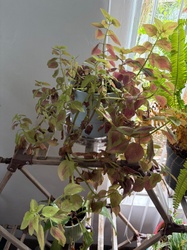
Native to Southeast Asia and Australia, coleus is grown worldwide as a tender bedding, container, and houseplant, prized for shade-to-sun foliage color. It's frost-sensitive and treated as an annual in cold climates. Look for it brightening shady beds, pots, and windowsills.
Quick ID Checklist
- Vividly patterned, multicolored leaves
- Square (four-sided) stems
- Opposite leaves with toothed or scalloped margins
- Pointed leaf tips, often ruffled edges
- Small blue-purple flower spikes (often pinched off)
A bushy plant with dazzling multicolored, toothed leaves on square stems is coleus.
Frequently asked questions
How can I confirm a plant is coleus?
Feel the stem — it should be square (four-sided), the mint-family signature — and check for opposite, toothed, vividly patterned leaves. Together these confirm coleus.
Why does my coleus have flower spikes?
Coleus naturally produces slender spikes of small blue-purple flowers. Many growers pinch them off to keep the plant bushy and focused on colorful foliage.
Is coleus related to mint?
Yes. It's in the mint family (Lamiaceae), which is why it has square stems and opposite leaves, though its scent is much milder than culinary mints.
Can coleus survive winter outdoors?
Only in frost-free climates. It's a tender tropical plant usually grown as an annual or brought indoors where winters are cold.
Coleus identified by the community
Recent Coleus specimens identified with Plant Identifier.