Cosmos Identification Guide
Recognize cosmos by its airy, finely divided foliage and daisy-like flowers with broad, often notched ray petals on tall slender stems.
Read the full Cosmos encyclopedia entry →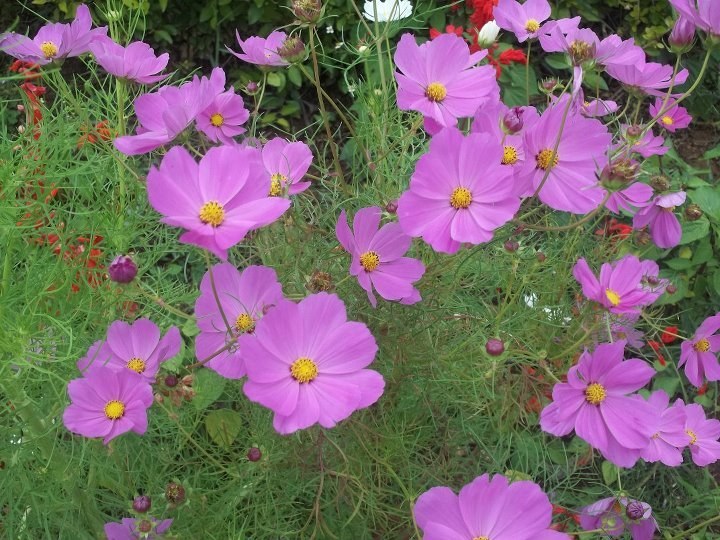
Key Identifying Features
Cosmos is a genus of annual and perennial plants in the daisy family (Asteraceae), best known as a breezy cottage-garden flower. Look for wide, daisy-like flower heads with about eight broad ray petals held above very feathery, thread-like leaves on tall, thin, swaying stems.
- Single-layer daisy flowers with broad, squared-off and slightly notched petal tips
- A flat yellow central disk
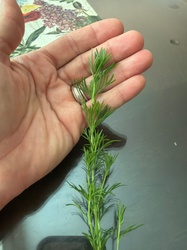
- Extremely fine, fern-like or thread-like foliage
- Tall, slender, branching green stems that move in the wind
Leaves & Stems
The foliage is a key identifier. In the common garden cosmos (Cosmos bipinnatus), leaves are opposite and twice-divided into fine, almost needle-like segments, giving the whole plant an airy, lacy look. Cosmos sulphureus has somewhat broader, more lobed leaf segments. Stems are slim, upright, branching, and green, often reaching 2-5 feet, and they bend easily in a breeze. The plant generally lacks the coarse, hairy feel of many sunflowers or zinnias.
Flowers & Fruit
Flower heads are solitary on long stalks and 2-4 inches across. They show a single ring of usually eight ray florets (the petals) surrounding a central disk of small yellow florets. In C. bipinnatus colors are white, pink, rose, and crimson; in C. sulphureus they are golden-yellow, orange, and scarlet. Petal tips are typically broad and shallowly toothed or notched rather than pointed. After bloom, the head produces clusters of slender, dark, dry seeds (achenes) often tipped with tiny bristles.
How to Tell It Apart from Look-Alikes
- Coreopsis: similar yellow daisy flowers, but petals are usually more deeply toothed at the tips and foliage is not as finely thread-like.
- Zinnia: has stiff, rough, oval undivided leaves and thicker stems, very unlike cosmos's lacy foliage.
- Dahlia: much more substantial flowers and divided but broad leaves; a tuberous plant, not airy.
- Bidens / tickseed: smaller flowers and differently shaped leaves.
The pairing of lacy thread-fine foliage with simple 8-petaled daisy flowers is the clearest way to confirm cosmos.
Where You'll Find It
Cosmos is native to Mexico and the southern United States and is grown worldwide as an easy annual. You will find it in cottage gardens, cutting beds, pollinator plots, and along roadsides where it has naturalized. It loves full sun and tolerates poor soil, blooming from summer to frost and attracting bees and butterflies.
Quick ID Checklist
- Daisy-like flowers with roughly eight broad, notched petals
- Flat yellow central disk
- Very feathery, thread-like opposite leaves
- Tall, slim, swaying branching stems
- Pink/white/crimson (bipinnatus) or yellow/orange (sulphureus) blooms
Frequently asked questions
How do I tell cosmos from coreopsis?
Cosmos has airy, thread-fine foliage and broad, shallowly notched petals, while coreopsis usually has more sharply toothed petal tips and less lacy leaves.
What are the two common kinds of cosmos?
Cosmos bipinnatus has very fine foliage and pink, white, or crimson flowers; Cosmos sulphureus has slightly broader leaves and yellow, orange, or scarlet flowers.
Why do cosmos plants look so wispy?
Their leaves are twice-divided into fine, almost needle-like segments and their stems are thin and tall, so the whole plant has an open, lacy, wind-tossed appearance.
Are cosmos good for pollinators?
Yes, the open daisy flowers with accessible central disks attract bees, butterflies, and other pollinators throughout summer and fall.
Cosmos identified by the community
Recent Cosmos specimens identified with Plant Identifier.