
Crown of Thorns Identification Guide
Learn to recognize Crown of Thorns (Euphorbia milii) by its spiny succulent stems, bright bract "flowers," and milky sap. This guide covers field marks and look-alike comparisons.
Read the full Crown of Thorns encyclopedia entry →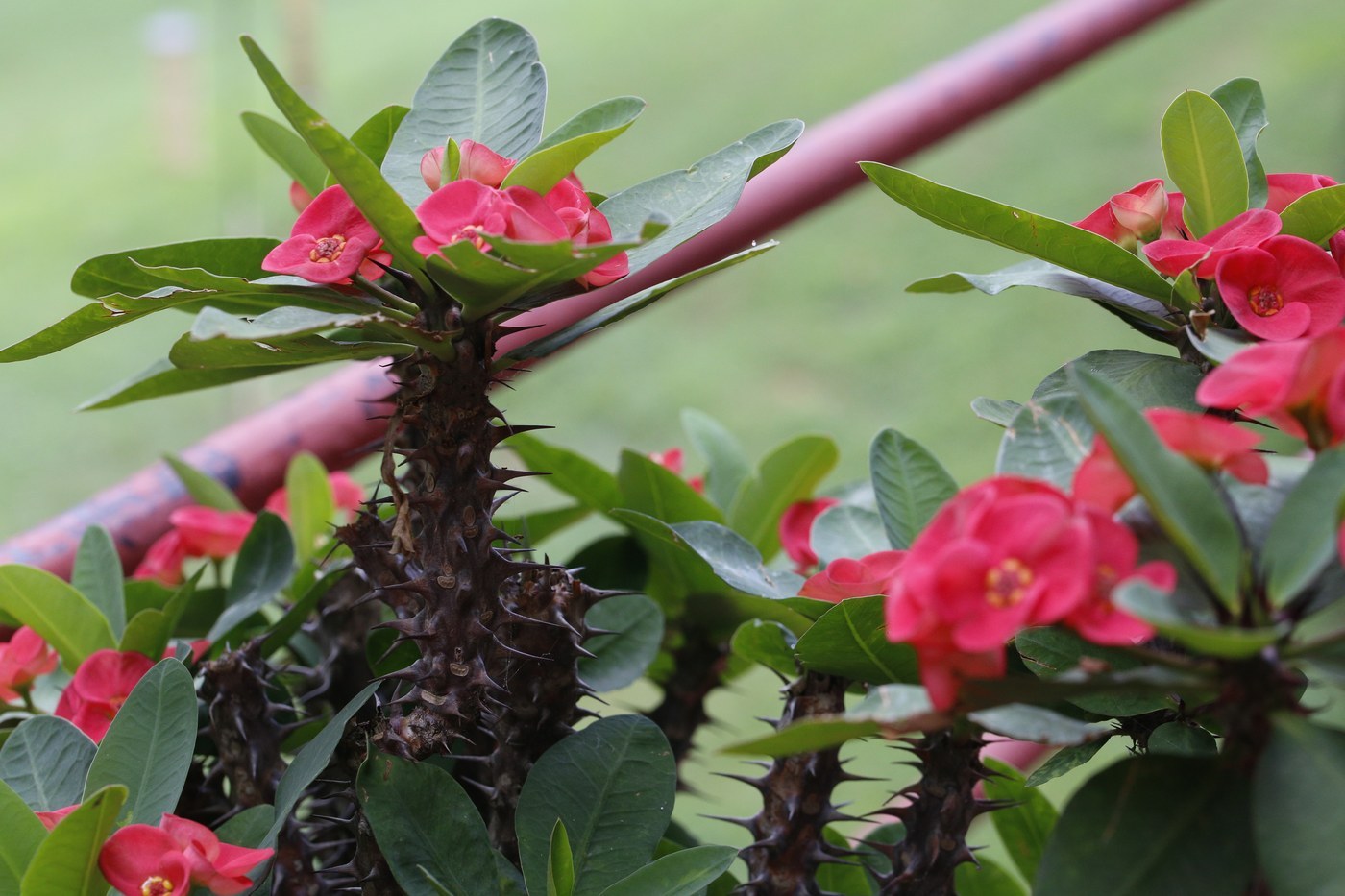
Key Identifying Features
Crown of Thorns (Euphorbia milii) is a sprawling, woody succulent shrub instantly recognizable by its dense covering of sharp gray-brown spines along thick, gray-green stems. The most decorative feature is the pair of showy, petal-like bracts that surround tiny true flowers, usually in red, pink, yellow, or coral.
- Spiny stems that are thick, succulent, and grayish
- Milky white latex sap that oozes when broken
- Paired colorful bracts mistaken for petals
- Bright green, paddle-shaped leaves clustered near growing tips
Leaves & Stems
Stems are 5-7 ribbed, fleshy, and densely armed with spines up to 1.2 inches long, arranged in rows. Plants grow as scrambling shrubs reaching 3-6 feet in the ground, less indoors. The leaves are obovate (teardrop/spoon-shaped), bright green, thin, and concentrated toward the stem ends; older lower leaves drop, leaving bare spiny stems. Snapping any part releases milky sap, a hallmark of the genus Euphorbia.
Flowers & Fruit
What looks like flowers are actually two rounded, kidney-shaped bracts (cyathophylls) about 0.5 inch wide, framing a cluster of minute yellow-green true flowers (a cyathium typical of euphorbias). Colors include scarlet, salmon, pink, white, and yellow, and blooms appear nearly year-round in warm conditions. Fruit is a small three-lobed capsule, rarely noticed indoors.
How to Tell It Apart from Look-Alikes
- Other Euphorbias also have milky sap but lack the dense spines plus colorful paired bracts combination.
- Roses or bougainvillea are sometimes confused at a glance for the colorful bracts, but neither has succulent spiny stems or milky sap.
- Cacti have areoles (cushion-like spine bases) and no milky latex; Crown of Thorns spines arise directly from the stem and the sap is milky, not clear.
The combination of succulent spiny stem + milky sap + two-bract "flowers" is diagnostic.
Where You'll Find It
Native to Madagascar, it is a popular houseplant and warm-climate landscape shrub (USDA zones 9-11). Indoors it favors bright, sunny windows; outdoors it tolerates heat and drought, often used in xeriscapes and hedges. It blooms best with strong light.
Quick ID Checklist
- Thick, gray-green succulent stems covered in long spines
- Milky white sap when cut
- Bright green spoon-shaped leaves near the tips
- Pairs of colorful, rounded bracts (red/pink/yellow)
- Sprawling shrubby growth habit
If you see all five, you are almost certainly looking at Crown of Thorns.
Frequently asked questions
Are the colorful parts real flowers?
No. The showy red, pink, or yellow structures are modified leaves called bracts. The true flowers are the tiny yellow-green clusters they surround.
How do I tell it apart from a cactus?
Cacti have spines that emerge from cushiony areoles and clear sap. Crown of Thorns has spines arising directly from the stem and exudes milky white sap, a hallmark of the genus Euphorbia.
Why are the lower stems bare and spiny?
It naturally sheds older leaves at the base, concentrating foliage near the growing tips. Bare spiny stems are normal, not a sign of illness.