Deutzia Identification Guide
How to identify deutzia by its arching stems, opposite toothed leaves, and profuse clusters of small white or pink star-shaped flowers.
Read the full Deutzia encyclopedia entry →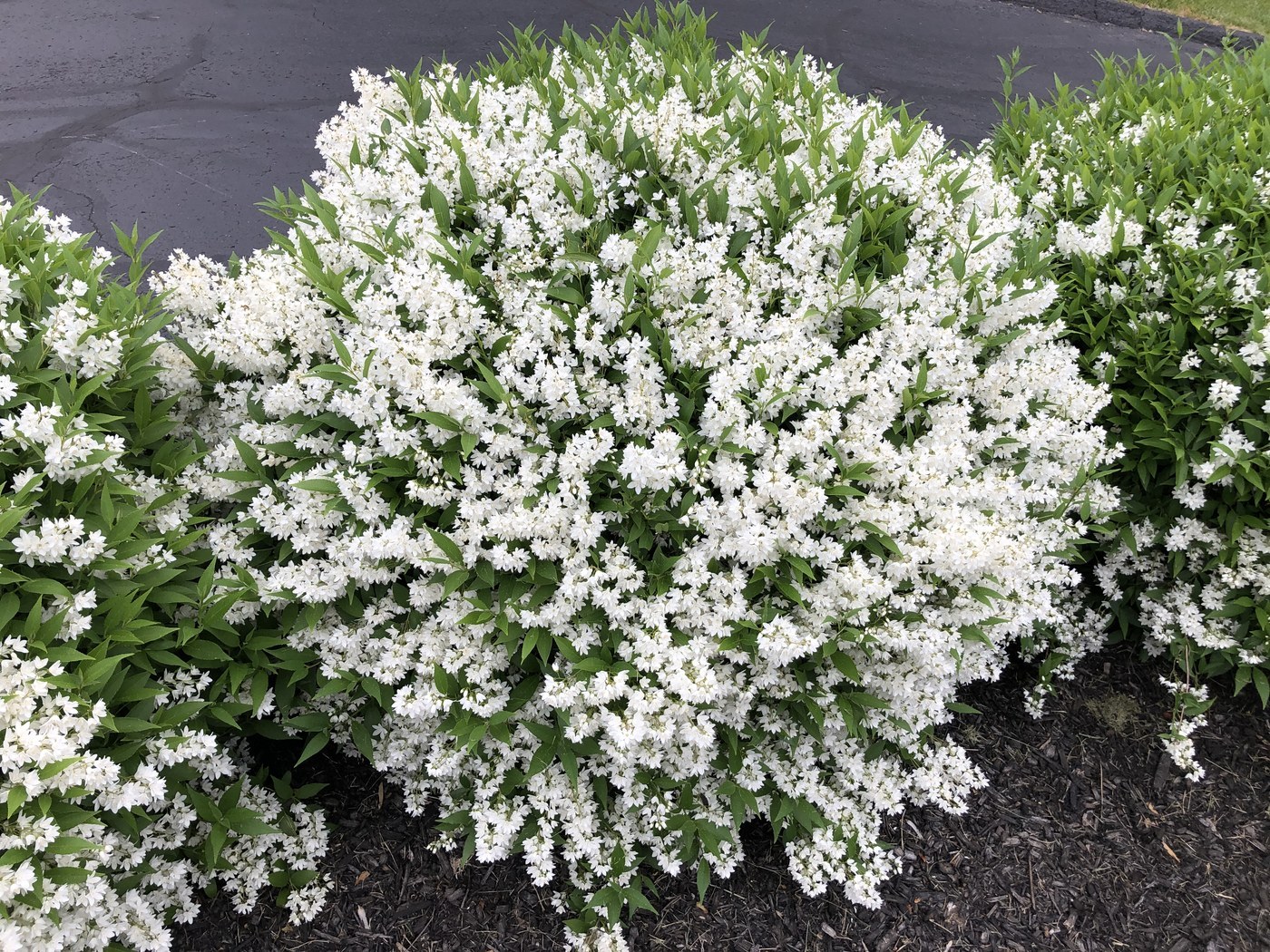
Key Identifying Features
Deutzia (Deutzia spp.) is a deciduous shrub grown for its profuse spring display of small white or pink star- or bell-shaped flowers smothering arching branches. Forms range from low spreading mounds (1-2 ft, e.g. D. gracilis) to taller arching shrubs (4-8 ft). It's closely related to mock orange but has smaller, only lightly scented (or scentless) flowers borne in great quantity.
- Masses of small 5-petaled white/pink flowers in late spring
- Opposite, simple, finely toothed leaves
- Arching stems, often with peeling bark
- Flowers in clusters along the branches
Leaves & Stems
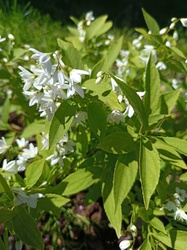
Leaves are opposite, simple, lance-shaped to oval, 1-4 inches long, with finely toothed margins and a pointed tip; the surface often bears tiny star-shaped (stellate) hairs that make leaves feel slightly rough—a useful close-up clue. Foliage is medium green, sometimes turning burgundy in fall (especially compact cultivars). Stems are slender and arching; older bark is brown and exfoliates/peels in thin strips, and the pith is hollow or chambered in many species. The opposite arrangement separates it from spireas.
Flowers & Fruit
In mid-to-late spring, deutzia produces an abundant show of small flowers (1/2-1 inch) with five petals, white or pink-flushed, in clusters (panicles, racemes, or corymbs) along and at the tips of the arching stems. Flowers are star-shaped or shallowly bell-shaped and only faintly fragrant (unlike mock orange). After bloom, small, dry, woody capsules form; there are no berries. The sheer quantity of small flowers covering a fountaining shrub is the classic look.
How to Tell It Apart from Look-Alikes
- Mock orange (Philadelphus): related, with larger four-petaled flowers and a strong orange-blossom fragrance; deutzia's are smaller, five-petaled, and barely scented.
- Spirea (bridalwreath types): similar white-flowered arching shrub but alternate leaves and flowers in rounded clusters; deutzia is opposite.
- Bridal wreath / Exochorda: larger pearl-bud white flowers, alternate leaves.
- Weigela: opposite leaves but tubular/funnel-shaped flowers, not flat stars.
The opposite toothed leaves + masses of small five-petaled lightly scented flowers + peeling stems confirm deutzia.
Where You'll Find It
Most garden deutzias are native to East Asia (a few to Central America and Europe) and are widely planted as spring-flowering border and foundation shrubs and groundcovers (slender deutzia, D. gracilis, and the low 'Nikko' and 'Yuki' types are very common). They grow in full sun to part shade in average, well-drained soil.
Quick ID Checklist
- Arching/mounding deciduous shrub
- Opposite, finely toothed leaves (often rough with star-shaped hairs)
- Masses of small 5-petaled white/pink flowers in late spring
- Little or no fragrance (unlike mock orange)
- Peeling brown bark; dry capsules, no berries
Frequently asked questions
How do I tell deutzia from mock orange?
Both are related arching shrubs with white flowers, but deutzia has smaller, five-petaled, lightly scented or scentless flowers in great profusion, while mock orange has larger four-petaled flowers with a powerful orange-blossom fragrance.
How is deutzia different from spirea?
Deutzia has opposite leaves, while bridalwreath-type spireas have alternate leaves. Both make masses of small white flowers on arching stems, so leaf arrangement is the key check.
Does deutzia have berries?
No. After flowering it forms small, dry, woody seed capsules rather than fleshy fruit. It is grown purely for its spring flower display.
Why do deutzia leaves feel rough?
Many deutzias have tiny star-shaped (stellate) hairs on the leaf surface that give a slightly sandpapery feel. Seeing these star hairs under a hand lens helps confirm the genus.
Deutzia identified by the community
Recent Deutzia specimens identified with Plant Identifier.