
Dracaena Identification Guide
Identify Dracaena by its rosettes of long strappy leaves atop cane-like stems, parallel leaf veins, and often reddish stem resin.
Read the full Dracaena encyclopedia entry →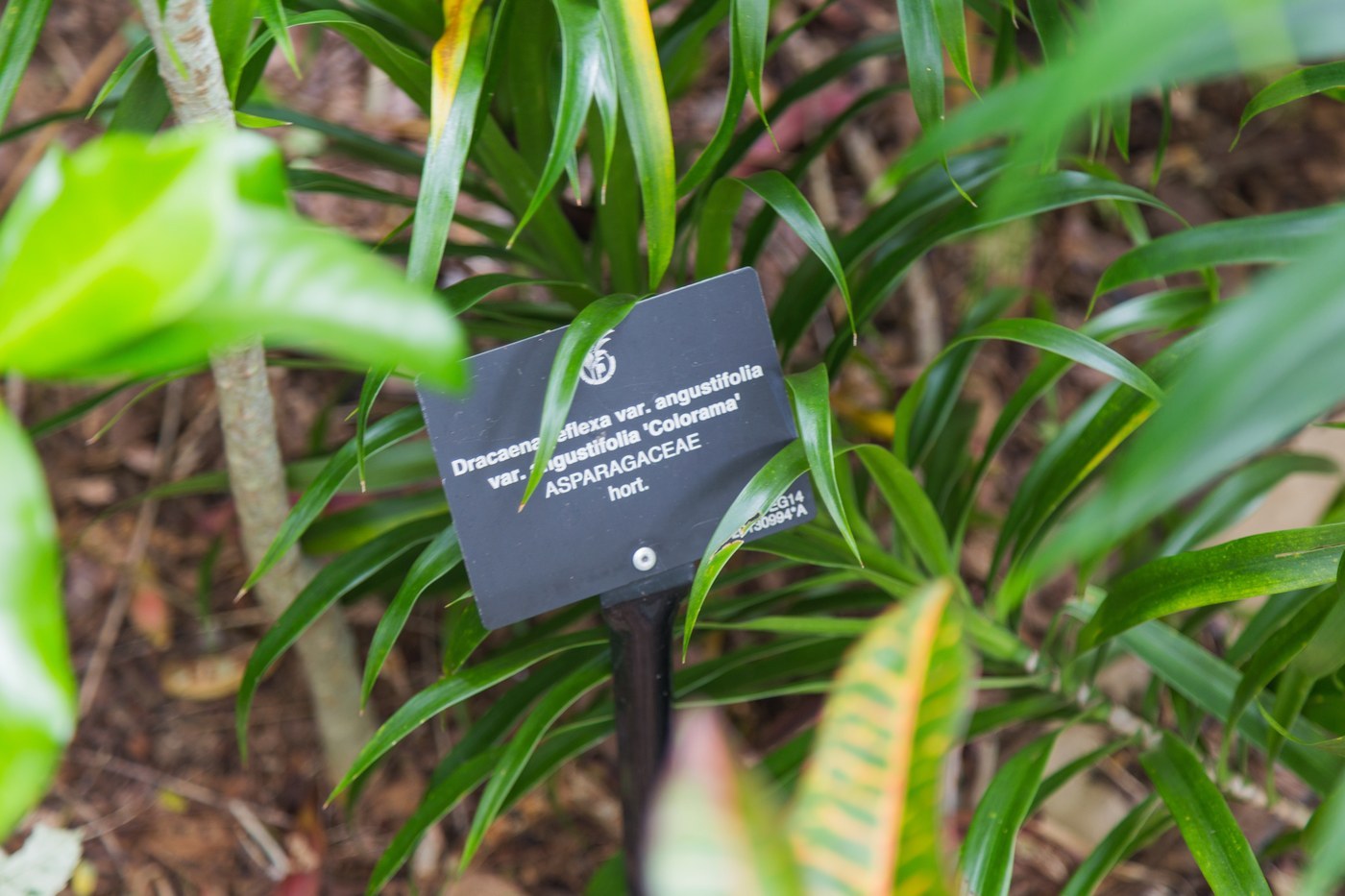
Key Identifying Features
Dracaena is a genus of woody, palm-like foliage plants (now including the former Sansevieria snake plants). Common ornamental dracaenas share:
- Rosettes or tufts of long, strap-shaped leaves at the top of bare, cane-like stems
- Parallel leaf veins (no central midrib branching) — a monocot trait
- Often colorful leaf margins or stripes (red, cream, yellow, or white)
- A single or branching woody 'cane' trunk with leaf scars
Leaves & Stems
Leaves are typically long, narrow, and pointed, arranged in spirals or tufts. Patterns help separate species: D. marginata (Dragon Tree) has thin red-edged green leaves on slender canes; D. fragrans (Corn Plant) has broad arching leaves with a yellow central stripe; D. trifasciata (Snake Plant) has stiff upright sword leaves with banding. All show parallel venation running the length of the leaf.
Stems form distinctive bare canes marked with old leaf scars, and older plants branch after the tip is cut. Cut stems of some species (notably D. draco and D. cinnabari) bleed a red resin historically called 'dragon's blood,' which gives the genus its dragon names.
Flowers & Fruit
Mature dracaenas occasionally produce panicles or globe-like clusters of small, fragrant white-to-pink flowers, often strongly scented at night (especially D. fragrans, the Corn Plant). Flowering is uncommon indoors. Fruit is a small orange-red berry. Flowers are not needed for ID, since the foliage and cane structure are diagnostic.
How to Tell It Apart from Look-Alikes
- True palms: palms have fan or feather (pinnate) fronds and a fibrous trunk; Dracaena has simple strap leaves with parallel veins on a smooth scarred cane.
- Cordyline: very similar strappy leaves, but Cordyline has white rhizomatous roots vs. Dracaena's yellow-orange roots — a classic separating test.
- Yucca: stiffer, sharper, more rigid leaves often with a sharp terminal spine; Dracaena leaves are more flexible.
- Snake Plant: now classified as Dracaena trifasciata — stiff upright leaves are still a dracaena.
The strap leaves with parallel veins on a scarred woody cane (plus yellow-orange roots) point to Dracaena.
Where You'll Find It
Native mostly to Africa, Madagascar, and southern Asia, dracaenas are among the most common indoor foliage plants for offices and homes due to their tolerance of low light and neglect. Outdoors they grow in frost-free climates (USDA 10-12). They prefer bright indirect light but survive low light; many are sensitive to fluoride in water (causing leaf-tip browning).
Quick ID Checklist
- Tufts/rosettes of long strappy leaves atop bare canes
- Parallel leaf veins (no branching midrib)
- Colored margins or central stripes common
- Woody cane stems with leaf scars
- Yellow-orange roots (vs. Cordyline's white roots)
Frequently asked questions
How do I tell a Dracaena from a palm?
Palms have feather or fan-shaped fronds and a fibrous trunk, while Dracaena has simple, strap-shaped leaves with parallel veins growing from a smooth, scarred woody cane. The leaf shape and cane are the giveaways.
Is the Snake Plant really a Dracaena?
Yes. Botanists reclassified Sansevieria into Dracaena, so the Snake Plant is now Dracaena trifasciata. Its stiff upright leaves still belong to the dracaena genus.
How can I separate Dracaena from Cordyline?
They look alike above ground, so check the roots. Dracaena has yellow to orange roots, while Cordyline has white, rhizome-like roots. That root color is the classic distinguishing test.
Why do my Dracaena leaf tips turn brown?
Dracaenas are sensitive to fluoride and salts in tap water, which commonly causes brown leaf tips. Using filtered or distilled water and avoiding over-fertilizing usually reduces it.