
Gladiolus Identification Guide
Recognize gladiolus by its tall one-sided spike of large funnel-shaped flowers and its upright fan of stiff sword-shaped leaves growing from a corm.
Read the full Gladiolus encyclopedia entry →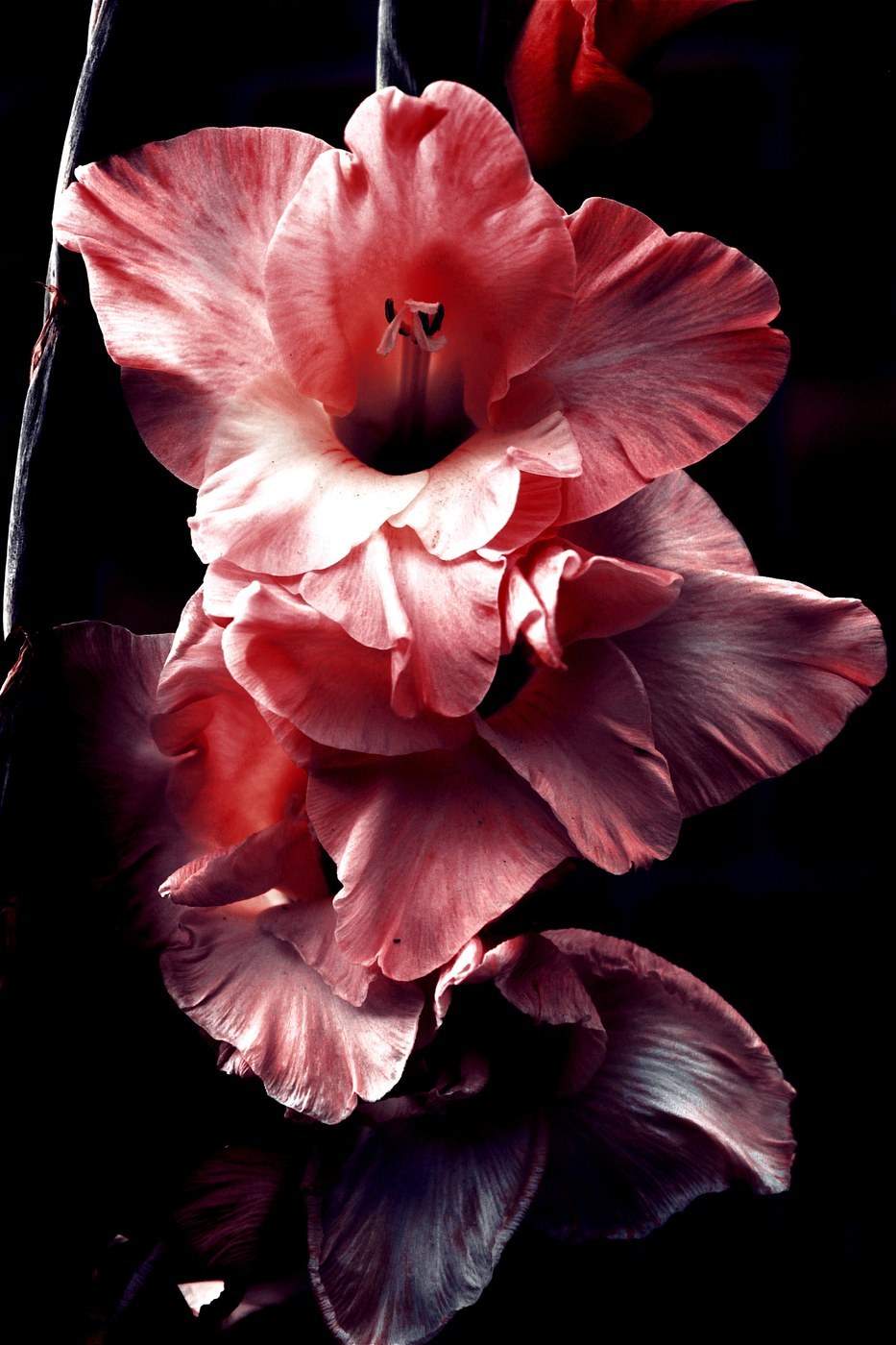
Key Identifying Features
Gladiolus is a genus of cormous plants in the iris family (Iridaceae). It is unmistakable for its tall, upright flower spike lined with large, funnel-shaped flowers facing mostly one direction, rising above a flat fan of stiff, sword-shaped leaves. The name comes from the Latin gladius (sword), referring to the leaves.
- A tall, straight spike (often 2-5 feet) of showy flowers
- Flowers usually arranged along one side, opening bottom to top
- Funnel-shaped, ruffled flowers with six tepals
- Rigid, vertical, sword-like leaves in a fan from a corm
Leaves & Stems
Leaves are long, narrow, stiff, and sword-shaped, with parallel veins and a prominent midrib, arranged in a flat overlapping fan at the base, the classic iris-family arrangement. The flowering stem is tall, stiff, and unbranched, emerging from the center of the fan. The plant grows from a rounded, flattened corm rather than a bulb.
Flowers & Fruit
The flower spike is the key feature: a long raceme bearing many large flowers, usually arranged on one side (secund), opening progressively from the bottom upward. Each flower is funnel-shaped with six tepals, the upper ones often larger, and edges are frequently ruffled or frilled. Colors are exceptionally varied: white, yellow, orange, pink, red, salmon, purple, green, and bicolors, often with contrasting throat blotches. Most modern florist gladioli are unscented. Fruit is a three-parted capsule with winged seeds.
How to Tell It Apart from Look-Alikes
- Freesia: same family and leaf fan, but smaller fragrant flowers on a stem that bends sharply to horizontal, not a tall straight vertical spike.
- Iris: fan of sword leaves too, but flowers have distinct falls and standards rather than a simple one-sided funnel spike.
- Crocosmia: related, with smaller flowers on arching, branched, wiry stems.
- Watsonia: similar tall spike but with more tubular flowers and a different growth pattern.
The combination of a tall straight one-sided spike of large funnel flowers over a fan of sword leaves from a corm confirms gladiolus.
Where You'll Find It
Most garden gladioli derive from South African species and are grown worldwide as cut flowers and back-of-border garden plants. They are planted from corms in spring in full sun and well-drained soil and bloom in summer; in cold climates corms are lifted and stored over winter. Some wild species grow in grasslands and on rocky slopes.
Quick ID Checklist
- Tall, straight, unbranched flower spike 2-5 feet high
- Large funnel-shaped flowers, mostly one-sided, often ruffled
- Flowers open from the bottom of the spike upward
- Stiff sword-shaped leaves in a flat basal fan
- Grows from a flattened corm; usually unscented
Frequently asked questions
How is gladiolus different from freesia?
Both are iris-family corm plants with fans of sword leaves, but gladiolus has large flowers on a tall straight vertical spike and is usually unscented, while freesia has smaller fragrant flowers on a sharply bent horizontal stem.
Why do gladiolus flowers open from the bottom up?
The spike is a raceme that matures sequentially, so the lowest buds open first and flowering progresses upward over several days, which is why they last well as cut flowers.
Does gladiolus grow from a bulb?
No, it grows from a corm, a solid swollen stem base; each year a new corm forms on top of the old one along with small cormels.
Are gladiolus flowers fragrant?
Most modern hybrid gladioli have little or no scent, though a few species and the night-scented Gladiolus types are fragrant.