
Ground Ivy Identification Guide
How to identify ground ivy (Glechoma hederacea), a creeping mint-family weed with square stems, scalloped leaves, and purple flowers.
Read the full Ground Ivy encyclopedia entry →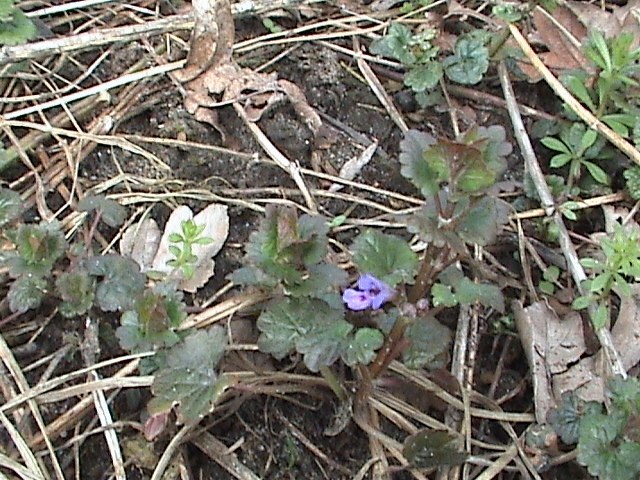
Key Identifying Features
Ground ivy (Glechoma hederacea), also known as creeping Charlie, gill-over-the-ground, or run-away-robin, is a low creeping perennial in the mint family. Identify it by its square stems, opposite kidney-shaped scalloped leaves, minty fragrance, and small blue-violet flowers. It forms dense mats in shady, moist places.
- Creeps flat, rooting at nodes to form spreading carpets
- Square stems characteristic of mints
- Aromatic, minty smell when crushed or mowed
Leaves & Stems
Leaves are opposite (in pairs), round to kidney-shaped, with scalloped (round-toothed) margins and a network of impressed veins giving a slightly puckered look. They are bright to deep green, sometimes purplish at the edges in cool weather, and held on long stalks. The square, four-sided stems trail along the ground and root at each node. Crushed foliage smells strongly minty. The square stem plus opposite scalloped leaves plus mint odor is the classic mint-family signature.
Flowers & Fruit
In spring to early summer, ground ivy produces small, funnel-shaped, blue to violet-purple flowers about 1/2 inch long in clusters (whorls) in the leaf axils. Each is two-lipped with purple speckling on the lower lip, typical of mints. Fruit is a tiny four-part nutlet. A spring carpet of low purple-flowered, scalloped-leaved growth in a shady lawn is a strong indicator.
How to Tell It Apart from Look-Alikes
- Henbit and purple deadnettle: also square-stemmed purple-flowered mints, but they grow upright with more triangular or lobed leaves; ground ivy creeps flat with kidney-shaped scalloped leaves.
- Common mallow: round leaves but rounded stems and no mint smell.
- Wild violet: heart-shaped leaves, rounded stems, no mint odor.
- Dollarweed (pennywort): round leaves attached at the center; ground ivy's stalk attaches at a notch in the leaf edge.
Where You'll Find It
Ground ivy prefers moist, shaded, fertile soil: shady lawns, garden beds, woodland edges, ditches, and under trees, though it tolerates some sun. Native to Europe and Asia, it is now a widespread weed across North America and other temperate regions, spreading both by seed and creeping stems.
Quick ID Checklist
- Square stems creeping and rooting at nodes
- Opposite, kidney-shaped, scalloped leaves
- Strong mint aroma when crushed
- Small blue-violet two-lipped flowers in spring
- Dense low mats in moist, shady spots
Frequently asked questions
Are ground ivy and creeping Charlie the same plant?
Yes. Glechoma hederacea goes by both names, along with gill-over-the-ground and run-away-robin. They all refer to the same creeping mint-family weed.
How do I distinguish ground ivy from wild violet?
Ground ivy has square stems, a minty smell, and scalloped kidney-shaped leaves, while wild violet has rounded stems, heart-shaped leaves, and no mint odor.
Why does ground ivy spread so fast?
Its square creeping stems root at every node they touch, so a single plant can quickly form a wide mat, and it also reproduces by seed.
What kind of flowers does ground ivy have?
It produces small, funnel-shaped, blue to violet-purple two-lipped flowers in the leaf axils during spring, often with darker speckles on the lower lip.