
Hoya Rope Plant Identification Guide
Identify the Hoya Rope Plant (Hoya carnosa 'Compacta') by its tightly curled, twisted leaves forming rope-like trailing stems.
Read the full Hoya Rope Plant encyclopedia entry →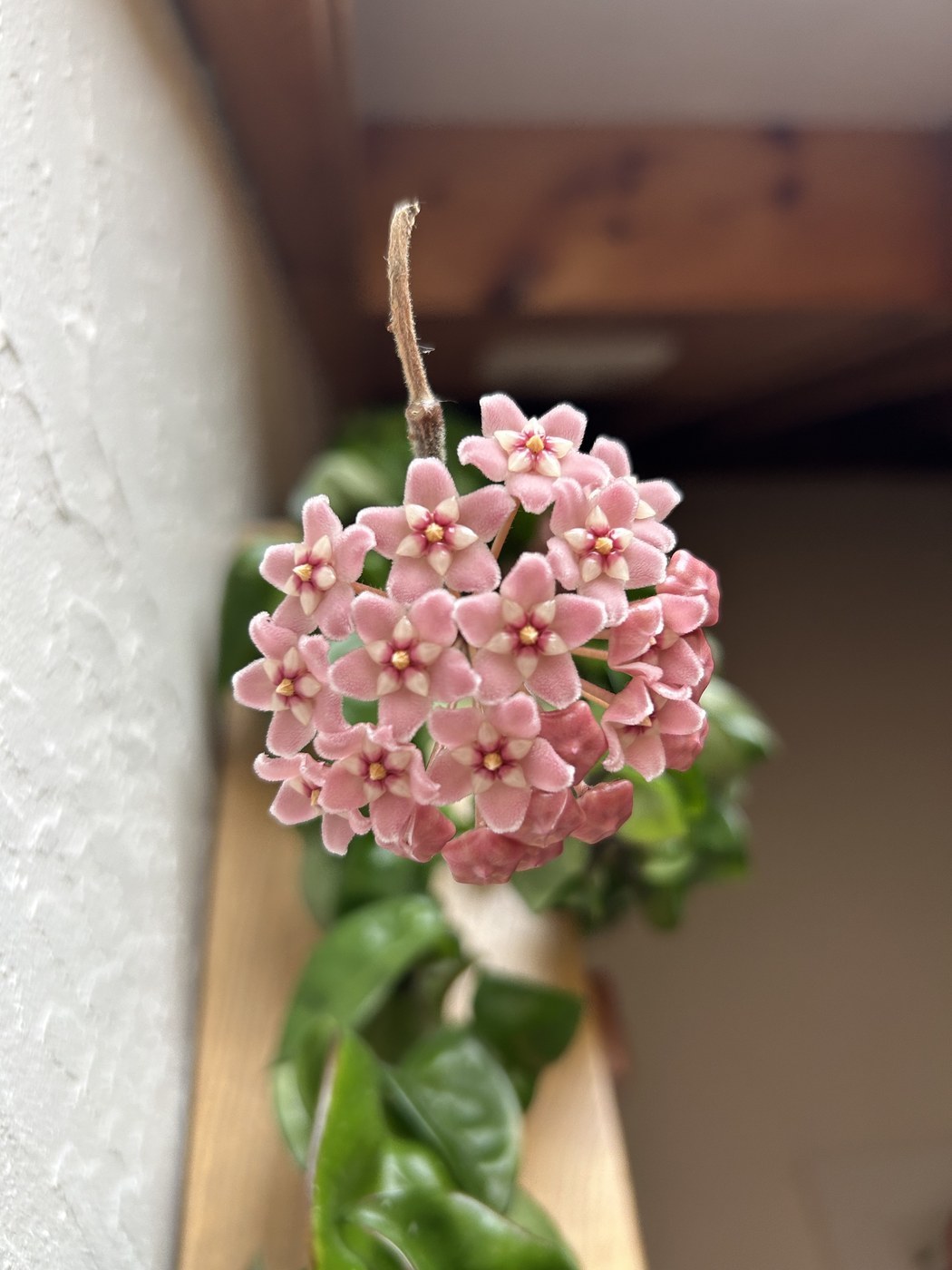
Key Identifying Features
The Hoya Rope Plant (Hoya carnosa 'Compacta'), also called the Hindu Rope, is one of the easiest hoyas to recognize. Look for:
- Thick, succulent leaves that are tightly curled and folded onto themselves
- Twisted, contorted stems resembling a braided rope
- Dense, cascading growth with leaves packed closely together
- Waxy, glossy green (or variegated) foliage
Leaves & Stems
The defining trait is the crinkled, cupped leaf: each leaf curls inward and folds, so the plant never shows flat foliage like normal hoyas. Leaves are thick, succulent, and waxy, dark green in the standard form. A common variegated 'Krimson' type shows creamy-white or pink margins and pink-tinged new growth. The stems are barely visible, hidden by overlapping curled leaves, which gives the whole vine its characteristic knotted, rope-like silhouette as it trails downward. Growth is slow and the strands dangle attractively from hanging pots.
Flowers & Fruit
When mature and happy, it produces classic Hoya umbels (clusters) of star-shaped flowers. Blooms are waxy, pale pink with a deeper pink or red central star (corona), fragrant especially in the evening, and often dripping sticky nectar. Flowers arise from persistent spurs (peduncles), which should never be removed because they rebloom from the same spur. Fruit (seed pods) is rare indoors.
How to Tell It Apart from Look-Alikes
- Standard Hoya carnosa: same waxy leaves and flowers but flat, smooth, oval leaves instead of curled ones.
- Hoya kerrii: thick heart-shaped, flat leaves, not twisted ropes.
- String of Hearts (Ceropegia): thin trailing stems with small heart leaves, far more delicate, not curled-and-waxy.
The twisted, curled-leaf rope habit is unmistakable and unique among common houseplants.
Where You'll Find It
Hoya carnosa is native to East Asia and Australia, growing as an epiphytic climber. The 'Compacta' cultivar is purely a houseplant, sold in hanging baskets to show off the trailing ropes. It thrives in bright indirect light, a chunky well-draining mix, and slightly dry-between-waterings care. You will find it in homes, plant shops, and collections rather than the wild.
Quick ID Checklist
- Curled, folded, crinkled leaves
- Twisted rope-like trailing stems
- Thick, waxy succulent texture
- Dense, overlapping foliage
- Optional cream/pink variegation
- Star-shaped pink waxy flower clusters when blooming
Frequently asked questions
Why are the leaves curled and twisted?
The curling is a stable genetic trait of the 'Compacta' cultivar, not a sign of stress or disease. Every healthy leaf naturally folds onto itself, giving the rope appearance.
How is the Rope Plant different from a normal Hoya carnosa?
They are the same species, but the Rope Plant ('Compacta') has tightly curled, contorted leaves, while standard Hoya carnosa has flat, smooth oval leaves.
What do the flowers look like?
Clusters of waxy, star-shaped pale-pink flowers with a darker pink central star, often fragrant and producing sticky nectar drops.
Should I cut off the flower stalks after blooming?
No. The bare stalks (spurs) rebloom year after year from the same point, so removing them prevents future flowers.