
Italian Cypress Identification Guide
Identify the Italian Cypress (Cupressus sempervirens) by its famously narrow, column-like form and dark green scale foliage on cordlike branchlets.
Read the full Italian Cypress encyclopedia entry →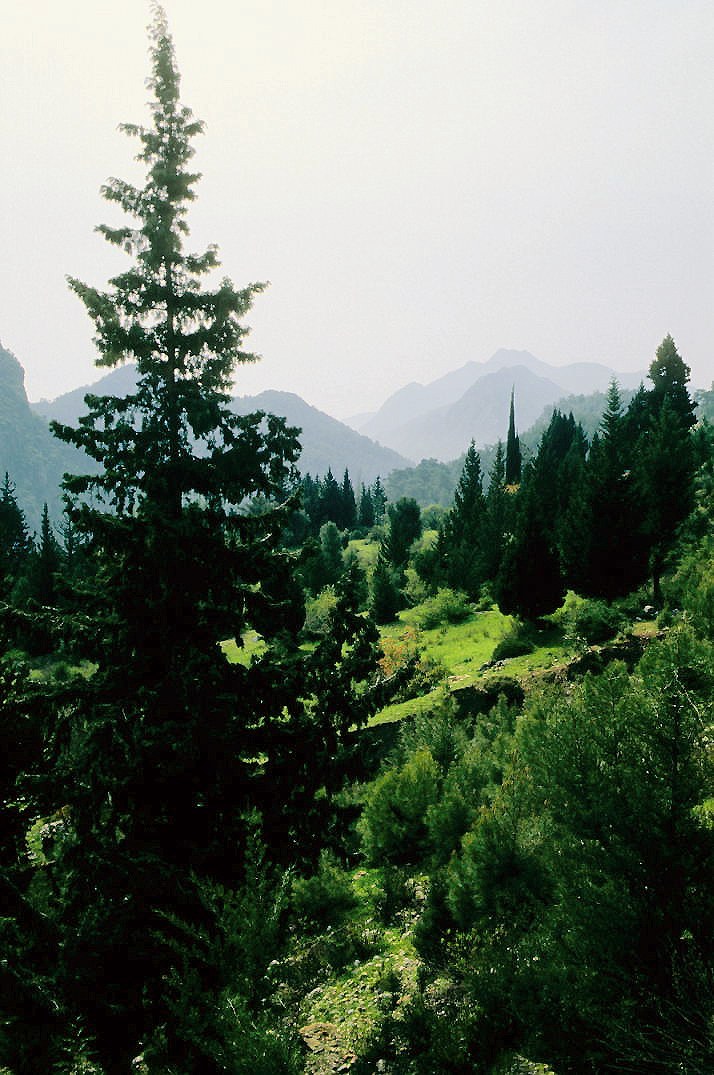
Key Identifying Features
The Italian Cypress (Cupressus sempervirens), also called Mediterranean or pencil cypress, is the iconic tall, extremely narrow, dark green column of Mediterranean landscapes, Tuscan hillsides and formal gardens. The most-planted form ('Stricta') grows 40-70 ft tall but only 3-6 ft wide, producing a dramatic vertical exclamation point. Its narrow columnar silhouette is its single most diagnostic feature.
- Form: very tall, very narrow column (pencil-like)
- Color: uniform dark green to gray-green
- Texture: fine, dense, soft cord-like sprays
Leaves & Stems
Like all cypresses, the foliage is made of tiny, scale-like leaves pressed tightly against the twigs, giving smooth, rounded, cord-like branchlets (not flattened fans). The foliage is dark green to slightly blue-green and held in 3-dimensional sprays rather than flat planes. Crushed foliage has a resinous, faintly cedar-like scent. The bark is gray-brown and shallowly ridged, twisting slightly on old trunks.
Flowers & Fruit
Cones are distinctive once you spot them. Seed cones are woody, oval to round, 1 to 1 1/2 inches long, gray-brown, made of 8-14 shield-shaped scales each with a small central point, and they remain on the tree for years. Closed cones look like small wrinkled wooden balls. Small yellowish pollen cones appear at branch tips in late winter.
How to Tell It Apart from Look-Alikes
- Arborvitae 'Emerald Green' / columnar thuja: also narrow, but foliage is in flat fern-like sprays and cones are tiny upright urns - very different from cypress's rounded sprays and woody ball cones.
- Eastern red cedar (Juniperus virginiana) columnar forms: bear blue berry-like cones, not woody balls.
- Leyland cypress: much broader and faster, with flattened sprays and small cones; rarely as strictly columnar.
- Other true cypresses (Arizona, Monterey): broader, often more spreading; Arizona cypress is grayer-blue.
The pencil-thin column + scale foliage in rounded sprays + woody ball cones with shield scales confirms Italian cypress.
Where You'll Find It
Native to the eastern Mediterranean, it is a signature plant of formal Mediterranean and Italianate gardens, driveways, and cemeteries, thriving in hot, dry, sunny climates with well-drained soil (California, the Southwest, southern Europe). Its slim form makes it a favorite vertical accent.
Quick ID Checklist
- Very tall, very narrow columnar form (pencil-like)
- Dark green scale foliage on rounded, cord-like branchlets
- Foliage in 3-D sprays, not flat fans
- Woody, oval ball cones ~1-1.5 in with shield-shaped scales
- Hot, dry Mediterranean-style settings
Frequently asked questions
What gives Italian cypress its famous shape?
The widely planted cultivar 'Stricta' grows in a tight, fastigiate column - tall and only a few feet wide - producing the slender vertical accent seen in Tuscan and Mediterranean landscapes.
How do I tell it from a columnar arborvitae?
Italian cypress has rounded, cord-like foliage sprays and woody ball-shaped cones. Columnar arborvitae has flat, fern-like foliage sprays and tiny upright urn cones.
What do the cones look like?
They are woody, oval to round, about 1-1.5 inches, gray-brown, made of shield-shaped scales each with a small point, and stay on the tree for years.
Where does it grow best?
It thrives in hot, dry, sunny Mediterranean-type climates with well-drained soil and is widely used in California and the Southwest as a formal vertical accent.