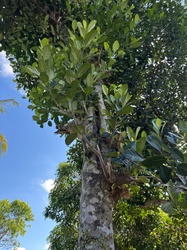
Jackfruit Tree Identification Guide
Identify the jackfruit tree (Artocarpus heterophyllus) by its glossy leathery leaves, milky sap, and enormous spiny fruit borne directly on the trunk.
Read the full Jackfruit Tree encyclopedia entry →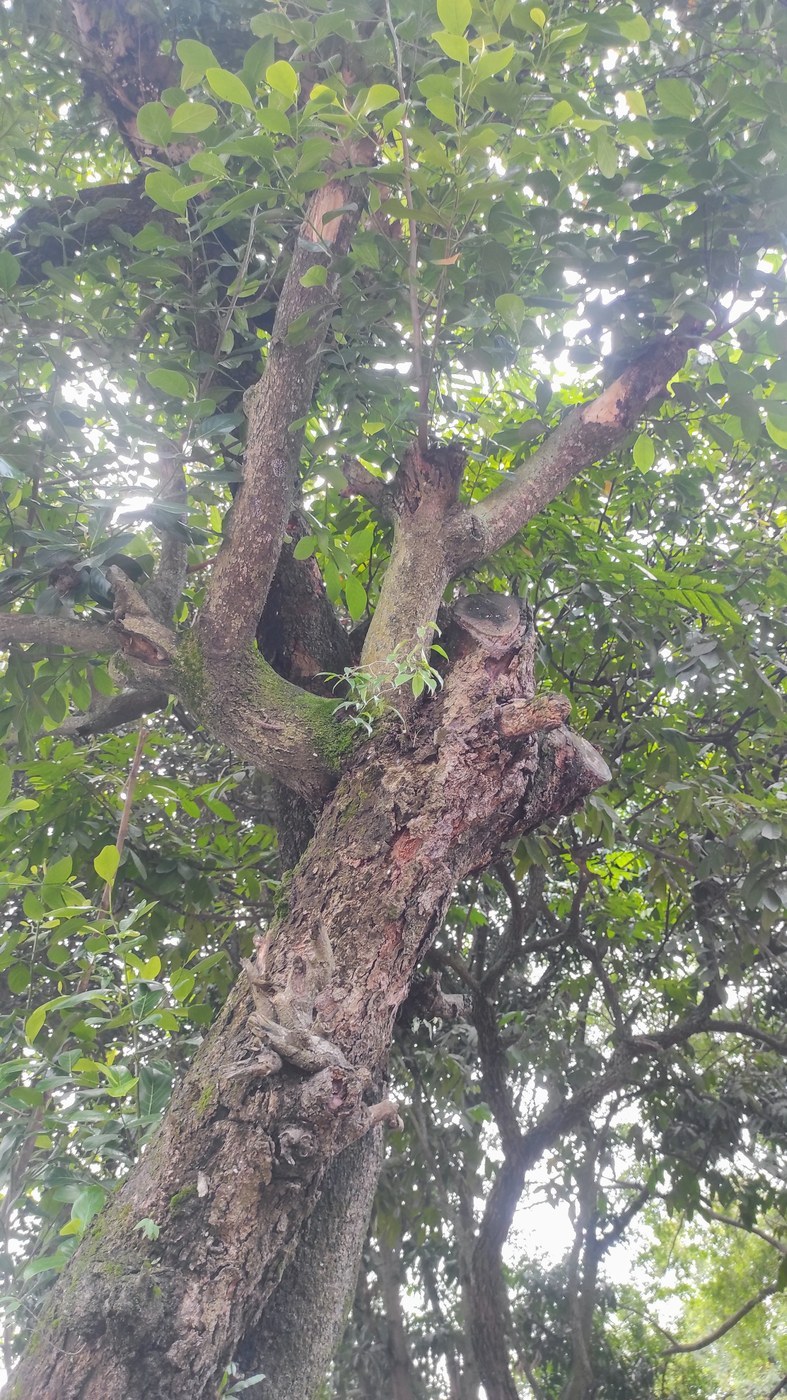
Key Identifying Features
Jackfruit (Artocarpus heterophyllus) is a large evergreen tropical tree, 30-70 ft tall, famous for producing the largest tree-borne fruit in the world. It is unmistakable thanks to its huge, green, spiny-knobbed fruit growing straight from the trunk and main branches (cauliflory), its glossy leathery leaves, and the sticky white latex that oozes from any cut surface.
- Enormous fruit (up to 80+ lb) with bumpy, spiny rind
- Fruit borne directly on the trunk and large limbs
- Milky white sticky sap in all parts
- Glossy, leathery, dark-green oval leaves
Leaves & Stems
Leaves are alternate, simple, thick and leathery, oval to elliptic, 4-8 in. long, dark glossy green above and paler beneath, with smooth (entire) margins on mature trees — though young trees and saplings may show lobed leaves (reflected in the name heterophyllus, "variable leaves"). The trunk is straight with rough, dark grayish-brown bark, and all parts exude copious milky latex when cut, a key confirming feature. The dense canopy casts heavy shade.
Flowers & Fruit
Flowers are tiny and densely packed on club-shaped greenish fleshy spikes that emerge on the trunk and branches; male and female spikes are separate on the same tree. The fruit is the ultimate ID clue: a massive oblong compound fruit, 1-3 ft long and up to 35+ kg, with a green-to-yellowish rind covered in short, hard, hexagonal spiny knobs, attached by a thick stalk to the trunk or main branches. Inside are sweet yellow fleshy bulbs around large seeds, with a strong aroma when ripe.
How to Tell It Apart from Look-Alikes
- Breadfruit (Artocarpus altilis): Relative with deeply lobed leaves and rounder, smaller fruit on branch tips, not the trunk; jackfruit fruit is far larger and trunk-borne.
- Durian: Has long sharp pyramidal spines and hangs from branches; jackfruit knobs are short, blunt, and the fruit grows on the trunk.
- Soursop (Annona): Smaller heart-shaped spiny fruit on branches, with non-glossy leaves and no milky latex.
- Cempedak: Very close relative; smaller, more cylindrical fruit and hairier twigs.
The trunk-borne giant spiny fruit plus milky sap is diagnostic.
Where You'll Find It
Jackfruit is native to South and Southeast Asia (the Western Ghats of India) and is grown across the humid tropics — India, Bangladesh, Sri Lanka, Southeast Asia, East Africa, Brazil, and tropical America. It grows in home gardens, village groves, and orchards in hot, humid, frost-free lowlands with deep, well-drained soil.
Quick ID Checklist
- Large evergreen tree, 30-70 ft, dense canopy
- Glossy leathery oval leaves (lobed on young plants)
- Milky white latex from any cut
- Giant green spiny-knobbed fruit on the trunk and limbs
- Tiny flowers on club-shaped trunk spikes
- Hot, humid tropical lowland setting
Frequently asked questions
Why does jackfruit grow on the trunk?
Jackfruit exhibits cauliflory, producing its flowers and enormous fruit directly on the trunk and main branches, which helps support the massive weight and makes it easy to identify.
How do I tell jackfruit from durian?
Durian has long, sharp pyramidal spines and hangs from branches, while jackfruit has short, blunt knobby spines and grows attached to the trunk.
What is the milky sap?
All parts of the jackfruit tree exude sticky white latex when cut, a reliable confirming feature shared with its relatives breadfruit and figs.
Why do young trees have differently shaped leaves?
The species name heterophyllus means 'variable leaves' — juvenile trees often have lobed leaves, while mature trees have smooth-edged oval leaves.
Jackfruit Tree identified by the community
Recent Jackfruit Tree specimens identified with Plant Identifier.