
Lobelia Identification Guide
Recognize lobelia by its small two-lipped flowers with a fan-shaped lower lip, in trailing annuals and tall perennial spikes.
Read the full Lobelia encyclopedia entry →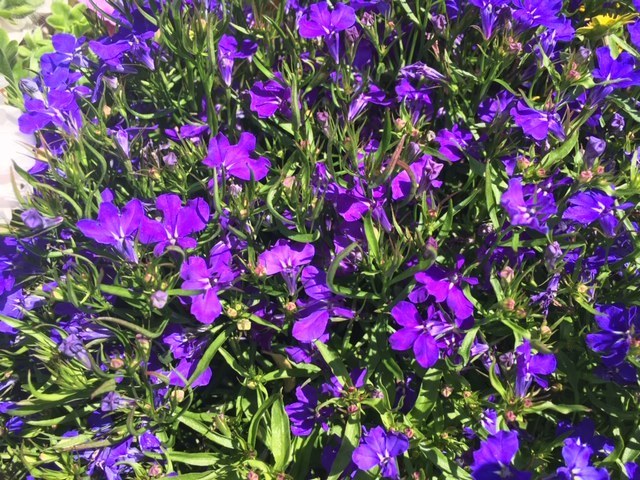
Key Identifying Features
Lobelia is identified by its distinctive two-lipped flowers: a small upper lip of two narrow lobes and a broad, fan-like lower lip of three lobes, often with a white or yellow throat. The genus splits into two common forms — low, mounding or trailing annual lobelia (Lobelia erinus) and tall, spiky perennial lobelia like cardinal flower (L. cardinalis).
- Asymmetric two-lipped flowers (2 lobes up, 3 lobes down)
- A pale or contrasting eye/throat at the flower center
- Either low trailing mats or upright flower spikes
- Milky sap in stems when broken
Leaves & Stems
Annual lobelia has small, narrow to oval leaves with a few teeth, on thin, much-branched stems that trail or mound. Perennial species are taller and stiffer: cardinal flower bears lance-shaped, alternate, finely toothed leaves up a single unbranched stem. Stems often exude a milky latex when cut — a useful confirming trait. Many lobelias have a slightly sticky or hairy feel.
Flowers & Fruit
Flowers are the defining feature. Each has a tubular base splitting into the two-lipped face. In L. erinus the blooms are typically intense blue, violet, or white with a white/yellow eye, smothering the plant. In cardinal flower they are brilliant scarlet on a long terminal spike; great blue lobelia (L. siphilitica) bears deep blue spikes. The fruit is a small two-chambered capsule holding many tiny seeds.
How to Tell It Apart from Look-Alikes
- Bacopa / Sutera: Similar trailing habit in baskets but has flat, five-equal-lobed flowers, not two-lipped.
- Salvia (red): Cardinal flower can be confused with red salvia, but salvia leaves are aromatic and opposite, while lobelia leaves are alternate and the flower has the classic fan lower lip.
- Penstemon: Also tubular and two-lipped, but penstemon flowers are larger, paired, and lack lobelia's milky sap.
The 2-up/3-down lip pattern plus milky sap reliably confirms lobelia.
Where You'll Find It
Annual lobelia is a staple of hanging baskets, containers, and edging in cool-summer gardens. Perennial species favor wet ground — cardinal flower grows along streambanks, ditches, and marsh edges in eastern North America, attracting hummingbirds. Most lobelias prefer moist, fertile soil and sun to part shade.
Quick ID Checklist
- Flowers two-lipped: 2 lobes up, 3 fan-shaped lobes down
- Contrasting white or yellow throat
- Either trailing blue/white mats or tall scarlet/blue spikes
- Milky sap in broken stems
- Small two-chambered seed capsules
- Wet soil habitat for perennial types
Frequently asked questions
What's the easiest way to recognize a lobelia flower?
Look for the two-lipped shape: two small lobes pointing up and three larger lobes fanning down, usually with a pale eye in the center. This asymmetric face is consistent across trailing and upright lobelias.
Is the trailing blue lobelia related to the tall red cardinal flower?
Yes, both are in the genus Lobelia and share the same two-lipped flower structure and milky sap, even though one trails and the other forms tall spikes.
Does lobelia really have milky sap?
Yes. Breaking a stem releases a milky latex, which helps distinguish lobelia from look-alikes like bacopa or penstemon.
Why is my lobelia growing in a wet ditch?
That's likely a native perennial species such as cardinal flower or great blue lobelia, which naturally grow in moist soil along streams, marshes, and ditches, unlike the basket-grown annual types.