Loropetalum Identification Guide
How to recognize Loropetalum (Chinese fringe flower) by its strappy, spider-like blooms, often-burgundy foliage, and layered, arching habit.
Read the full Loropetalum encyclopedia entry →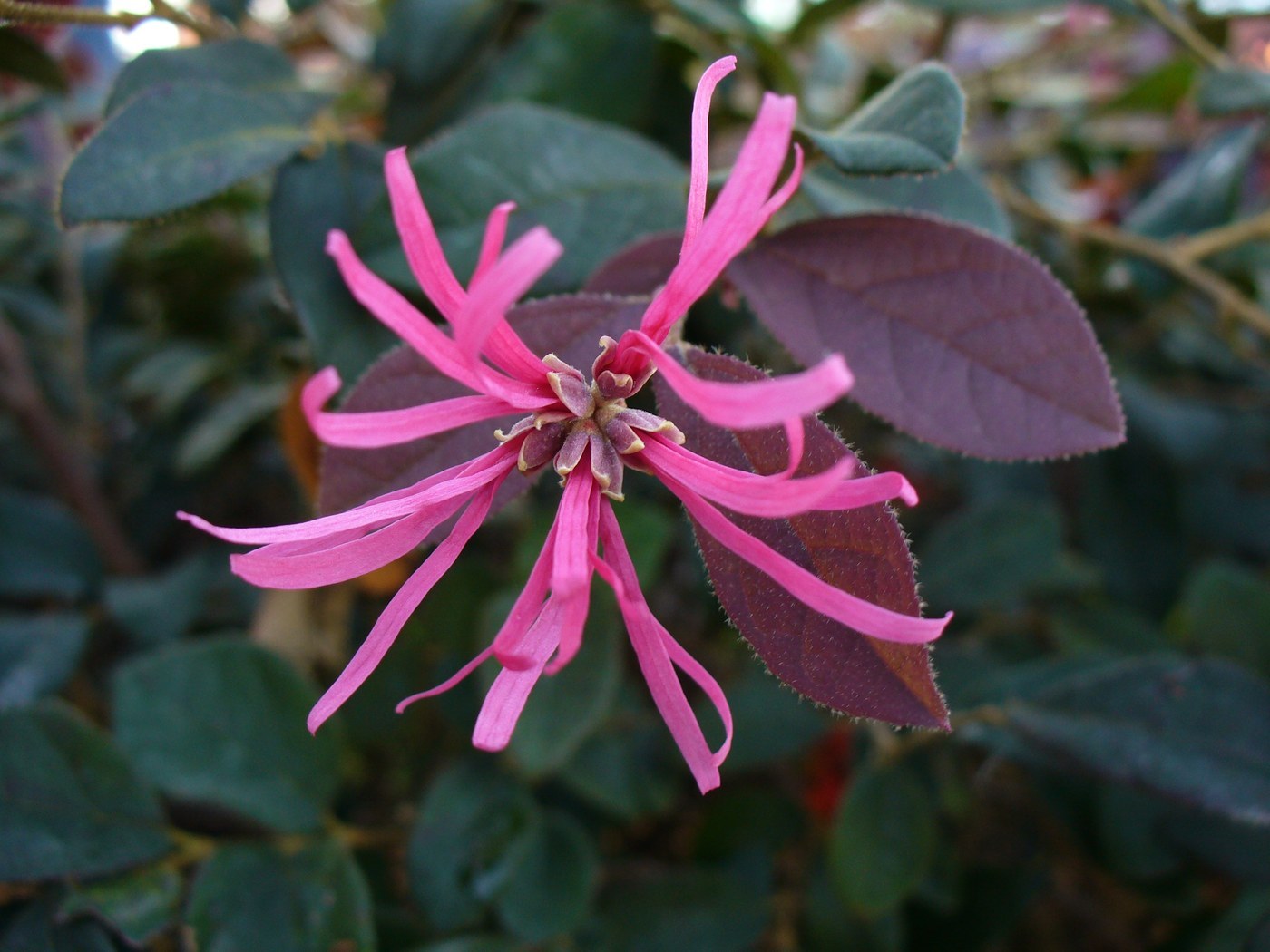
Key Identifying Features
Loropetalum chinense, commonly called Chinese fringe flower, is an evergreen shrub in the witch hazel family (Hamamelidaceae). Its most distinctive trait is the cluster of strap-shaped, ribbon-like petals that look like tangled spider legs or fringe. Combined with horizontally tiered, arching branches and (in many cultivars) deep burgundy to purple foliage, it is hard to confuse once flowering.
- Evergreen, multi-stemmed shrub, typically 4–10 ft tall and wide; some forms reach 15 ft
- Spidery flowers with 4 narrow, twisted petals roughly 1 in long
- Flower color ranges from white/cream (green-leaf forms) to hot pink, magenta, or red (purple-leaf forms)
- Layered, slightly weeping branch structure
Leaves & Stems
Leaves are alternate, simple, ovate with smooth (entire) margins and a pointed tip, generally 1–2.5 in long. The surface has a slightly rough, sandpapery texture and prominent veins. Green-leaf types are dark olive green; the popular ornamental forms ('Ruby', 'Plum', 'Purple Diamond', 'Sizzling Pink') hold maroon, plum, or near-black foliage that often deepens in cooler weather and on new growth. Young stems are slender and finely hairy.
Flowers & Fruit
Flowers appear in dense clusters at the branch tips and along stems, with a heavy main flush in late winter to spring and sporadic reblooming through the warm season. Each bloom has four crinkled, ribbon-like petals. The effect is a frothy haze of color over the shrub. Fruit is a small woody two-lobed capsule, but the plant is grown almost entirely for foliage and flowers, not fruit.
How to Tell It Apart from Look-Alikes
- Witch hazel (Hamamelis): Also has fringe-like petals, but witch hazel is deciduous with larger, scalloped leaves and yellow/orange winter flowers — never the purple evergreen foliage of Loropetalum.
- Fothergilla: Bottlebrush-like white flowers, not strappy spider petals, and is deciduous.
- Purple-leaf barberry or smokebush: Similar dark foliage but lack the spidery fringe flowers; barberry has spines, which Loropetalum never has.
The combination of evergreen leaves + spider-leg petals + (often) burgundy color is diagnostic.
Where You'll Find It
A staple of warm-temperate and subtropical landscapes (roughly USDA zones 7–10), used as foundation plantings, hedges, screens, and specimen shrubs across the southeastern U.S., California, and similar climates. Native to China, Japan, and the Himalayas. It thrives in sun to part shade and acidic, well-drained soil.
Quick ID Checklist
- Evergreen shrub with arching, tiered branches
- Spidery, strap-petaled flowers in pink, red, or white
- Alternate, oval, smooth-edged leaves, often burgundy/plum
- Slightly rough leaf texture, finely hairy young stems
- No spines or thorns
- Heaviest bloom late winter to spring
Frequently asked questions
Why are my Loropetalum's leaves purple?
Many cultivars are bred for burgundy or plum foliage that intensifies in cool weather and on new growth. Green-leaf forms exist too, so leaf color depends on the variety.
What do the flowers look like?
Each flower has four narrow, crinkled, ribbon-like petals that resemble tangled spider legs or fringe, clustered along the stems and branch tips.
Is Loropetalum the same as witch hazel?
They are relatives in the same family with similar fringe-like petals, but Loropetalum is evergreen with smooth oval leaves and pink/white flowers, while witch hazel is deciduous with scalloped leaves and yellow winter blooms.
When does Loropetalum bloom?
The main flush is late winter into spring, with scattered reblooming during warm months.
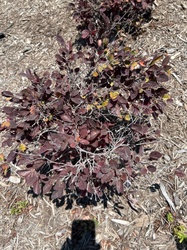
Loropetalum identified by the community
Recent Loropetalum specimens identified with Plant Identifier.