
Mayapple Identification Guide
Identify Mayapple by its umbrella-like lobed leaves carpeting spring woodlands and its single hidden white flower borne only on two-leaf stems.
Read the full Mayapple encyclopedia entry →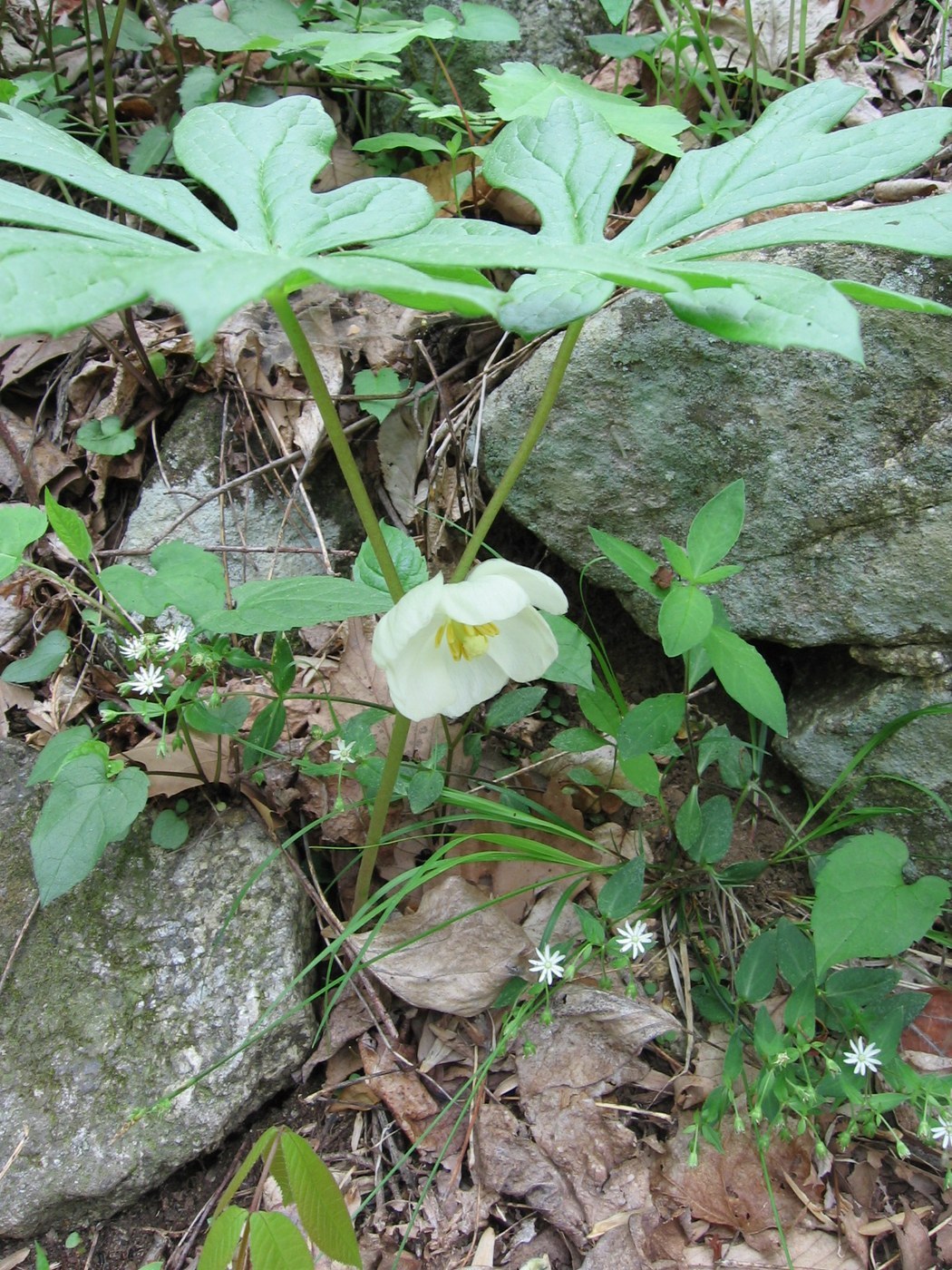
Key Identifying Features
Mayapple (Podophyllum peltatum) is a colony-forming woodland perennial of eastern North America, famous for the green "umbrellas" that blanket spring forest floors. Key marks:
- Large, deeply lobed, umbrella-like leaves held horizontally on a central stalk
- Plants 12-18 inches tall, forming broad colonies from spreading rhizomes
- Single-leaf shoots (no flower) versus two-leaf shoots (one flower hidden beneath)
- A solitary white flower in the fork of two-leaf plants
Leaves & Stems
The leaf is the signature: palmately lobed (5-9 deep lobes), 6-12 inches across, attached in the center like a parasol (peltate), so the stalk meets the leaf at its middle. Young leaves emerge folded down like a closed umbrella and open as they rise. Two distinct shoot types help ID and reproduction:
- Non-flowering shoots bear a single umbrella leaf on one stalk
- Flowering shoots bear two leaves with the flower in the V where the leaf stalks split
Flowers & Fruit
The flower is a single, nodding, waxy white bloom about 2 inches wide, with 6-9 petals and many yellow stamens. It hides beneath the leaves at the stalk fork, so you must lift a leaf to see it. Bloom time is spring (April-May). By summer it forms a single fleshy green-to-yellow fruit (the "apple"), roughly egg-sized.
How to Tell It Apart from Look-Alikes
- Umbrellaleaf (Diphylleia cymosa): also umbrella-like but leaves are two-lobed/cleft and toothed, with a cluster of flowers, found in southern Appalachian seeps.
- Bloodroot, hepatica, other spring ephemerals: lack the centrally attached parasol leaf.
- Wild ginger or trilliums: very different leaf shapes and flower positions.
The centrally attached, deeply lobed umbrella leaf in spreading woodland colonies is essentially unmistakable.
Where You'll Find It
Mayapple carpets rich, moist deciduous woods, shaded floodplains, woodland edges, and damp meadows across the eastern and central U.S. and adjacent Canada. It spreads by rhizomes into large clonal patches, so where you find one, you usually find many.
Quick ID Checklist
- Umbrella-like leaf attached at its center, deeply lobed
- Single-leaf plants have no flower; two-leaf plants have one
- Solitary white 6-9 petaled flower hidden under the leaves
- Colonies carpeting moist woodland floors
- Single fleshy fruit in summer
- Spring bloom
Frequently asked questions
Why do some Mayapple plants have flowers and others don't?
Only shoots with two leaves produce a flower, borne in the fork between the leaf stalks. Single-leaf shoots are immature or non-flowering, so a patch is a mix of both.
Why is the flower so hard to see?
The single white flower nods downward and is hidden beneath the large umbrella leaves, so you usually have to lift a leaf to find it during the spring bloom.
Why does Mayapple grow in large patches?
It spreads by underground rhizomes, forming extensive clonal colonies where many shoots are genetically connected, which is why it often carpets whole sections of forest floor.