
Medallion Calathea Identification Guide
How to identify the Medallion Calathea (Goeppertia / Calathea roseopicta 'Medallion') by its rounded leaves with feathered green patterning and deep purple undersides.
Read the full Medallion Calathea encyclopedia entry →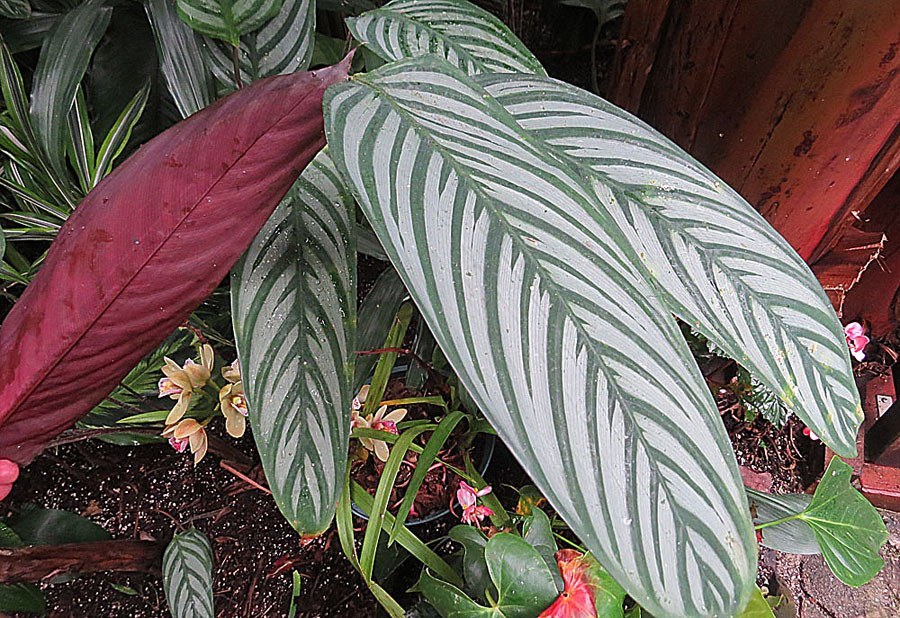
Key Identifying Features
The Medallion Calathea (Goeppertia roseopicta 'Medallion') is identified by its broad, rounded leaves marked with a feathered, brushstroke-like ring of light green over darker green, often with a pale center, and deep burgundy-purple undersides.
- Rounded, almost circular leaves like a medallion
- Feathered light-green band ringing a darker center
- Purple-maroon undersides
- Prayer-plant leaf movement (folds up at night)
Leaves & Stems
Leaves are broadly oval to nearly round, 6-10 inches, with a glossy upper surface showing concentric, painterly markings: a dark green field overlaid with a lighter green to silvery feathered halo, sometimes flushed pink in new growth, and a contrasting paler central zone. The pattern looks hand-painted.
The undersides are rich purple-red, displayed when leaves lift at night. Leaves rise on upright petioles in a clumping rosette. As a Marantaceae member, it shows nyctinasty, raising and lowering leaves daily, often with an audible rustle as they shift.
Flowers & Fruit
Flowering is rare and unremarkable indoors; the plant is grown solely for its dramatic foliage. Any blooms are small and low among the leaves.
How to Tell It Apart from Look-Alikes
- Pinstripe Calathea (G. ornata): Elongated leaves with thin pink/white pinstripes; Medallion has rounder leaves with a broad feathered halo, not fine lines.
- Calathea 'Dottie' / 'Rosy': Same species (roseopicta) but darker near-black with pink rings; Medallion is green-on-green with a silvery feather.
- Maranta (prayer plant): Lower, trailing, with red veins; Medallion is upright with rounded patterned leaves.
- Stromanthe: Cream-and-pink variegation rather than the green feathered medallion pattern.
Where You'll Find It
A popular statement houseplant for bright indirect light and high humidity. Native to South America. Prone to crispy brown edges from dry air, hard water, or direct sun, so it is often grown in humid spots or with filtered water.
Quick ID Checklist
- Rounded, medallion-shaped leaves
- Feathered light-green halo over a darker field
- Purple undersides
- Glossy upper surface, pale central zone
- Leaves fold up at night; clumping habit
If the leaves are round with a painterly feathered green pattern and purple backs that fold up at night, you have a Medallion Calathea.
Frequently asked questions
Why is it called a Medallion Calathea?
Its broad, rounded leaves bear a feathered, ringed pattern that resembles a decorative medallion, with a lighter green halo painted over a darker green field.
How do I tell it from a Pinstripe Calathea?
Medallion leaves are rounder with a broad feathered green halo and a pale center, while Pinstripe leaves are more elongated with thin pink-to-white line-stripes.
What makes the leaves move and rustle?
It is a prayer plant (family Marantaceae) and shows nyctinasty, raising and folding its leaves each evening and lowering them by day. The shifting leaves can rustle audibly.
Why do the leaf edges turn brown?
Medallion Calathea is sensitive to dry air, hard or fluoridated water, and direct sun, all of which cause crispy brown edges. High humidity and filtered water help prevent it.