Monstera Albo Identification Guide
Identify Monstera Albo (variegated Monstera deliciosa 'Albo Variegata') by its irregular pure-white leaf variegation and unstable, sectoral patterning.
Read the full Monstera Albo encyclopedia entry →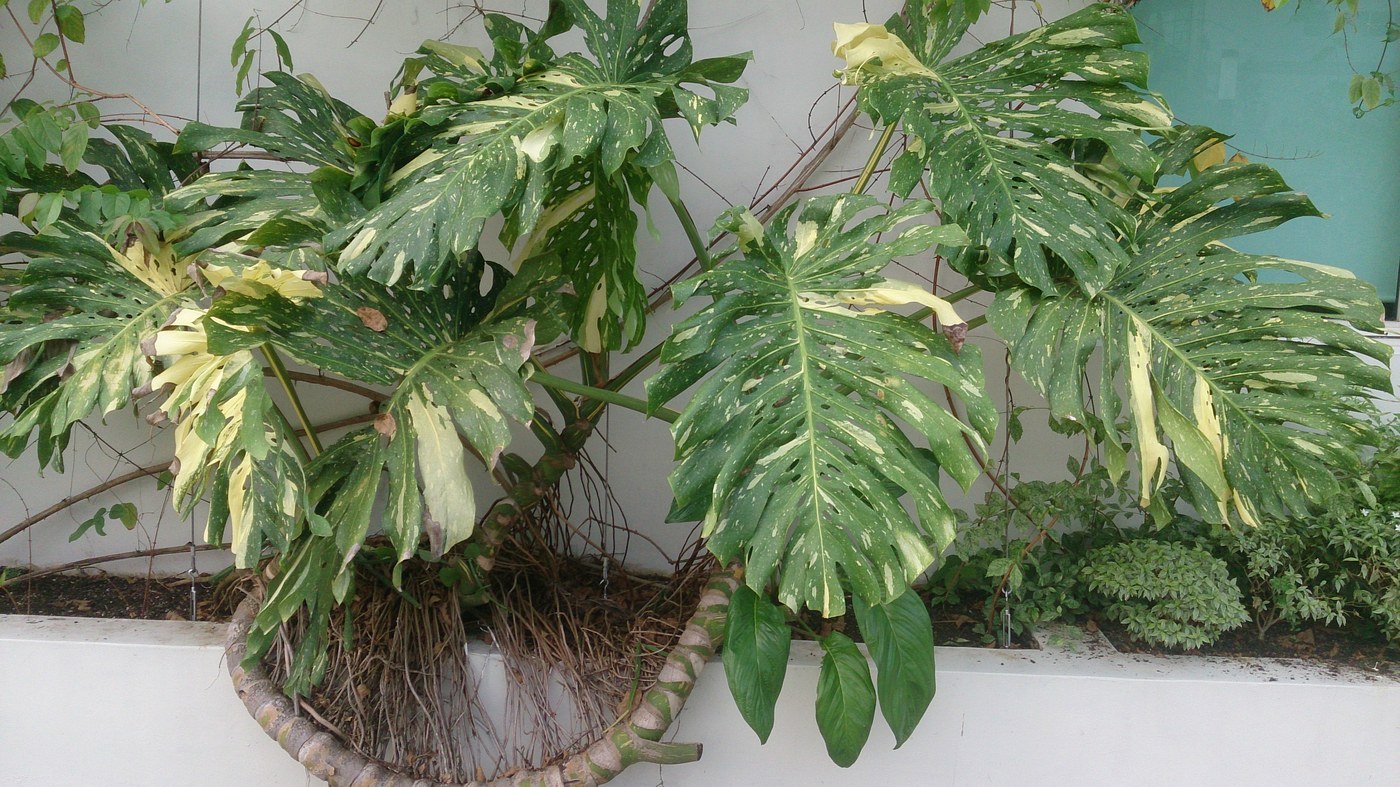
Key Identifying Features
Monstera Albo is the prized variegated form of Monstera deliciosa ('Albo Variegata'). It shares the species' fenestrated leaves but is identified by its variegation:
- Crisp, pure-white (not cream/yellow) variegation in irregular blocks, splashes, and half-moons
- Unstable, sectoral patterning that differs leaf to leaf, often whole sectors of the plant white or green
- The standard Monstera deliciosa leaf shape with splits and holes
- Thick climbing stems with aerial roots
The sharp white-on-green marbling with no fixed pattern is the signature trait.
Leaves & Stems
Leaves have the classic deliciosa form — heart-shaped, glossy, developing marginal splits and oval holes with age — but each is overlaid with bright white variegation. The white is chunky and blocky, often appearing as large sectors, sometimes a full half-moon (half white, half green) or a fully white leaf. Because the variegation is chimeric and sectoral, the stem itself shows green and white striping, and the pattern is inherited along whichever side of the stem is variegated. Pure-white leaf areas lack chlorophyll and can brown or burn.
Flowers & Fruit
As a deliciosa cultivar it can produce the same aroid inflorescence — a white spathe and pale spadix — but flowering is rare indoors and variegated plants are grown for foliage, not fruit. Any fruit and all plant parts contain irritating calcium oxalate.
How to Tell It Apart from Look-Alikes
- Monstera 'Thai Constellation' has creamy-yellow speckled/dappled variegation that is stable and evenly flecked, not blocky white sectors, and is tissue-cultured (more uniform, no fully white leaves).
- Monstera 'Aurea/Marmorata' shows yellow-gold marbling rather than pure white.
- Monstera adansonii variegata has smaller, thinner, holes-only leaves.
- Painted/sprayed fakes show variegation that rubs off — real variegation runs through the leaf tissue.
If variegation is pure white, blocky, irregular, and unstable on a deliciosa leaf, it's Albo; if it's creamy, speckled, and uniform, it's Thai Constellation.
Where You'll Find It
It does not occur in the wild as a stable population; it's a collector houseplant propagated by cuttings (each node carries the chimera). Grown in bright indirect light worldwide, it commands premium prices because variegation cannot be guaranteed from seed.
Quick ID Checklist
- Standard Monstera deliciosa leaf with splits and holes
- Pure-white (not cream) variegation
- Blocky, irregular, sectoral pattern — half-moons or full white leaves
- Green-and-white striped stem
- Variegation runs through tissue (doesn't rub off)
- Sold as cuttings, not seed
Match these and you have a Monstera Albo. Give variegated leaves bright light but avoid direct sun on the white sections, which scorch easily.
Frequently asked questions
How is Monstera Albo different from Thai Constellation?
Albo has pure-white, blocky, irregular and unstable variegation (including half-moon and full-white leaves), while Thai Constellation has creamy-yellow speckled variegation that is stable and evenly flecked.
Why is the variegation so unpredictable?
Albo is a chimeric mutation, so white and green tissue is distributed in sectors. Each leaf and stem section can differ, and propagation only carries the pattern present at that node.
Can a fully white leaf survive?
Not for long on its own — white tissue lacks chlorophyll and cannot photosynthesize, so plants need enough green tissue to sustain growth, and all-white leaves eventually decline.
How can I spot a fake Albo?
Genuine variegation runs through the leaf and along the striped stem; painted or sprayed fakes have color that rubs off and a uniform, unnatural look.
Why is it so expensive?
Because the chimeric variegation can't be reliably produced from seed and only spreads through cuttings, making well-variegated plants slow to propagate and scarce.
Monstera Albo identified by the community
Recent Monstera Albo specimens identified with Plant Identifier.