
Monstera Esqueleto Identification Guide
Identify Monstera esqueleto (Monstera epipremnoides) by its large leaves riddled with huge fenestrations that reach nearly to the leaf edge.
Read the full Monstera Esqueleto encyclopedia entry →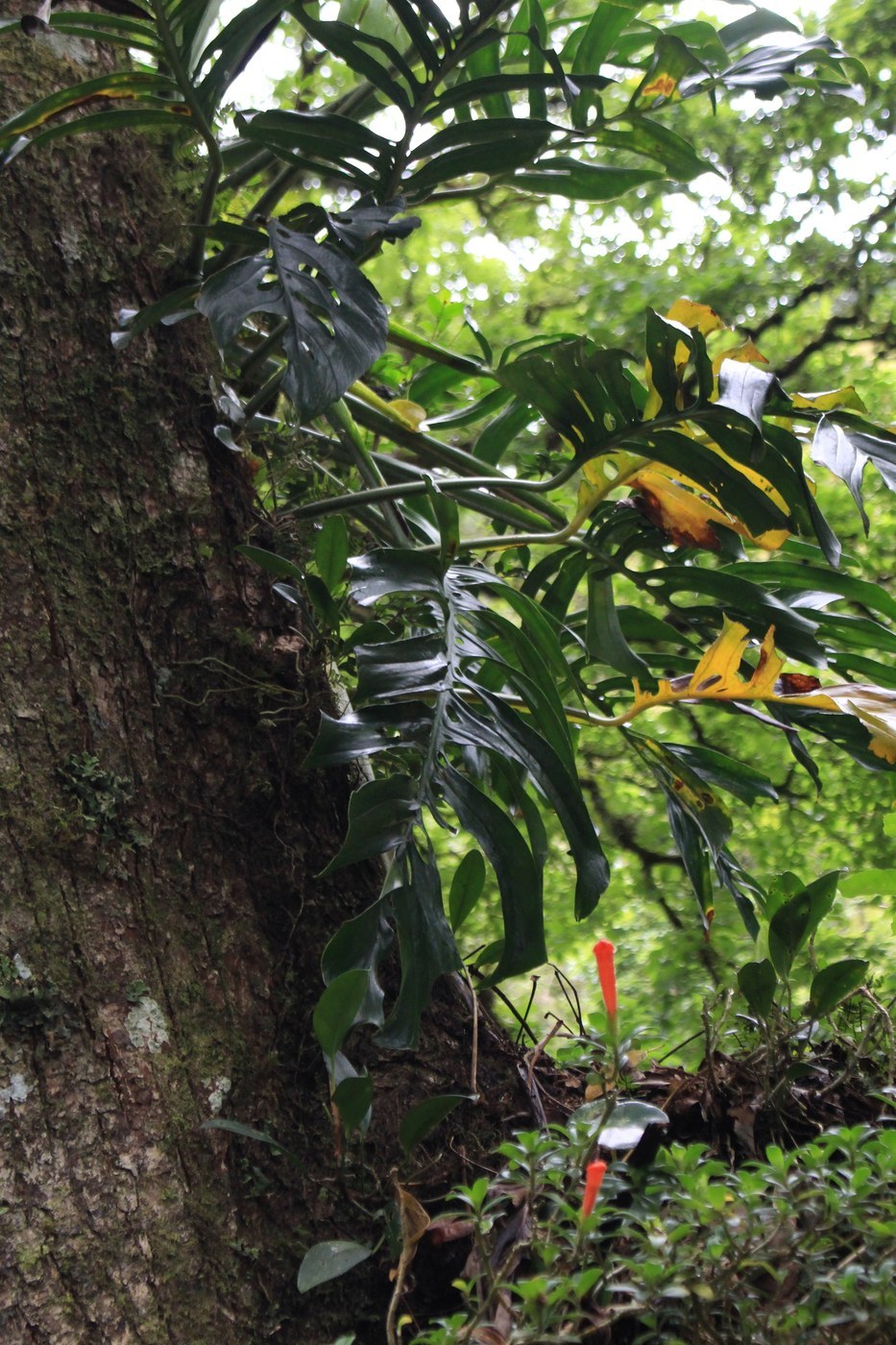
Key Identifying Features
Monstera esqueleto (correctly Monstera epipremnoides) is a large climbing aroid whose Spanish name means 'skeleton'. Identify it by:
- Large leaves with dramatic, oversized fenestrations (holes)
- Holes that extend nearly to the leaf margin, leaving only thin strips of tissue
- Thin, papery leaf texture with a slight gloss
- Climbing vine producing larger, more perforated leaves as it matures
Leaves & Stems
The diagnostic feature is the extreme fenestration: mature leaves develop multiple large oval-to-elongated holes per side that reach so close to the edge the leaf looks skeletal. Leaves are broadly heart-shaped to elongated, mid-to-light green, and notably thinner and more delicate than the leathery leaves of Monstera deliciosa. The plant is a vigorous climber with long internodes and aerial roots; leaf size and hole count increase with climbing height and maturity. Petioles are long and relatively smooth.
Flowers & Fruit
Like other Monstera, mature plants can produce a cream-white spathe and a spadix, followed by a cone-like fruit, though flowering is uncommon indoors. The plant is grown for foliage.
How to Tell It Apart from Look-Alikes
- Monstera deliciosa: leaves are thick and leathery with fenestrations plus deep marginal splits (lobes); esqueleto holes reach the edge but leaves are thinner and lack the heavy leathery feel.
- Monstera adansonii: similar 'holey' look but leaves are much smaller and holes do not reach as close to the margin; adansonii leaves are more elongated and stay modest in size.
- Rhaphidophora tetrasperma: small, split (not just holed) leaves on a thin vine.
The combination of very large, thin leaves with holes nearly touching the edge distinguishes esqueleto.
Where You'll Find It
Native to the cloud forests of Costa Rica and Panama, it climbs tree trunks as a hemiepiphyte. Indoors it is a sought-after collector climber needing a sturdy moss pole, bright indirect light, warmth, and good humidity to size up. You will find it in specialty shops and collections, often confused at the nursery with large-form adansonii.
Quick ID Checklist
- Large leaves with many big holes
- Holes reach almost to the leaf edge
- Thin, papery leaf texture (not leathery)
- No deep marginal splits like deliciosa
- Climbing vine with aerial roots
- Bigger, holier leaves with maturity
Frequently asked questions
Is Monstera esqueleto the same as Monstera epipremnoides?
Yes. Esqueleto is the popular trade name; the accepted botanical name is Monstera epipremnoides.
How is esqueleto different from Monstera adansonii?
Esqueleto leaves grow much larger, thinner, and have holes that reach nearly to the edge, while adansonii stays small with holes set further from the margin.
Why does it look like a skeleton?
The fenestrations are so large and reach so close to the leaf edge that only thin ribs of green remain, giving a skeletal, lattice-like appearance.
Do young plants show the big holes?
Not fully. Juvenile leaves have fewer, smaller holes; the dramatic fenestration develops as the plant climbs and matures.