
Morning Glory Identification Guide
Recognize morning glory by its twining stems, heart-shaped leaves, and funnel-shaped flowers that open in the morning and fade by afternoon.
Read the full Morning Glory encyclopedia entry →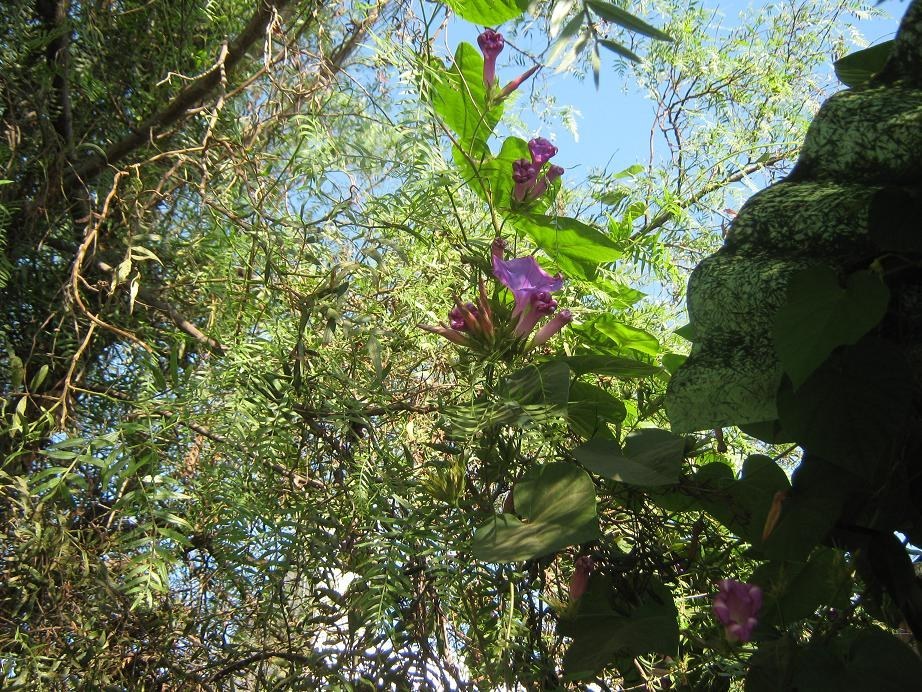
Key Identifying Features
Morning glory (chiefly Ipomoea species) is a fast-growing twining vine in the bindweed family (Convolvulaceae). The classic signs are broad funnel- or trumpet-shaped flowers that open in the morning and close or fade by afternoon, heart-shaped leaves, and whole-stem twining that lets the vine spiral up almost any support.
- Trumpet/funnel flowers, often blue, purple, pink, or white with a paler star pattern inside
- Flowers open in early morning and wilt by midday or afternoon
- Heart-shaped (sometimes lobed) alternate leaves
- Slender stems that twine around supports
Leaves & Stems
Leaves are alternate and typically heart-shaped (cordate), with a pointed tip and smooth margins, though some species have three-lobed or deeply divided leaves. They are usually 2-5 inches long and medium green, attached by long stalks. Stems are thin, green to reddish, and twine in a spiral around poles, strings, and other plants, climbing several feet in a season. Broken stems of some species exude a slight milky sap.
Flowers & Fruit
The funnel-shaped flower is the standout feature. Each bloom flares from a narrow tube into a wide, shallow, five-sided trumpet 2-4 inches across, the petals fused so the rim looks nearly circular with five faint points. A five-pointed star or pinwheel pattern is often visible in the throat. Colors include sky blue, deep purple, magenta, pink, and white, sometimes with white throats. Flowers are short-lived, opening at dawn and closing or fading the same day. Fruit is a small round capsule containing a few hard, wedge-shaped black or brown seeds.
How to Tell It Apart from Look-Alikes
- Field bindweed (Convolvulus arvensis): a related weed with smaller (under 1 inch) white-to-pink flowers and arrowhead-shaped leaves; morning glory flowers are much larger.
- Moonflower (Ipomoea alba): very similar but with large white flowers that open at night instead of morning.
- Clematis: climbs by leaf stalks and has opposite leaves and sepal flowers, not fused trumpet petals.
- Sweet potato vine: same genus, but grown for foliage; flowers are similar funnels.
The combination of large morning-opening funnel flowers, heart-shaped alternate leaves, and twining stems is diagnostic.
Where You'll Find It
Morning glories are native to the Americas and now grow worldwide. You will see them on fences, trellises, mailboxes, and arbors in gardens, and scrambling over hedges, fields, and roadside thickets where they have naturalized. They thrive in full sun and warm weather and can self-seed aggressively.
Quick ID Checklist
- Large funnel/trumpet flowers, 2-4 inches, often with a star throat pattern
- Flowers open in the morning and fade by afternoon
- Heart-shaped alternate leaves
- Stems twine spirally up supports
- Small round seed capsules with hard dark seeds
Frequently asked questions
Why do morning glory flowers close during the day?
The blooms are very short-lived; they open at dawn to attract early pollinators and close or wilt as the day heats up, with fresh flowers opening the next morning.
How is morning glory different from bindweed?
They are related, but bindweed has small flowers under an inch and arrowhead leaves and is a creeping perennial weed, while morning glory has large 2-4 inch trumpet flowers and heart-shaped leaves.
What is the star pattern inside the flower?
It is a natural five-pointed pinwheel marking in the flower's throat formed where the fused petals meet, and it is a helpful ID feature.