
Noble Fir Identification Guide
Identify Noble Fir (Abies procera) by its blue-green upswept needles, large erect cones with protruding bracts, and high-elevation Cascade habitat.
Read the full Noble Fir encyclopedia entry →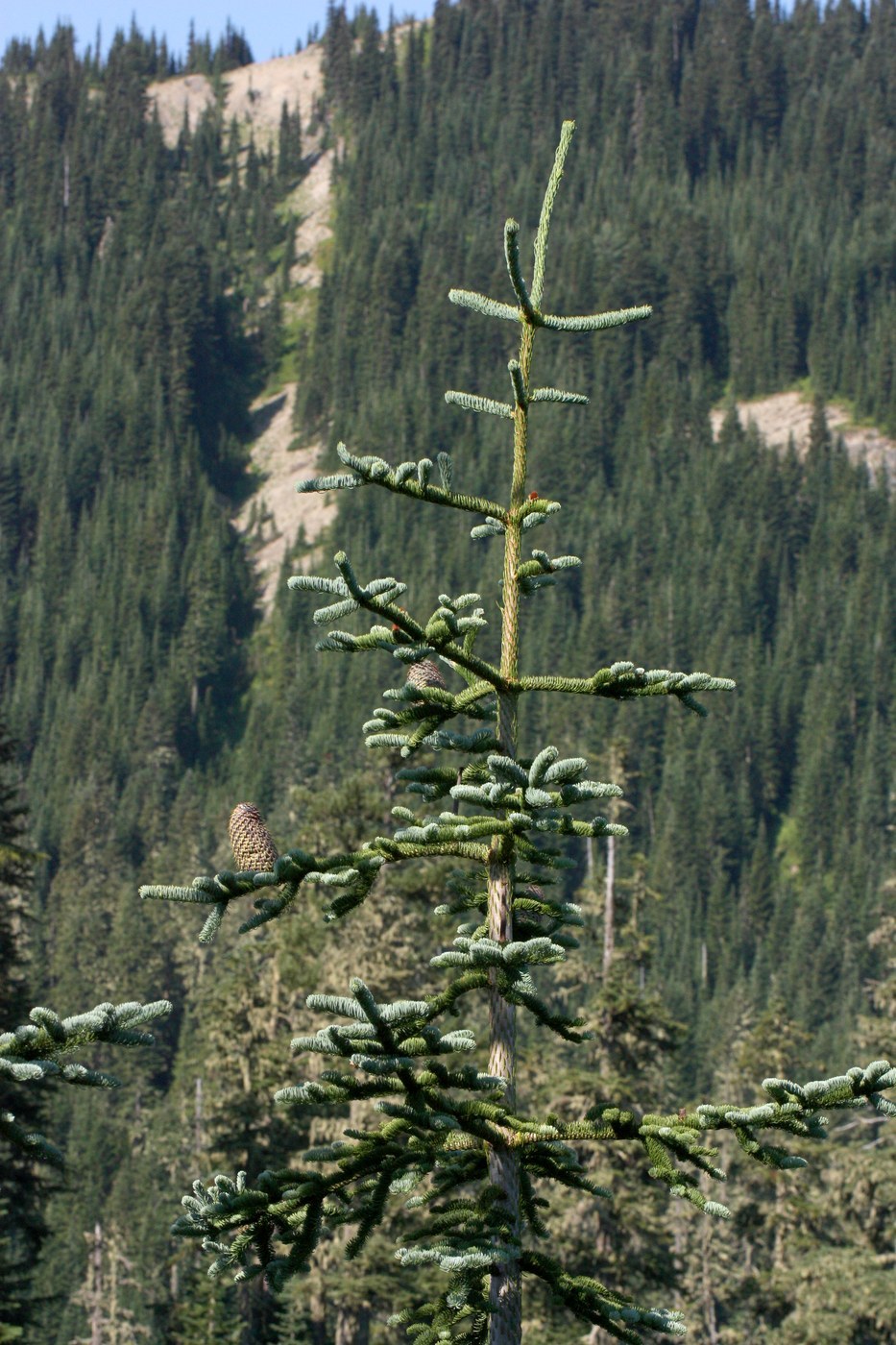
Key Identifying Features
Noble Fir (Abies procera) is a tall, stately true fir of the Pacific Northwest mountains, prized as a premium Christmas tree. Recognize it by its blue-green to silvery needles that curve upward and lie densely along the upper side of the twig, and by large upright cones with conspicuous papery bracts.
- Symmetrical, narrow conical crown on a straight trunk
- Stiff, four-sided blue-green needles that twist and sweep upward
- Smooth gray bark with resin blisters when young, becoming furrowed and reddish-brown with age
- Strong, well-spaced horizontal branches
Leaves & Stems
Needles are about 1-1.5 inches long, distinctly blue-green to silvery, and four-sided though flattened. A signature trait: needles emerging from the lower twig curve up and over the top, so most of the foliage appears crowded on the upper surface, leaving the twig's underside more exposed. Each needle has a grooved upper surface and a tiny hockey-stick bend near its base. Needles leave flat, round scars when pulled (a true-fir trait, no pegs). Twigs are reddish-brown and finely hairy.
Flowers & Fruit
Like all true firs, cones stand erect on the upper branches and disintegrate on the tree rather than falling whole. Noble Fir cones are large — 4-7 inches long — green to purplish, ripening brown. A diagnostic feature is the long, papery bracts that extend out and bend downward over the cone scales, partly hiding them and giving the cone a shingled, shaggy look.
How to Tell It Apart from Look-Alikes
- Pacific Silver Fir (Abies amabilis): needles greener and notched at the tip, cones lack the protruding reflexed bracts.
- Grand Fir: flat, glossy green needles in two flat rows; not blue and upswept.
- Subalpine Fir: narrower spire crown, gray-green needles, smaller cones without exposed bracts.
- Spruces: sharp needles on woody pegs and hanging cones — firs have upright cones and soft round scars.
Blue upswept needles plus a large upright cone with downturned papery bracts confirm Noble Fir.
Where You'll Find It
Native to the Cascade and Coast Ranges of Washington, Oregon, and far northern California, typically at mid to high elevations (2,500-7,000 ft) in cool, moist mountain forests. Widely grown in plantations for Christmas trees and greenery.
Quick ID Checklist
- Blue-green to silvery four-sided needles
- Needles curve upward, crowding the top of the twig
- Flat round needle scars (no pegs)
- Large upright cones with downturned papery bracts
- Pacific Northwest mountains
Blue, upswept fir foliage with big shingled upright cones in the Cascades means Noble Fir.
Frequently asked questions
How do I tell Noble Fir from other Christmas tree firs?
Noble Fir has distinctly blue-green needles that sweep upward and crowd the top of the twig, plus very stiff branches. Grand Fir, by contrast, has flat green needles in two flat rows.
Why are the cones standing upright?
All true firs (Abies) bear erect cones on the upper branches that break apart on the tree to release seeds, rather than dropping intact like pine or spruce cones.
What are the papery flaps on the cones?
Those are bracts that extend beyond the cone scales and bend downward, giving Noble Fir cones a shaggy, shingled appearance. This is a reliable identifying feature.
Where does Noble Fir grow naturally?
It is native to the Cascade and Coast Ranges of the Pacific Northwest, growing at mid to high mountain elevations in cool, moist forests.