
Peanut Cactus Identification Guide
Identify the Peanut Cactus (Echinopsis chamaecereus) by its low, sprawling clusters of finger-like, peanut-shaped stems and large orange-red flowers.
Read the full Peanut Cactus encyclopedia entry →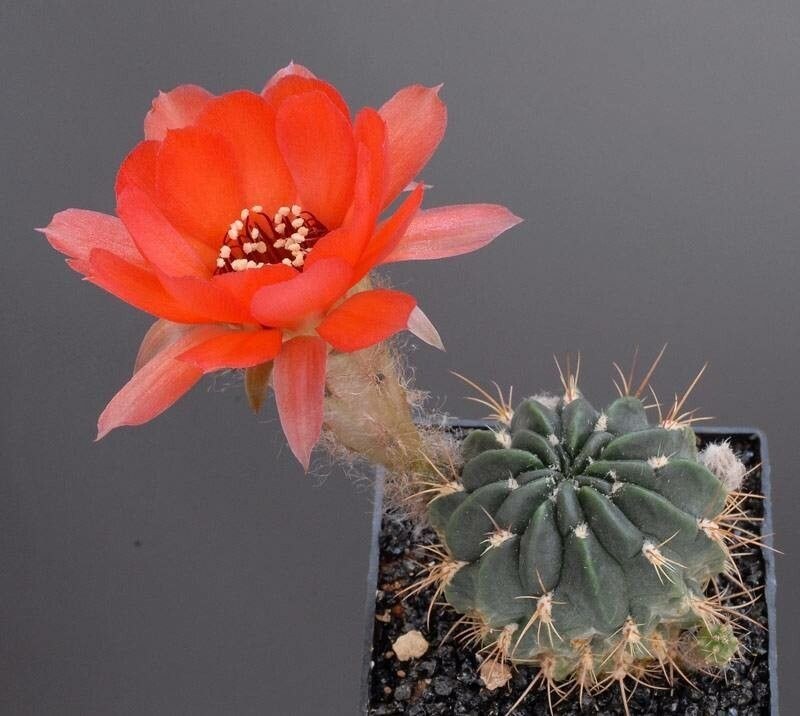
Key Identifying Features
The Peanut Cactus (Echinopsis chamaecereus, formerly Chamaecereus silvestrii) is a small, mat-forming cactus made of many short, finger-thick stems that resemble fuzzy peanuts laid end to end. It spreads horizontally rather than growing tall, forming sprawling clumps just a few inches high but spreading a foot or more wide.
- Clusters of short, cylindrical, finger-like stems, each 2–6 inches long and about ½ inch thick
- Light to bright green stems with multiple low ribs
- Soft, white, bristly spines lying close to the stem (not sharp)
- Large, vivid orange-red, funnel-shaped flowers that dwarf the stems
Leaves & Stems
Leafless like all cacti. The trailing or prostrate stems branch freely and snap off easily at the joints — a natural propagation method. Each stem has roughly 8–10 shallow ribs lined with areoles bearing short, soft white spines, giving a fuzzy peanut-shell texture. The whole plant offsets prolifically, building dense low mats.
Flowers & Fruit
The flowers are the showpiece: large (up to 2–3 inches), brilliant scarlet to orange-red, funnel-shaped blooms that open in spring along the stem sides. They are big relative to the small stems and are reliably produced on mature plants given a cool, dry winter rest. Fruit is a small dry berry.
How to Tell It Apart from Look-Alikes
- Rat Tail Cactus (Aporocactus): Has much longer, truly trailing rope-like stems and pink/magenta flowers; Peanut Cactus stems are short, stubby, and finger-like.
- Other Echinopsis: Most form solitary globes or columns; Peanut Cactus is distinctly clustering and low with soft spines.
- Mammillaria: Have tubercles (bumps) rather than ribs and usually a ring of small flowers, not single large orange blooms.
Where You'll Find It
Native to the mountains of Argentina, it is now a popular, easy houseplant and rockery cactus worldwide. Grow in bright light to full sun, gritty well-drained soil, with a cool, dry winter to encourage flowering. Hardy roughly to USDA zones 9–11; elsewhere kept as a potted plant.
Quick ID Checklist
- Low, sprawling clumps of short, finger-like green stems
- Stems look like fuzzy peanut shells, soft white spines
- Easily detached joints; freely offsetting
- Large orange-red funnel flowers in spring
- Ribbed stems (not tubercled)
Frequently asked questions
Why won't my Peanut Cactus flower?
It needs a cool, dry winter rest (around 40–50°F with little water) and plenty of light. Without that dormancy, the big orange-red blooms often fail to set.
Are the spines dangerous?
No. The white spines are short, soft, and bristly rather than sharp, so the plant is easy and safe to handle compared with most cacti.
Why do the stems keep falling off?
The finger-like joints detach very easily — this is normal and is the plant's way of propagating. Each fallen stem can root and form a new plant.
Is it the same as Rat Tail Cactus?
No. Rat Tail Cactus has long, rope-like trailing stems and pink flowers, while Peanut Cactus has short, stubby finger stems and orange-red blooms.