Pear Tree Identification Guide
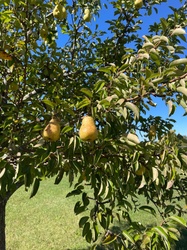
Identify the pear tree (Pyrus species) by its glossy rounded leaves on long stalks, white five-petaled blossoms with dark anthers, scaly blocky bark, and classic pear-shaped fruit.
Read the full Pear Tree encyclopedia entry →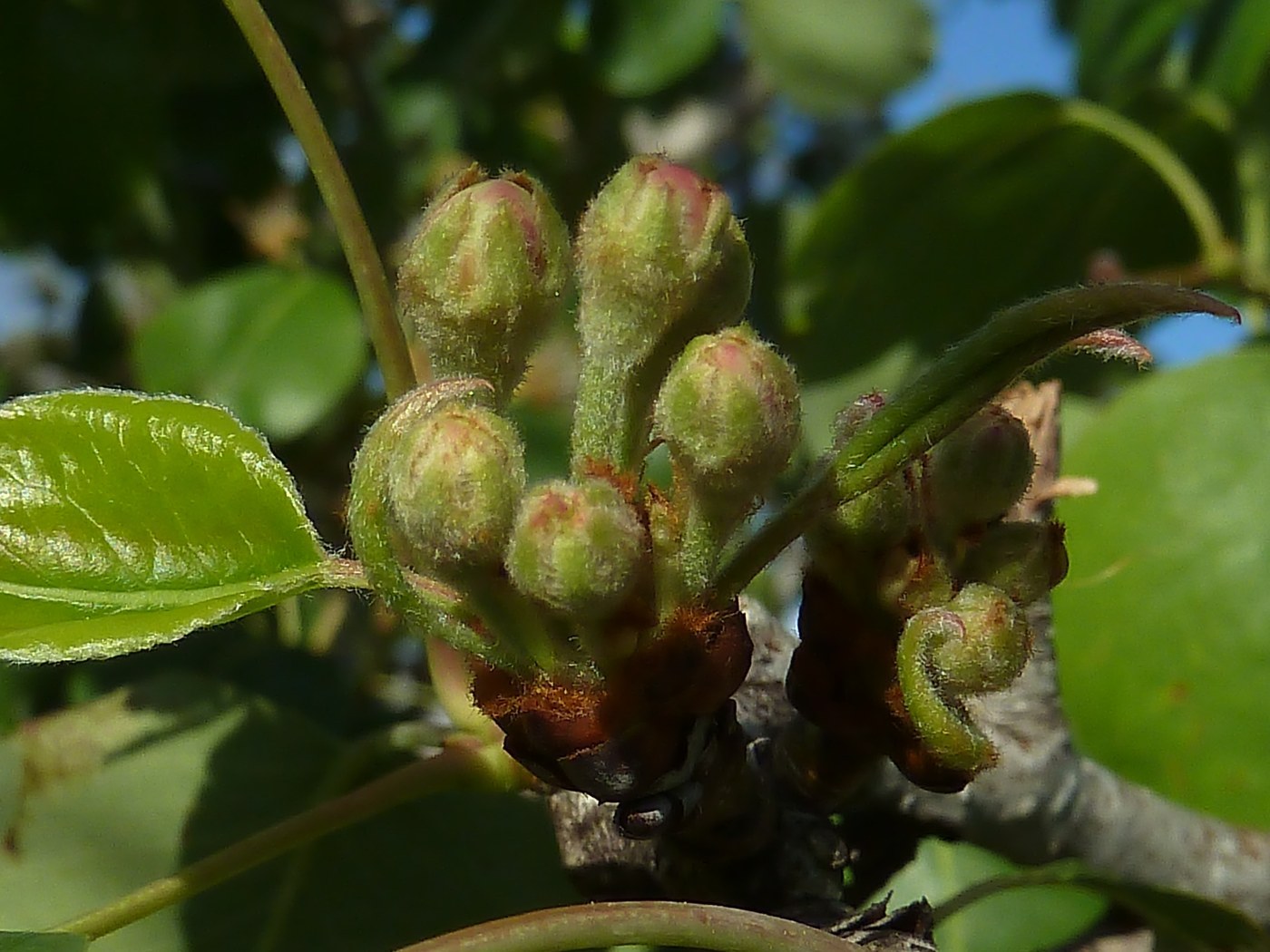
Key Identifying Features
The pear tree (Pyrus communis and relatives) is a deciduous tree, often upright and pyramidal when young, reaching 5-15 m. Identify it by its glossy, rounded-to-oval leaves on notably long stalks that flutter in the breeze, clusters of white five-petaled blossoms with distinctive dark pink-to-black anthers, bark that breaks into small square scaly blocks, and the familiar pear-shaped fruit (pome). Cut fruit reveals gritty stone cells in the flesh, a pear hallmark.
Leaves & Stems
- Leaves are simple, alternate, oval to nearly round, 4-8 cm, glossy dark green above.
- Margins are finely toothed or nearly smooth; tips often short-pointed.
- Petioles (leaf stalks) are long and slender, so leaves tremble in wind — a useful clue.
- Autumn color is often yellow to red.
- Bark on mature trees is grayish-brown, breaking into small rectangular scaly plates; some species/branches bear short spur-like thorns.
Flowers & Fruit
- Flowers open in spring, usually just before or with the leaves, in flat-topped clusters (corymbs).
- Each is white, 2-3 cm, five-petaled, with prominent reddish to dark purple/black anthers — a strong distinguishing detail from apple (which has pink-tinged petals and yellow anthers).
- Flowers have a slightly musty rather than sweet scent.
- Fruit is the classic pear shape (narrow at the stalk, swollen at the base), green/yellow/brown, with gritty flesh and a core of small seeds.
How to Tell It Apart from Look-Alikes
- Apple tree (Malus): Leaves more dull and downy beneath, flower buds pink, anthers yellow, fruit round with a dimpled base. Pear blossoms are pure white with dark anthers and the fruit is pear-shaped with gritty cells.
- Cherry/plum (Prunus): Single-stone fruit and glossy lenticel bark, not a seedy pome.
- Callery/ornamental pear (Pyrus calleryana): Profuse white blossom and glossy leaves but tiny hard fruit and a strong flower odor.
The long-stalked glossy leaves + white flowers with dark anthers + pear-shaped gritty pome confirms the identification.
Where You'll Find It
Pears grow in orchards, gardens, and old hedgerows across temperate regions, preferring full sun and deep, well-drained soil. Ornamental Callery pears are widely planted along streets. The trees are easiest to identify in spring blossom and late summer/autumn when fruit hangs.
Quick ID Checklist
- Glossy, rounded leaves on long fluttering stalks
- Bark in small square scaly blocks
- White five-petaled flowers with dark pink-to-black anthers
- Flat-topped spring flower clusters
- Pear-shaped fruit with gritty flesh and seedy core
- Upright/pyramidal young form, deciduous
Frequently asked questions
How do I tell a pear tree from an apple tree in blossom?
Pear flowers are pure white with dark pink-to-black anthers and a slightly musty smell, while apple flowers usually have pink-tinged petals and yellow anthers. Pear leaves are also glossier with longer, fluttering stalks.
Why do pear leaves flutter so much in the wind?
Pear leaves sit on long, slender petioles, which lets the rounded blades tremble in even a light breeze. This long-stalked glossy foliage is a handy identification clue.
What causes the gritty texture in pear fruit?
Pears contain stone cells (sclereids) clustered in the flesh, giving the characteristic slightly gritty bite. This is a feature of Pyrus fruit and helps distinguish a true pear from other pomes.
Is an ornamental Callery pear the same as a fruiting pear?
They are the same genus (Pyrus) and have similar white blossoms and glossy leaves, but Callery pear produces only tiny hard fruits and has a notably strong flower odor, whereas common pear bears the large pear-shaped fruit.
Pear Tree identified by the community
Recent Pear Tree specimens identified with Plant Identifier.