
Pencil Cactus Identification Guide
Identify the Pencil Cactus (Euphorbia tirucalli) by its leafless, pencil-thin green branching stems and milky sap. Covers key marks and how it differs from true cacti.
Read the full Pencil Cactus encyclopedia entry →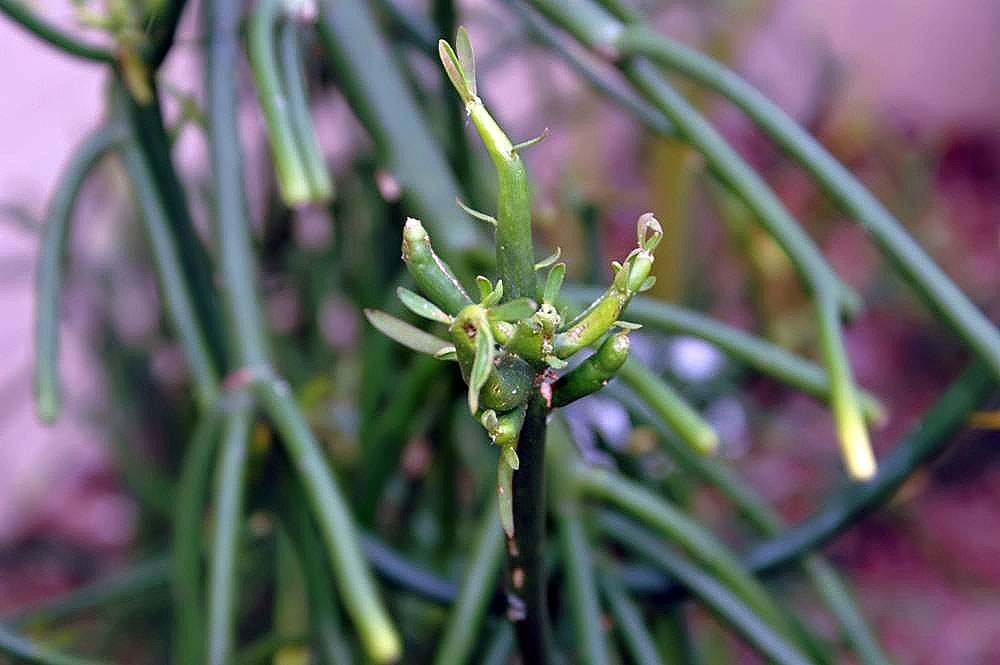
Key Identifying Features
Despite its name, the Pencil Cactus (Euphorbia tirucalli) is not a true cactus but a succulent spurge. It is recognized by its mass of smooth, cylindrical, pencil-thick green stems that branch repeatedly, giving a coral- or shrub-like silhouette with essentially no visible leaves.
- Thin (pencil-diameter) round green stems that branch in clusters
- No spines and almost no leaves
- Copious milky white sap when cut
- A tree or shrub habit, sometimes called "Firestick" when stems turn red-orange
Leaves & Stems
The photosynthetic work is done by the green stems rather than leaves. Tiny, narrow leaves appear briefly on new growth and quickly drop, so the plant usually looks entirely leafless. Stems are smooth, succulent, and about pencil-width (1/4-1/2 inch), repeatedly forking into dense clusters. In bright light or cool stress, cultivars like 'Sticks on Fire' flush orange, coral, and red at the tips. Outdoors it can become a small tree to 15-30 feet; indoors it stays a manageable shrub.
Flowers & Fruit
Flowers are insignificant: tiny yellow cyathia clustered at branch tips, easy to overlook. Most indoor plants rarely bloom. Fruit is a small lobed capsule. The plant is grown for its architectural stem form, not for flowers.
How to Tell It Apart from Look-Alikes
- True cacti have areoles and spines and clear sap; Pencil Cactus has neither spines nor areoles and bleeds milky latex.
- Other rod-stemmed euphorbias can look similar, but E. tirucalli stems are uniformly slim and pencil-like.
- Rhipsalis (mistletoe cactus) is also leafless and thin-stemmed but has soft, pendulous stems, clear sap, and lacks the stiff branching candelabra form.
The diagnostic combo: slim leafless green stems + no spines + milky sap.
Where You'll Find It
Native to Africa and India, it thrives in warm, arid climates (USDA zones 10-11) and is a common houseplant worldwide. Indoors it wants bright direct light; outdoors it is used in dry gardens and as living fencing. It is extremely drought tolerant.
Quick ID Checklist
- Dense clusters of pencil-thin, smooth green stems
- No spines, essentially no leaves
- Milky white sap that oozes when broken
- Branching, coral- or shrub-like form
- Possible orange/red tips in bright light (Firestick types)
Frequently asked questions
Is the Pencil Cactus actually a cactus?
No. It is a succulent member of the spurge family (Euphorbia tirucalli). True cacti have areoles and spines, which this plant lacks.
Why does it have no leaves?
It photosynthesizes through its green stems. Tiny leaves form on new growth but drop quickly, so the plant normally appears leafless.
Why did my plant turn red and orange?
Firestick cultivars develop red-orange stem tips in strong sunlight and cooler temperatures. It is a normal color response, not a disease.