
Pickerelweed Identification Guide
Identify Pickerelweed by its glossy heart-shaped leaves emerging from shallow water and its dense spike of violet-blue flowers, a common native of pond and marsh edges.
Read the full Pickerelweed encyclopedia entry →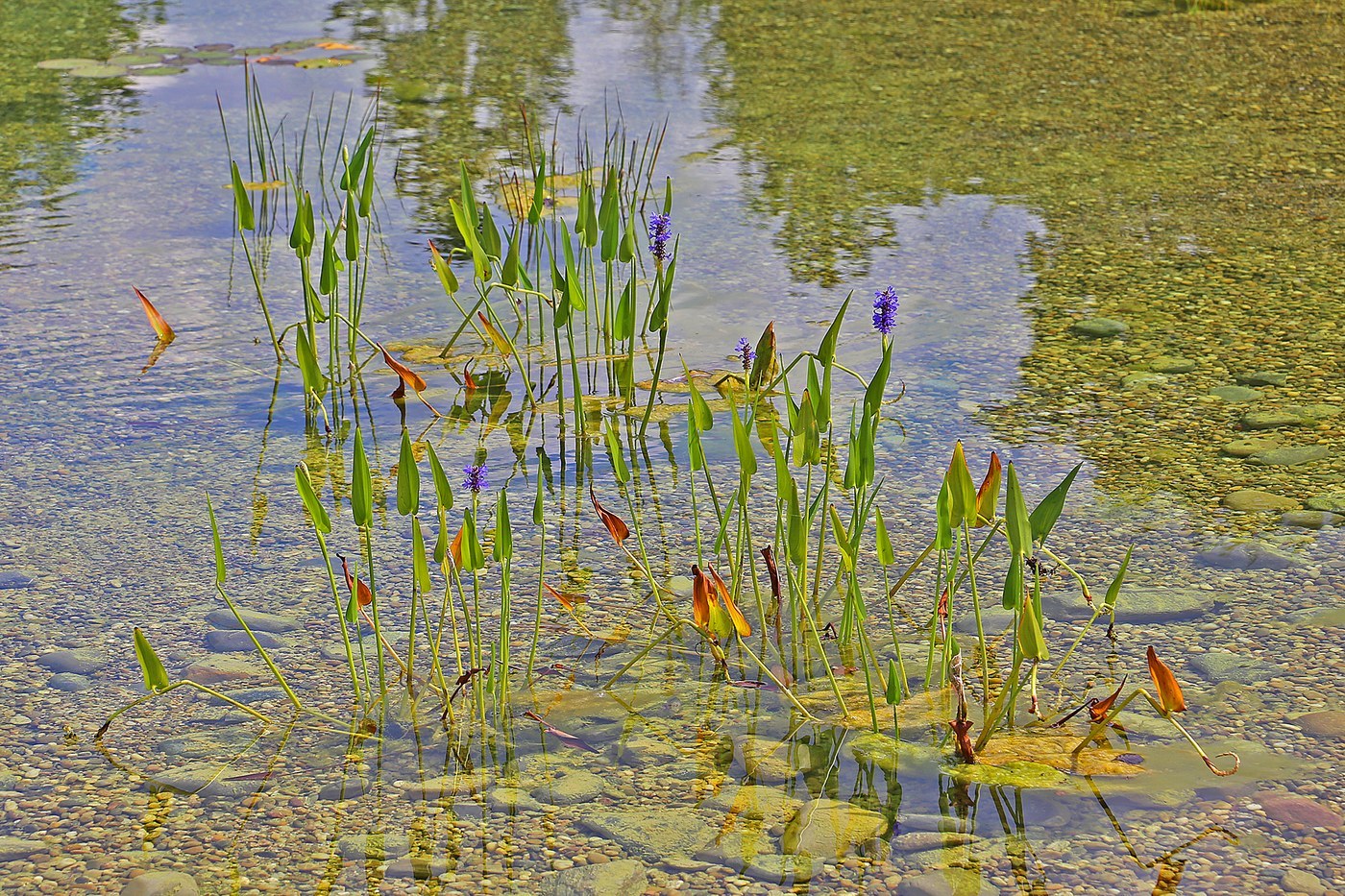
Key Identifying Features
Pickerelweed (Pontederia cordata) is a common native emergent aquatic plant of pond, lake, and marsh margins across eastern North America. Recognize it by:
- Glossy, heart-shaped (arrowhead-like) leaves standing above shallow water
- A dense, club-shaped spike of violet-blue flowers held above the foliage
- Plants growing directly out of shallow standing water or saturated mud
- Stands 1.5-3 feet tall above the waterline, often in large colonies
Leaves & Stems
The leaves are a key feature: thick, smooth, shiny, and heart- to lance-shaped with a rounded or notched base and parallel-curving veins, on long stalks that rise from underwater rhizomes. The species name cordata means "heart-shaped." Each flower stalk carries a single leaf partway up plus the terminal flower spike. The plant spreads by creeping rhizomes in the mud, forming dense beds that provide cover for fish (including the pickerel it is named for) and habitat for frogs and insects.
Flowers & Fruit
The flowers form a dense, erect spike (3-6 inches long) of many small violet-blue (occasionally white) tubular flowers, each with 6 lobes; the upper lobe usually bears two small yellow-green nectar-guide spots. Bloom time is long, summer into early fall (June-October), with new flowers opening over weeks. The flowers attract many bees and butterflies. The fruit is a small, ribbed seed (nutlet) borne along the spike.
How to Tell It Apart from Look-Alikes
- Arrowhead / Duck Potato (Sagittaria): has arrow-shaped leaves too but produces whorls of 3-petaled white flowers, not a blue spike.
- Water Hyacinth (Eichhornia): a floating invasive with swollen spongy leaf stalks and showier lavender flowers; Pickerelweed is rooted in mud with plain stalks.
- Cattails / bur-reed: strap-like leaves and brown/green flower structures, not heart-shaped leaves with blue spikes.
The heart-shaped glossy emergent leaf + dense violet-blue flower spike rising from shallow water is diagnostic.
Where You'll Find It
Pickerelweed grows in shallow water and muddy margins of ponds, lakes, slow streams, marshes, and ditches, in full sun to part shade, usually in water up to about a foot deep. It is widespread and native through the eastern U.S. and into Canada, often forming showy blue-flowered colonies along shorelines.
Quick ID Checklist
- Glossy, heart/arrow-shaped leaves emerging from shallow water
- Dense spike of violet-blue 6-lobed flowers
- Two yellow spots on the upper flower lobe
- Rooted in mud at pond/marsh edges, in colonies
- 1.5-3 ft tall above water
- Blooms summer into early fall
Frequently asked questions
How do I tell Pickerelweed from Arrowhead?
Both have arrow- or heart-shaped emergent leaves, but Pickerelweed produces a dense spike of violet-blue flowers, while Arrowhead (Sagittaria) produces whorls of three-petaled white flowers. The flower color and shape are the easiest way to separate them.
Why is it called Pickerelweed?
Its dense underwater stands provide cover for fish such as pickerel, and folklore associated the plant with waters where pickerel live, giving it the common name.
Is Pickerelweed invasive?
No, it is a beneficial native plant in eastern North America that supports pollinators and aquatic wildlife. It can form large colonies but is not the problematic invasive that floating water hyacinth is.
What habitat does Pickerelweed grow in?
Pickerelweed roots in mud at the margins of ponds, lakes, slow streams, marshes, and ditches, standing in shallow water usually up to about a foot deep in full sun to part shade.