
Potato Identification Guide
Identify the potato plant (Solanum tuberosum) by its compound leaves, white-to-purple star flowers, underground tubers, and small green berries. Covers how to distinguish it from tomato.
Read the full Potato encyclopedia entry →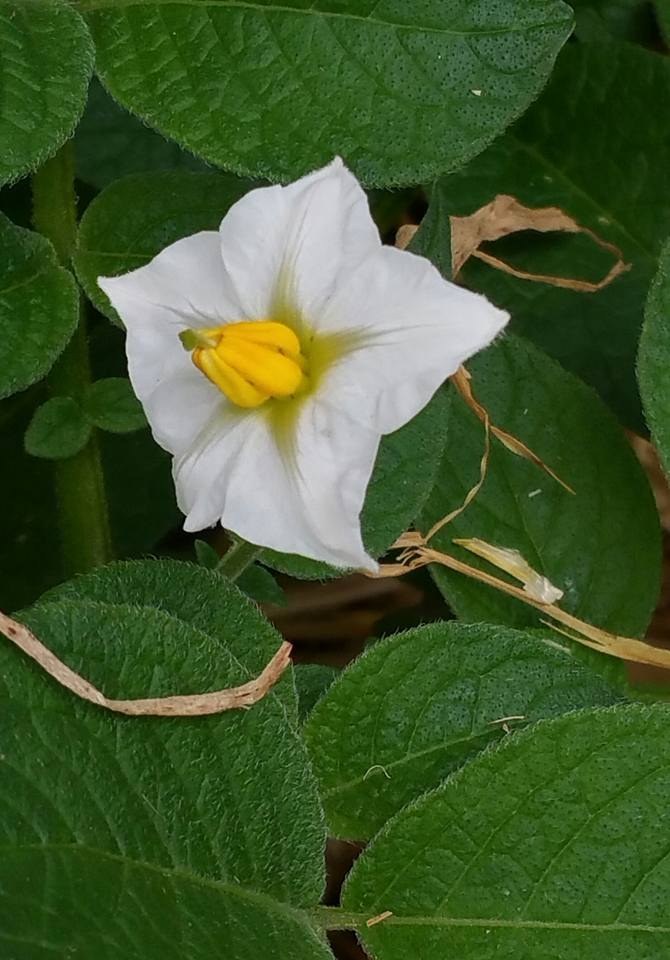
Key Identifying Features
The potato (Solanum tuberosum) is a nightshade (Solanaceae) grown for its starchy underground tubers. Identify it by:
- Pinnately compound leaves with broad, oval leaflets
- Star-shaped flowers, white to lavender or purple, with a yellow center cone
- A bushy, low-mounding habit on sprawling green stems
- Underground tubers (the potatoes) forming on stem offshoots, plus small green berries
Leaves & Stems
Leaves are alternate and pinnately compound, with a central stalk bearing several pairs of large oval leaflets and smaller leaflets between them. Leaflets are broad, smooth- to slightly wavy-edged, dull green, and softly hairy, with a faintly rough texture; brushing them gives a mild green, herbaceous (less pungent than tomato) smell. Stems are green to reddish, ribbed, somewhat hairy, and angular, forming a bushy clump 1-3 feet tall that can flop with age. Below ground, horizontal stems (stolons) swell at their tips into tubers the potatoes which bear 'eyes' (buds) and are stems, not roots.
Flowers & Fruit
Flowers appear in loose clusters atop the plant, each a five-pointed star in white, pink, lilac, or purple, with a prominent cone of bright yellow anthers at the center (very like a tomato flower). Pollinated flowers may form small round green to yellowish-green berries about the size of a cherry tomato; these resemble tiny tomatoes. Not all varieties set fruit reliably. The crop itself is the tuber underground.
How to Tell It Apart from Look-Alikes
- Tomato (Solanum lycopersicum): very similar foliage, but tomato has a strong pungent smell, more jagged/toothed leaflets, yellow flowers, and produces large red fruit above ground. Potato has milder leaves, white-to-purple flowers, small green berries, and forms tubers below ground.
- Black nightshade (Solanum nigrum): smaller, with white flowers and shiny black berries, and simple (not pinnate) leaves.
- Bittersweet nightshade (Solanum dulcamara): a vine with purple-and-yellow flowers and red berries.
The combination of compound leaves + white/purple star flowers + underground tubers with eyes confirms potato.
Where You'll Find It
Native to the Andes of South America, potatoes are grown globally in vegetable gardens, allotments, and farms as a cool-season crop. They're planted from seed potatoes (tuber pieces) in mounded rows or containers; foliage dies back as tubers mature. Look for hilled-up rows and 'volunteer' plants sprouting from leftover tubers.
Quick ID Checklist
- Pinnately compound leaves with broad oval leaflets
- Bushy mound on green/reddish ribbed stems
- Star flowers white to purple with a yellow anther cone
- Underground tubers on stolons, with eyes/buds
- Small green berries (not large red fruit)
- Milder smell than tomato; cool-season crop in hilled rows
Frequently asked questions
How do I tell a potato plant from a tomato plant?
Both are nightshades with compound leaves, but potato has milder-smelling, broader leaflets, white-to-purple flowers, and forms tubers underground with small green berries above. Tomato smells strongly pungent, has yellow flowers, and bears large red fruit above ground.
Is a potato a root?
No, it is a tuber, which is a swollen underground stem. The 'eyes' are buds that can sprout new shoots, confirming it is a stem rather than a root.
What do potato flowers look like?
They are five-pointed stars in white, pink, lilac, or purple, with a prominent cone of bright yellow anthers at the center, borne in loose clusters atop the plant and closely resembling tomato flowers.
Where do the potatoes themselves form on the plant?
Tubers form on the tips of horizontal underground stems called stolons. They bear small buds known as 'eyes,' which is how you can tell a potato is a modified stem rather than a root.