
Powder Puff Cactus Identification Guide
Recognize the Powder Puff Cactus (Mammillaria bocasana) by its silky white wool and hidden hooked spines on clustering globe-shaped stems.
Read the full Powder Puff Cactus encyclopedia entry →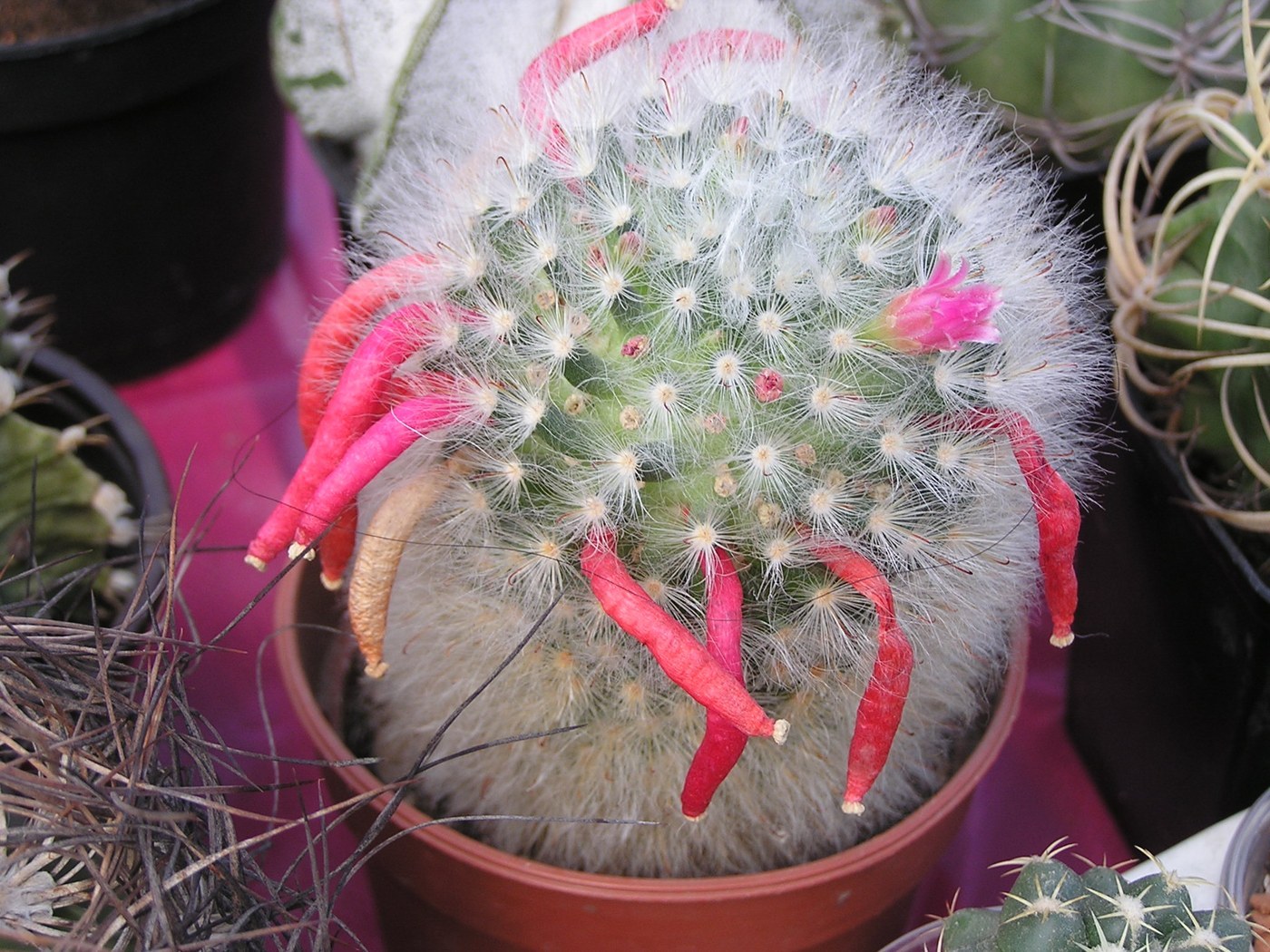
Key Identifying Features
Powder Puff Cactus (Mammillaria bocasana) looks like a cluster of soft white snowballs but conceals fishhook spines. Look for:
- Globular blue-green stems wrapped in silky white hairs.
- Clustering, mound-forming growth of many heads.
- Hooked central spines poking through the wool — the key feature.
Stems & Spines
Each stem is a rounded ball about 1.5-2.5 in (4-6 cm) across, blue-green to gray-green, arranged in tubercles rather than ribs. From each areole radiate 20-50 fine, white, hair-like radial spines that wrap the body in soft wool. Crucially, one or more central spines are stiff, amber-to-brown, and end in a sharp hook — these are easy to miss in the fluff but readily catch skin and clothing. The plant offsets freely, forming dense cushions up to 6-8 in (15-20 cm) wide.
Flowers & Fruit
It is a reliable bloomer, producing a ring of small funnel-shaped flowers near the crown, typically cream to pale yellow, sometimes pink-tinged, in spring to summer. Flowers are followed by long, slender bright pink-to-red fruits that push out from between the tubercles — a charming and diagnostic display.
How to Tell It Apart from Look-Alikes
- Mammillaria plumosa (Feather Cactus): soft feathery spines with no hooks; Powder Puff has hidden hooked centrals.
- Mammillaria gracilis (Thimble): white-spined but with firm bristly spines and stems that detach easily; less woolly.
- Mammillaria hahniana (Old Lady Cactus): woolly with white hair but bears a ring of magenta flowers and white bristles, larger single heads.
- Espostoa lanata: columnar and hairy, not a low cluster.
Where You'll Find It
Native to central Mexico, it is one of the most common beginner and windowsill cacti. Grown outdoors in USDA 9-11 and as a potted plant elsewhere, needing bright light, fast-draining mineral soil, and dry winters. Handle with care because of the hooked spines.
Quick ID Checklist
- Silky white wool over blue-green globular stems
- Clustering into cushions of many heads
- Hooked central spines hidden in the fluff
- Cream/yellow flowers then slender pink-red fruit
- Tubercles, not ribs
Frequently asked questions
Why does the Powder Puff Cactus prick me if it looks soft?
Beneath the soft white hairs are stiff central spines tipped with sharp hooks. They snag skin and clothing easily, so handle the plant carefully despite its fluffy appearance.
How is it different from the Feather Cactus?
Feather Cactus (M. plumosa) has truly soft, feathery, hookless spines. Powder Puff (M. bocasana) has hidden hooked central spines and a silkier, less feathery wool.
What are the long pink things growing out of it?
Those are its fruits. After the cream-yellow flowers fade, slender bright pink to red fruits emerge from between the tubercles, often months later.
Is it good for beginners?
Yes. It is hardy, free-flowering, and forgiving, needing only bright light, gritty soil, and dry winters. Just mind the hooked spines when handling.