
Red Currant Identification Guide
Learn to identify red currant (Ribes rubrum) by its thornless stems, lobed leaves, and signature long clusters of glossy translucent red berries.
Read the full Red Currant encyclopedia entry →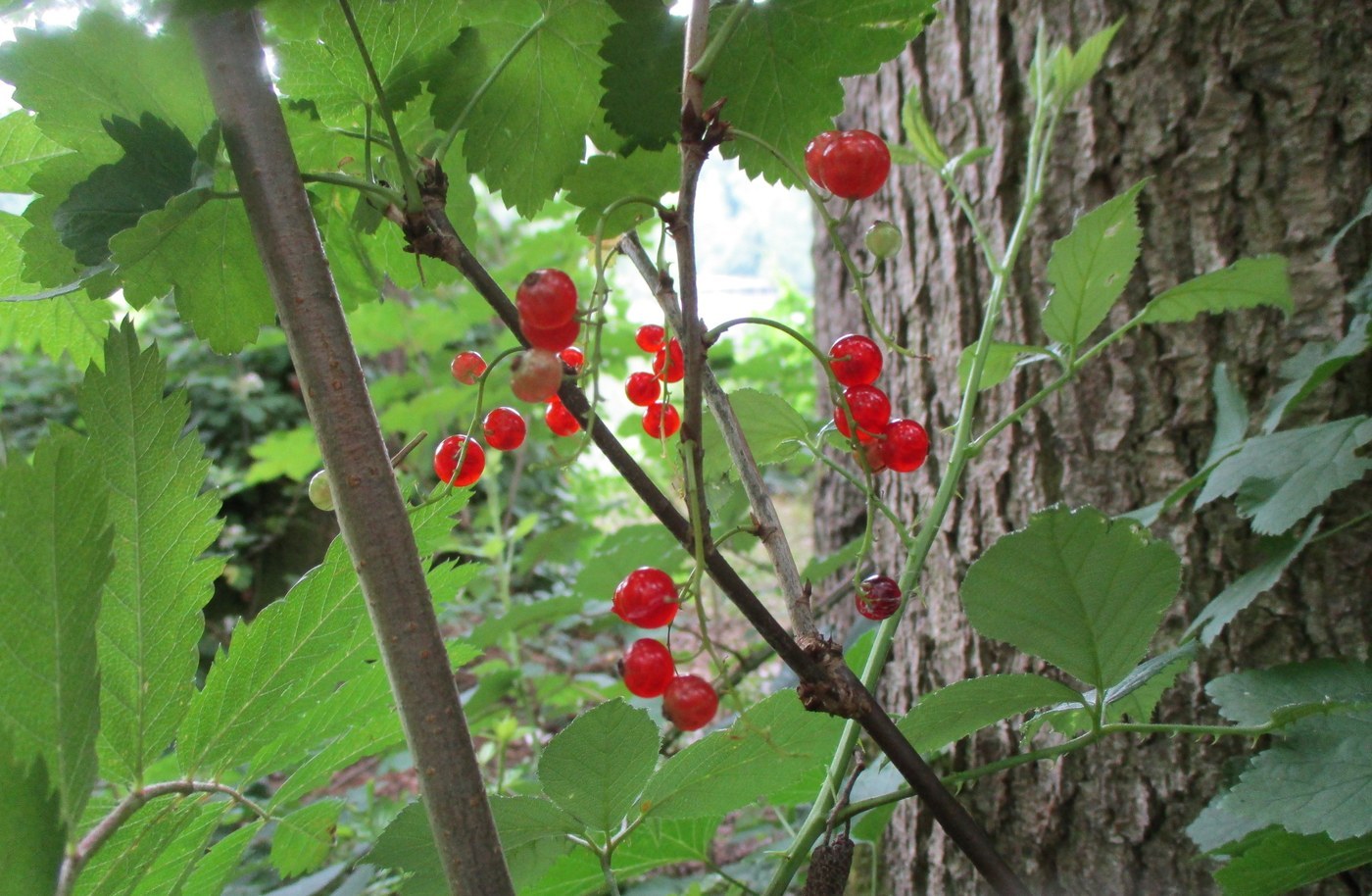
Key Identifying Features
Red currant is a thornless deciduous shrub in the genus Ribes, growing 3-5 ft tall in a clump of upright-to-arching woody stems. The defining feature is its fruit: strings (strigs) of small, glossy, translucent red berries hanging like tiny grapes. Combined with the lack of spines, this distinguishes it instantly from gooseberries.
- No thorns anywhere on the stems
- Berries in long hanging clusters, not singly
- Translucent, jewel-like red fruit with visible seeds inside
Leaves & Stems
Leaves are palmately lobed with 3-5 lobes, 1.5-3.5 in. across, with rounded teeth along the margins — broadly maple-like, similar to gooseberry but generally larger and smoother. They are alternate, mid-green above and paler below, often with sparse hairs on the underside veins. Unlike black currant, the foliage lacks a strong pungent odor when crushed. Stems are smooth gray-brown and spineless; older bark may flake slightly. Buds and leaves emerge on short spurs.
Flowers & Fruit
Flowers appear in spring as drooping clusters (racemes) of small, flat, greenish-yellow saucer-shaped blooms. Each raceme later becomes a hanging string of fruit. Ripe berries are bright translucent red (some cultivars pink or white), 6-12 mm, round, smooth, and slightly tart-sweet, with the dried flower remnant at the tip. The visible seeds suspended in clear pulp are a hallmark.
How to Tell It Apart from Look-Alikes
- Gooseberry: Has spines and bears single or paired berries — red currant is spineless with clustered fruit.
- Black currant: Foliage smells strongly aromatic when crushed; fruit is black, not translucent red. Black currant leaves have tiny golden resin glands beneath.
- White/pink currant: Same species, just a color form — identical leaves and clusters.
- Highbush cranberry / honeysuckle berries: Different leaf shape (not lobed Ribes-type) and not borne in pendulous strigs; avoid confusing ornamental red berries.
Where You'll Find It
Red currant is widely cultivated in cool-temperate gardens and grows wild or naturalized across Europe and parts of North America in moist woodlands, hedgerows, and stream banks. It tolerates partial shade better than most fruit bushes and prefers rich, well-drained, moisture-retentive soil. Look for it at woodland margins and in old garden plots.
Quick ID Checklist
- Upright clumping shrub, 3-5 ft, no thorns
- 3-5 lobed maple-like leaves, not strongly aromatic
- Spring racemes of small greenish-yellow saucer flowers
- Hanging strings of glossy translucent red berries
- Visible seeds inside clear pulp
- Moist woodland, hedgerow, or garden setting
Frequently asked questions
How is red currant different from black currant?
Red currant berries are translucent red and the leaves have little scent, while black currant has opaque black berries and strongly aromatic foliage with golden glands underneath.
Why are the berries see-through?
Red currants have thin, translucent skin and clear pulp, so you can see the small seeds suspended inside — a reliable identifying trait.
Does it have thorns?
No. Red currant is completely thornless, which separates it from the closely related, spiny gooseberry.
Are white currants a different plant?
No, white and pink currants are simply color variants of Ribes rubrum with the same leaves, clusters, and growth habit.