
Red Pagoda Identification Guide
Identify Red Pagoda (Crassula capitella 'Red Pagoda') by its stacked, triangular leaves that pile into tower-like stems turning fiery red in sun.
Read the full Red Pagoda encyclopedia entry →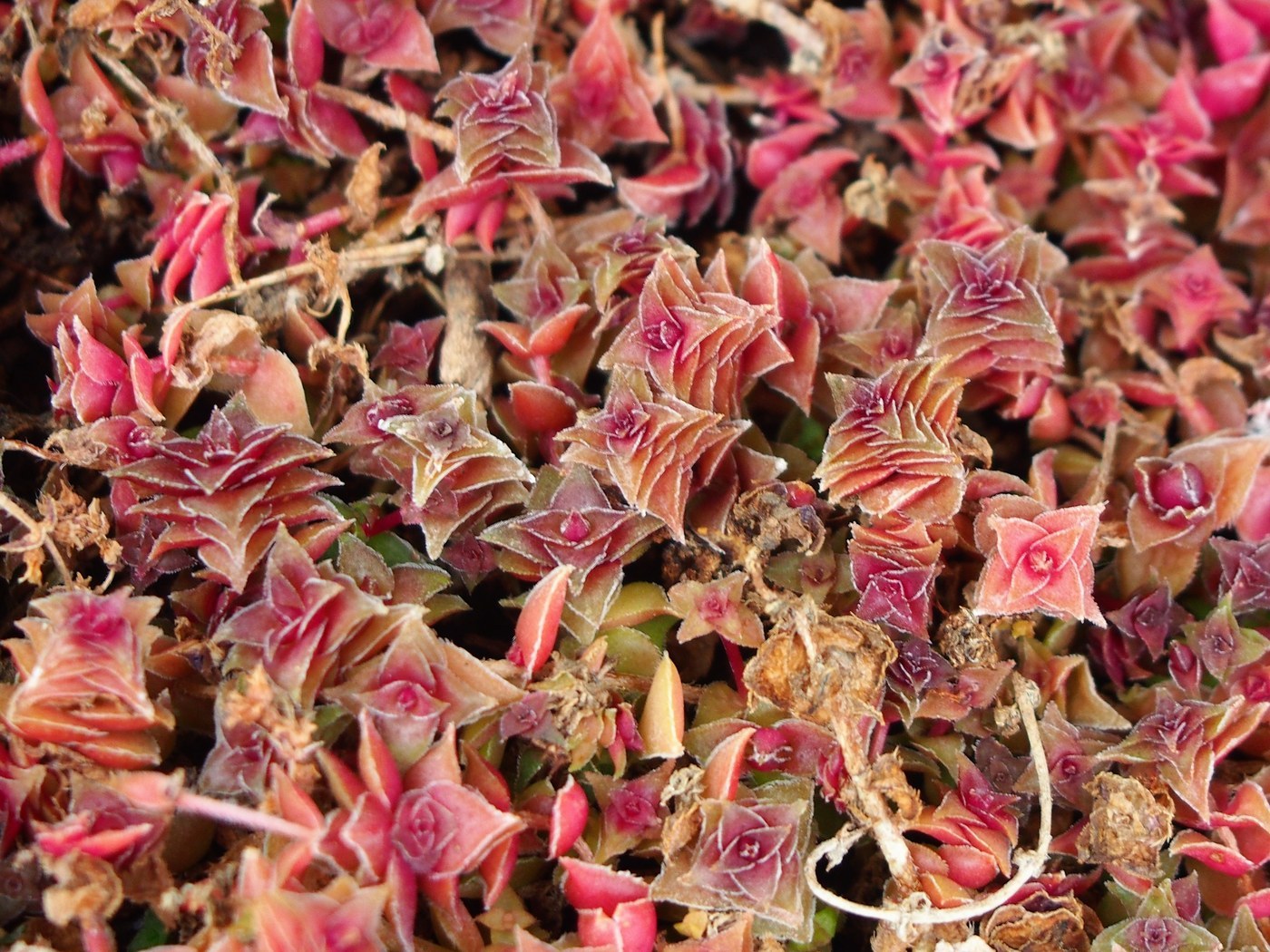
Key Identifying Features
Red Pagoda (Crassula capitella subsp. thyrsiflora 'Red Pagoda', closely related to 'Campfire') is named for its leaves that stack into pagoda-like towers. Look for:
- Triangular leaves stacked in four neat rows along the stems.
- A layered, tiered tower appearance that gets wider toward the tips.
- Color shifting from green at the base to brilliant red-orange at the tips in bright sun.
Leaves & Stems
The leaves are flat, broadly triangular, and tightly packed in opposite pairs that rotate, forming four vertical ranks (decussate stacking). Toward the growing tip the leaves become progressively smaller, creating the stepped, pagoda silhouette. In shade or cool growth the plant is lime-green; under bright sun and drought stress the tips flame red, scarlet, and orange — the key visual signature.
Stems are low, spreading, and trailing, branching to form a dense mat or mounding clump rarely more than 6 in (15 cm) tall. Older stems become woody and lie along the ground, rooting where they touch.
Flowers & Fruit
In summer it can produce dense, terminal clusters of tiny white-to-cream star flowers held just above the foliage. The blooms are small and slightly fragrant, secondary to the foliage display.
How to Tell It Apart from Look-Alikes
- Crassula 'Campfire': a very close relative with larger, more spreading triangular leaves; 'Red Pagoda' stacks more tightly and tower-like. The two are often confused and sometimes sold interchangeably.
- Crassula perforata (String of Buttons): also stacks leaves around the stem, but those leaves wrap fully around in pairs forming a square 'threaded' column, not a flat triangular tower.
- Crassula rupestris: rounder, bead-like stacked leaves.
- Sedum nussbaumerianum (Coppertone): orange tones but with loose, spindle-shaped leaves, not stacked triangles.
Where You'll Find It
Native to South Africa, it is grown as a groundcover and container/rockery plant in USDA zones 9-11 and as a houseplant elsewhere. It shows its best fiery color in full sun with lean soil and minimal water; in rich shade it stays green and leggy.
Quick ID Checklist
- Triangular leaves stacked in 4 rows into towers
- Stepped, pagoda-like tiered shape
- Green-to-red gradient, fiery red tips in sun
- Low, trailing, mat-forming stems
- Small white star flowers in summer
Frequently asked questions
Why does my Red Pagoda turn red?
Bright sun, cool temperatures, and drought stress trigger red pigments (anthocyanins). Well-watered plants in shade stay green; sun-stressed plants flame red-orange at the tips.
What's the difference between 'Red Pagoda' and 'Campfire'?
They are very close Crassula capitella relatives and often confused. 'Red Pagoda' has tightly stacked triangular leaves forming neat towers, while 'Campfire' has larger, more sprawling leaves.
Is the red color permanent?
No. Color is reversible with conditions. Move it to shade or water it more and the leaves green up again; stress it in sun and the red returns.
Does it spread?
Yes. Stems trail and root where they touch soil, so it works well as a colorful, low groundcover or spilling container plant.