
Red Pine Identification Guide
How to identify Red Pine (Pinus resinosa) by its brittle paired needles that snap cleanly, reddish flaky bark, and symmetrical open crown. Covers the features that separate it from other northeastern pines.
Read the full Red Pine encyclopedia entry →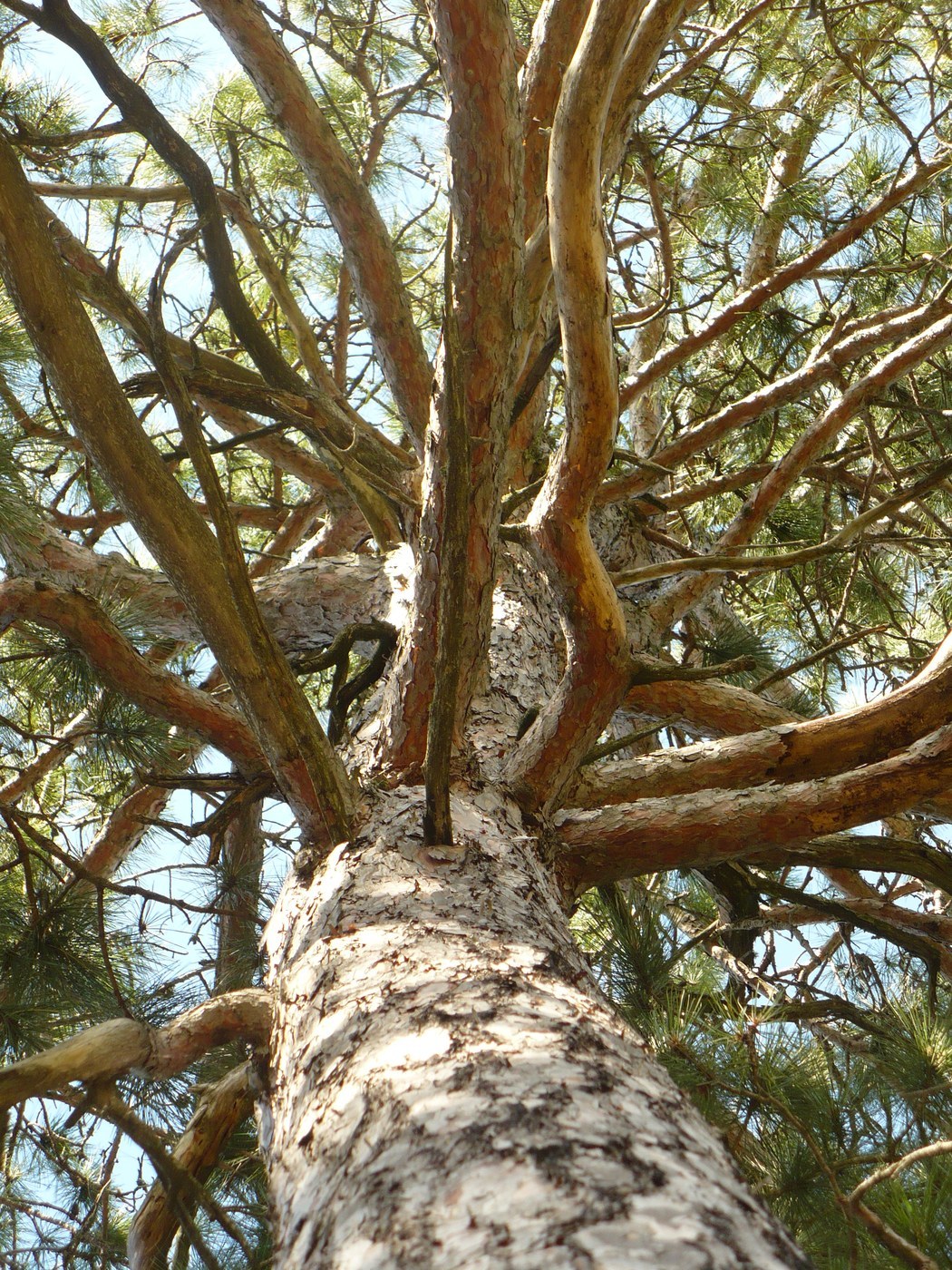
Key Identifying Features
Red Pine (Pinus resinosa) is a medium-to-large evergreen of the northeastern and Great Lakes regions. The fastest field test: bundles of two needles about 4 to 6 inches long that are brittle and snap cleanly in two when bent sharply. The bark on mature trunks is reddish to pinkish-brown, broken into broad, flat, flaky plates. The species name resinosa refers to the resinous wood.
Leaves & Stems
- Needles in bundles of two (fascicles of 2) — a key separator from white pine (5) and most yellow pines.
- Length 4 to 6.5 inches, dark green, glossy, and stiff yet brittle; a fresh needle bent double will fracture rather than fold.
- Needles concentrate toward branch tips, giving a tufted, slightly open look.
- Twigs orange-brown; buds reddish-brown, resinous, sharply pointed.
- The trunk is typically straight with a clean, branch-free lower bole and a rounded, symmetrical crown.
Flowers & Fruit
- Male cones small, purplish, clustered at branch bases in spring, shedding yellow pollen.
- Female (seed) cones ovoid, about 1.5 to 2.5 inches long, light brown, nearly stalkless, sitting close to the twig.
- Cone scales are unarmed — no prickle or spine at the tip, a useful difference from many hard pines.
- Cones open at maturity and fall mostly intact, often leaving a short rosette of basal scales.
How to Tell It Apart from Look-Alikes
- Scotch/Scots pine also has two needles but they are shorter (1.5 to 3 in), often twisted, blue-green, and the upper trunk shows bright orange papery bark; Red Pine needles are longer and the snap test is decisive.
- Austrian pine has two needles of similar length but they are flexible and do not snap cleanly, and its bark is gray-brown, not reddish.
- Eastern white pine has soft needles in bundles of five and long slender cones.
- Jack pine has very short (1 to 1.5 in) twisted needles and curved cones.
Where You'll Find It
Native to the Northeast, Upper Midwest, and southern Canada, on sandy or rocky, well-drained, acidic soils. Widely planted in dense plantation rows for timber and reforestation, where its uniform straight trunks and matched crowns are obvious. Common around the Great Lakes and in New England uplands.
Quick ID Checklist
- Needles in bundles of two, 4 to 6 inches
- Needles brittle — snap cleanly when bent double
- Reddish, flaky plated bark on mature trunk
- Cones ~2 inches, stalkless, scales without prickles
- Straight trunk, symmetrical rounded crown, often in plantation rows
Frequently asked questions
What is the easiest way to confirm a Red Pine?
Bend a needle sharply in half. Red Pine needles are brittle and snap cleanly in two, while similar two-needle pines like Austrian and Scotch pine bend without breaking.
How many needles are in each Red Pine bundle?
Two. The needles are dark green, glossy, and 4 to 6 inches long, growing in tight pairs.
How do I distinguish Red Pine from Scotch pine?
Scotch pine has shorter, twisted, blue-green needles and bright orange flaky bark on the upper trunk. Red Pine has longer, brittle needles and reddish-brown plated bark lower on the trunk.
Do Red Pine cones have prickles?
No. The cone scales are unarmed (smooth-tipped), which helps separate it from many spiny hard pines.