
Red Tip Photinia Identification Guide
Identify red tip photinia by its brilliant red new growth, glossy toothed evergreen leaves, and flat white flower clusters with a distinctive odor.
Read the full Red Tip Photinia encyclopedia entry →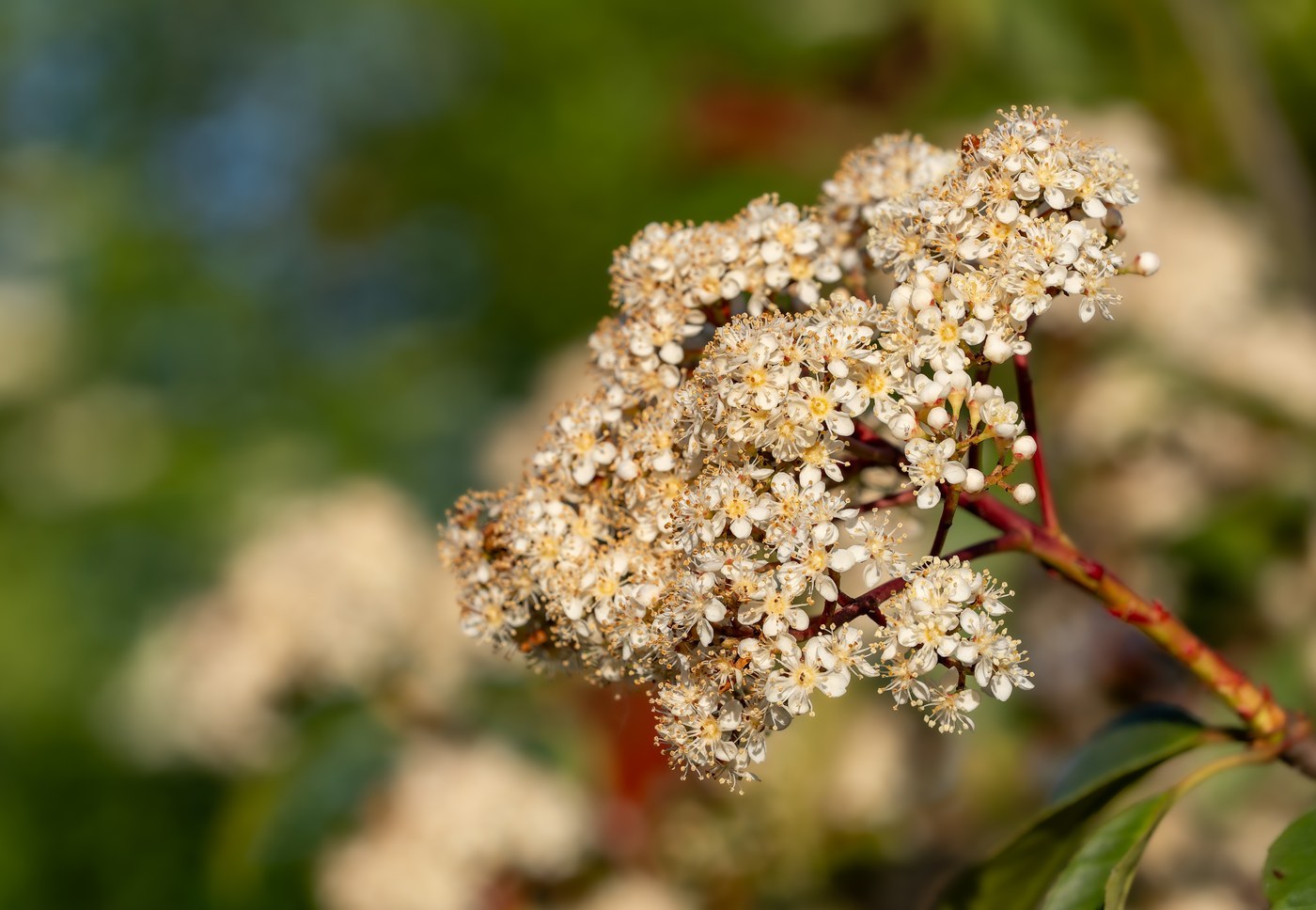
Key Identifying Features
Red tip photinia (Photinia × fraseri, 'Red Robin') is a vigorous evergreen hedge shrub instantly known for its brilliant red, glossy new growth that flushes each spring (and after every pruning) before maturing to dark green. This vivid red-over-green color is the single most diagnostic feature.
- Large, fast-growing evergreen shrub, 8–15 ft (often kept clipped)
- New leaves emerge bright glossy red to bronze-red
- Mature leaves glossy dark green, leathery, finely toothed
- Flat clusters of small white flowers in spring (often sheared off in hedges)
Leaves & Stems
Leaves are alternate, simple, elliptical to oblong (2–5 in long), with finely serrated (toothed) margins. The upper surface is glossy and waxy; the midrib is prominent. The defining trait is color: emerging leaves are a vivid waxy red, gradually turning bronze, then deep green as they harden. Stems are stout and reddish when young. Repeated shearing keeps producing fresh red flushes, which is why hedges look perpetually red-tipped.
Flowers & Fruit
When allowed to flower, it produces broad, flat-topped clusters (corymbs) of many small, 5-petaled white flowers in spring — superficially like hawthorn or pear blossom. The flowers have a strong, somewhat unpleasant or musty odor, a useful but off-putting clue. As a hybrid, it rarely sets much fruit; when it does, fruits are small red pomes. Most hedge specimens are pruned before flowering.
How to Tell It Apart from Look-Alikes
- Cherry laurel: glossy leaves but smooth-edged or sparsely toothed and much larger, with no red new growth and white flower spikes (racemes), not flat clusters.
- Japanese pieris: red new growth too, but leaves are smaller, in whorls, and flowers are urn-shaped white bells in drooping chains.
- Nandina: red foliage but compound leaves, not single glossy serrated leaves.
- Loropetalum: reddish leaves but with fringed pink flowers and fuzzy small leaves.
The bright red glossy new growth + large glossy toothed evergreen leaves + flat white musty-smelling flower clusters combination is unique to Photinia × fraseri.
Where You'll Find It
One of the most common privacy and screening hedges in warm-temperate suburbs across the US South, UK, Mediterranean Europe, Australia, and New Zealand. It tolerates a range of soils in full sun to part shade but is notoriously prone to Entomosporium leaf spot (red-purple spotting causing defoliation) in humid climates.
Quick ID Checklist
- Large, fast-growing evergreen hedge shrub
- Brilliant glossy red new growth in spring/after pruning
- Mature leaves glossy dark green, finely toothed
- Flat clusters of small white flowers (if unpruned)
- Flowers with strong, musty odor
- Often seen as a clipped privacy hedge
If you see a tall clipped hedge that's bright red at the tips and glossy green below, you've found red tip photinia.
Frequently asked questions
Why is the new growth so red?
Red tip photinia's young leaves are loaded with red pigments and emerge a brilliant glossy red before chlorophyll develops and turns them green. Each spring flush — and each new flush after pruning — produces this red coloring, which is the plant's signature feature.
Why do the flowers smell bad?
The flat white flower clusters give off a strong, musty, somewhat unpleasant odor that some people find off-putting. It's normal for the species; many people prune the shrub as a hedge before it blooms partly to avoid the smell.
What causes black or red spots on the leaves?
That's Entomosporium leaf spot, a fungal disease that's very common on red tip photinia in humid climates. It causes reddish-purple spots, yellowing, and heavy leaf drop, and is the main reason the plant has fallen out of favor in some regions.
How do I distinguish it from cherry laurel?
Both are glossy evergreen hedges, but red tip photinia has finely toothed leaves and vivid red new growth, while cherry laurel has larger, smoother-edged leaves, no red flush, and upright spikes of white flowers rather than flat clusters.