
Sausage Tree Identification Guide
Identify the sausage tree (Kigelia africana) by its enormous hanging sausage-shaped fruits, maroon bell flowers on long stalks, and pinnate compound leaves.
Read the full Sausage Tree encyclopedia entry →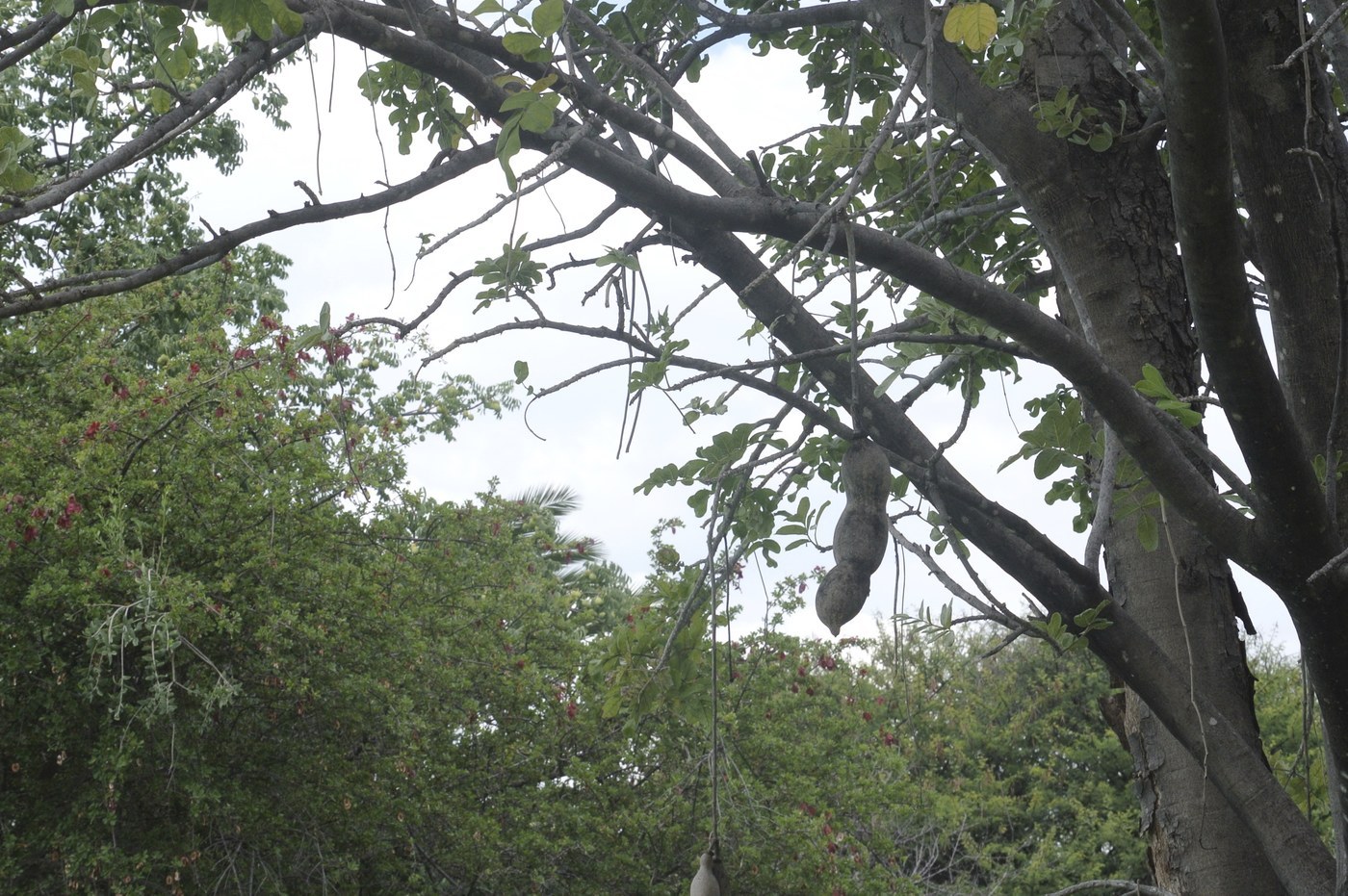
Key Identifying Features
The sausage tree (Kigelia africana) is unmistakable thanks to its huge, heavy, gray-brown fruits shaped like giant sausages that dangle from long cord-like stalks. Combined with maroon, foul-smelling flowers, no other tree looks quite like it.
- Massive cylindrical sausage-like fruits, up to 1-2 ft long and several pounds each, hanging on long stalks
- Velvety, dark maroon-red, trumpet/bell-shaped flowers that open at night
- Pinnately compound leaves clustered toward branch ends
- Broad, rounded, spreading crown on a thick trunk
Leaves & Stems
Leaves are opposite or whorled, pinnately compound, 12-20 in long, with 3-5 pairs of opposite leaflets plus a terminal leaflet (7-11 leaflets total). Leaflets are oval, 3-6 in long, leathery, with a rough upper surface. The tree is semi-deciduous, briefly bare in the dry season. Bark is gray and flakes off in patches; the trunk is stout and the crown wide and dense, casting heavy shade.
Flowers & Fruit
Flowers hang on long, rope-like flexible stalks (panicles) that drop below the canopy. Each flower is a wide, fleshy, dark maroon to wine-red trumpet about 4 in across, with a velvety texture and an unpleasant smell that attracts bats and night pollinators. The famous fruit follows: a sausage-shaped, gray-brown, woody-fleshy capsule up to 2 ft long and 4 in thick, weighing up to 15 lb, hanging on the long cords. It does not split open and is fibrous inside with many seeds.
How to Tell It Apart from Look-Alikes
- Catalpa and other Bignoniaceae: related, with trumpet flowers, but produce slender bean-like pods, not giant sausages.
- Calabash tree (Crescentia): has large round gourd-like fruits, not elongated sausages, and simple clustered leaves.
- Baobab: also African with a fat trunk, but baobab has palmate leaves and large round pendulous fruits, not sausages.
- Jacaranda: ferny bipinnate leaves and blue flowers - very different.
The giant hanging sausage fruits + maroon velvety night flowers + pinnate leaves are diagnostic and unique to Kigelia.
Where You'll Find It
Native across tropical sub-Saharan Africa, it grows along rivers, floodplains, and savannas, and is planted as a shade and curiosity tree in tropical and subtropical parks worldwide (USDA zones 10-11). The heavy fruits make it unsuitable for planting over paths or parking.
Quick ID Checklist
- Enormous sausage-shaped fruits hanging on long cords
- Maroon, velvety, bell-shaped flowers that smell unpleasant
- Pinnate compound leaves clustered at branch tips
- Broad spreading crown, stout trunk, flaking gray bark
- Tropical/subtropical climate, often near water
- Flowers open at night, pollinated by bats
Frequently asked questions
What is the sausage tree's most distinctive feature?
Its fruit. The tree produces huge gray-brown fruits shaped like sausages, up to two feet long and weighing several pounds, hanging from long rope-like stalks below the canopy. Nothing else looks like it.
Why do the flowers smell bad?
The dark maroon flowers open at night and emit an unpleasant odor to attract bats, which are their main pollinators. The night-blooming, bat-pollinated habit is part of its biology.
How is the sausage tree different from a baobab?
Both are African, but baobab has a massively swollen trunk, palmate leaves, and round hanging fruits, while the sausage tree has a normal trunk, pinnate compound leaves, and elongated sausage-shaped fruits.