
Snowball Cactus Identification Guide
Identify the Snowball Cactus (Mammillaria bocasana / candida) by its globular body densely cloaked in soft white spines that give it a fluffy, snow-like look.
Read the full Snowball Cactus encyclopedia entry →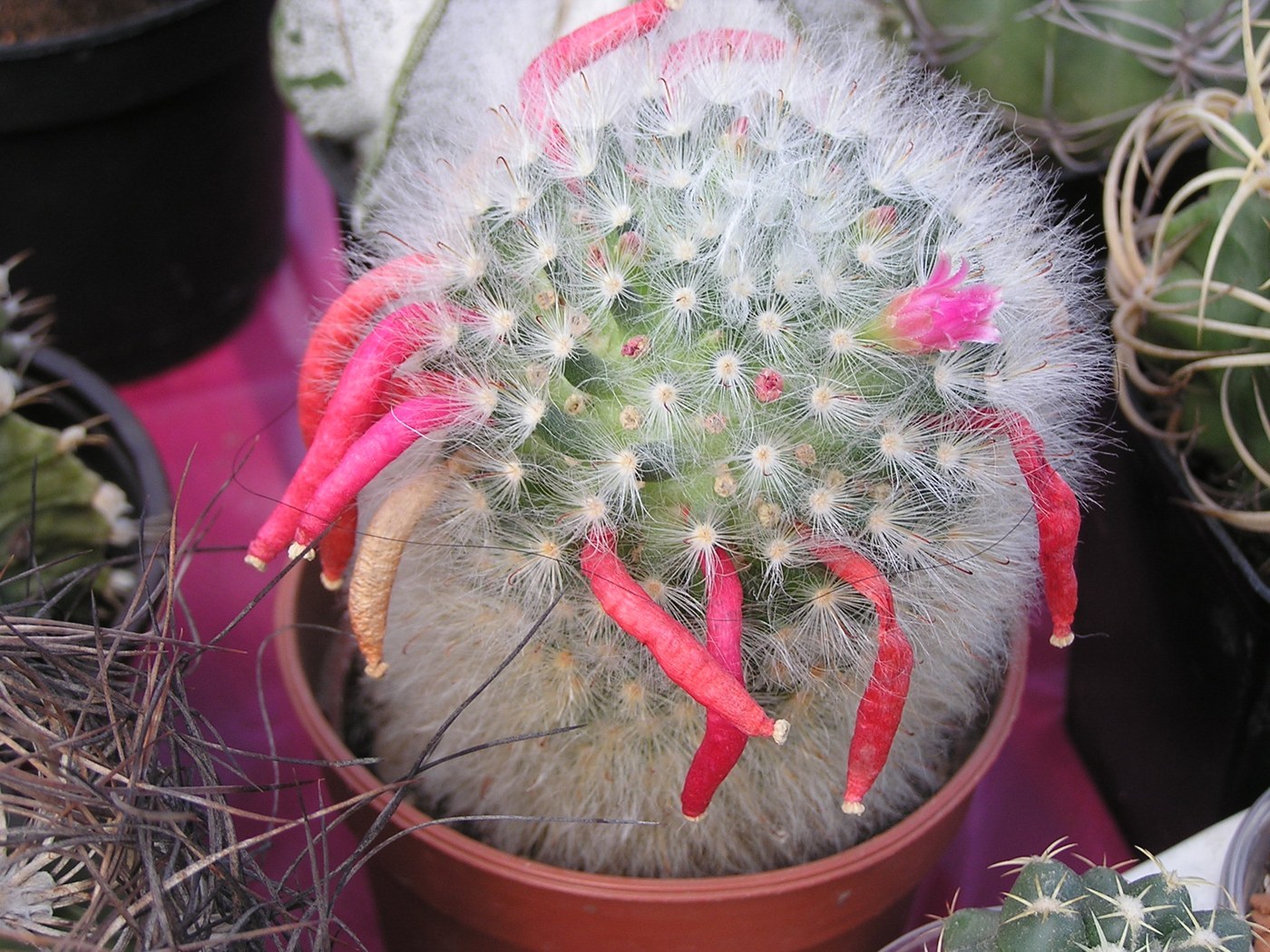
Key Identifying Features
Snowball Cactus is a common name for clustering Mammillaria species — most often Mammillaria bocasana (Powder Puff Cactus) and Mammillaria candida (Snowball Pincushion) — that are densely covered in fine white spines and hair-like bristles, giving each globe a soft, fluffy, snowball appearance.
- Globular to barrel-shaped stems, often forming clusters
- Body densely cloaked in white, hair-like or feathery spines
- Frequently a fishhook-tipped central spine hidden among the white fluff (in M. bocasana)
- Compact, mounding, pincushion habit
Leaves & Stems
Like all cacti, there are no leaves. The globular green stem is covered in spiraling tubercles, each topped by an areole producing a dense burst of radial spines that are white, fine, and often hair-like. In M. bocasana this woolly white covering hides hooked central spines that can snag skin, so handle carefully. In M. candida, the white spines are more bristly and chalky, giving a clean snowball-white look. Plants typically offset freely, forming clumps of multiple white globes.
Flowers & Fruit
A charming ID feature: Snowball Cactus blooms in a ring of small flowers around the crown, usually in spring. Flowers are funnel-shaped and cream, pale yellow, or pink, sometimes with a darker midstripe. After flowering, small elongated red or pink berries often emerge in a similar ring, a classic Mammillaria trait.
How to Tell It Apart from Look-Alikes
- Old Lady Cactus (Mammillaria hahniana): also white and woolly, but covered in long white hairs plus spines and tends to be larger and more solitary; Snowball forms tighter white globes.
- Other white pincushion cacti: check for the hooked central spine (points to M. bocasana) versus straight chalky-white bristles (points to M. candida).
- Crested or non-white Mammillaria: if spines are golden or the body is folded, it isn't a Snowball Cactus.
Where You'll Find It
Native to Mexico, Snowball Cactus is a popular windowsill and collector's houseplant worldwide, and grows outdoors in warm, dry, frost-free climates (USDA zones 9-11). Look for it in small pots where its white fuzz and ring of spring flowers make it a favorite ornamental.
Quick ID Checklist
- Globular stems in clustering mounds
- Dense white, hair-like or feathery spines (snowball look)
- Tubercles with areoles (true cactus)
- Possible hidden hooked central spine (M. bocasana)
- Ring of small cream/yellow/pink flowers in spring
- Small red berries following flowers
Caution: The soft appearance is deceptive — hooked spines in some species cling to skin. Handle with tongs or gloves.
Frequently asked questions
Which species is the 'real' Snowball Cactus?
The name is applied to a few woolly white Mammillarias, most commonly Mammillaria bocasana (Powder Puff) and Mammillaria candida (Snowball Pincushion). Both look like fluffy white globes.
Are the soft white spines harmless?
Not entirely. The fine white covering looks soft, but some species (especially M. bocasana) hide hooked central spines that catch on skin and are hard to remove. Handle with care.
Does Snowball Cactus flower?
Yes. In spring it typically produces a ring of small funnel-shaped flowers in cream, pale yellow, or pink around the top of each globe, often followed by small red berries.
How is it different from Old Lady Cactus?
Old Lady Cactus (Mammillaria hahniana) has long white hairs over its spines and is usually larger and more solitary, while Snowball forms tighter clusters of fluffy white globes.