
Spotted Spurge Identification Guide
Identify spotted spurge (Euphorbia maculata), a flat, mat-forming summer annual with milky sap and small oval leaves bearing a reddish spot. Covers the milky-sap test and how to separate it from purslane and knotweed.
Read the full Spotted Spurge encyclopedia entry →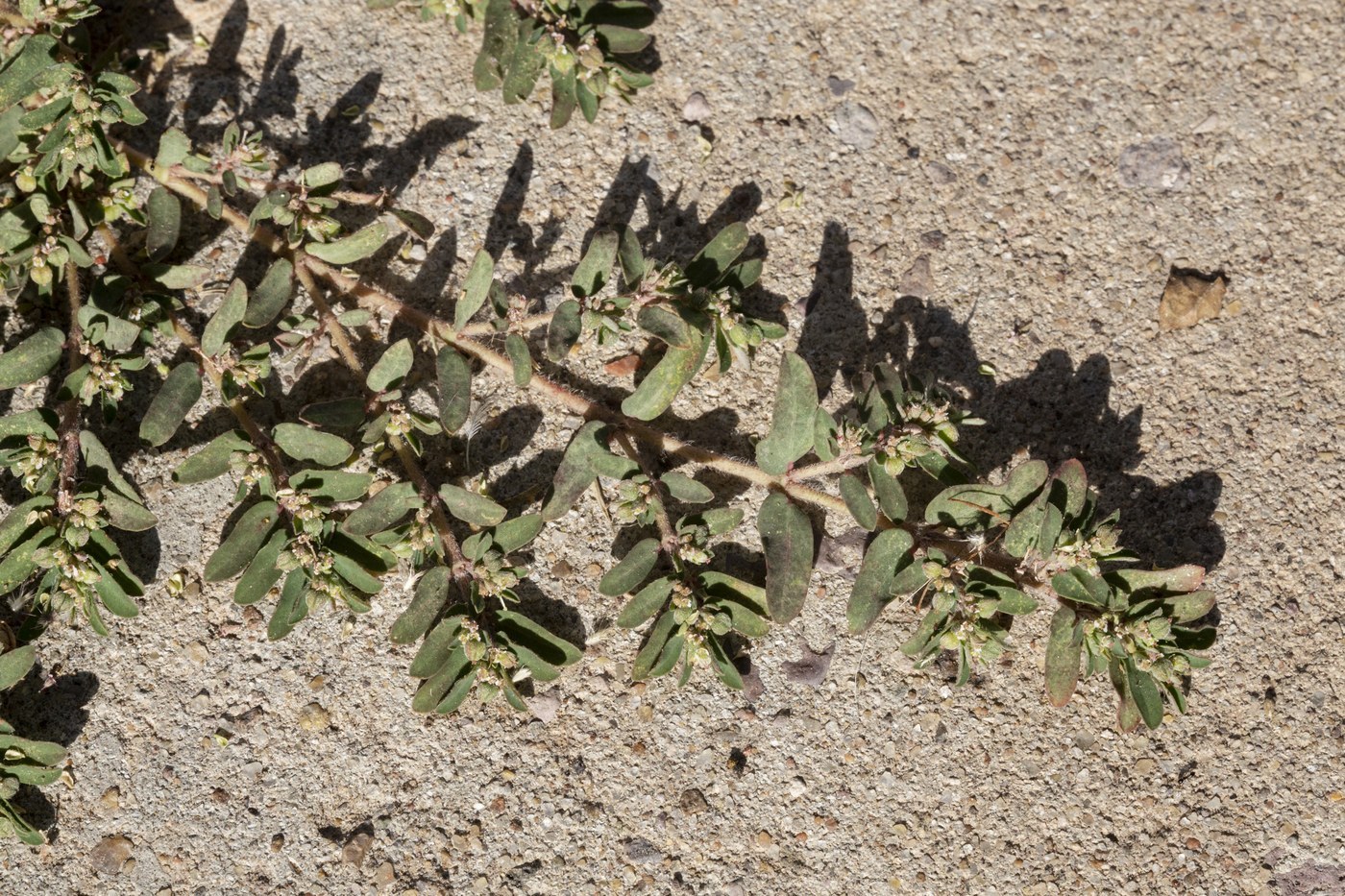
Key Identifying Features
Spotted spurge (Euphorbia maculata, syn. Chamaesyce maculata) is a low, mat-forming summer annual that spreads flat against the ground in a circular patch. Its two surest features are the milky white sap that oozes from any broken stem and the small, opposite oval leaves, many bearing a reddish-purple spot or blotch in the center.
- Flat, ground-hugging mat radiating from a central taproot
- Milky sap in stems and leaves (snap to confirm)
- Small opposite leaves with a dark reddish central spot
- Pinkish-red, slender, slightly hairy stems
- Tiny, inconspicuous flowers in leaf axils
Leaves & Stems
The leaves are small (about 0.25 to 0.5 inch), oblong to oval, opposite, and asymmetric at the base, with finely toothed margins. Most carry a distinct maroon to purple spot or smudge along the midrib, the source of the name "spotted." The stems are thin, wiry, often reddish or pink, and radiate outward from a single central point, branching repeatedly to form a dense flat mat that may reach a foot or more across. The stems are usually finely hairy. Breaking any part releases a milky latex that distinguishes spurges from nearly all look-alikes.
Flowers & Fruit
The flowers are minute and easily overlooked, clustered in the leaf axils. Like all spurges, they form a specialized cup-like structure (a cyathium) with tiny appendages rather than true petals. The fruit is a small, three-lobed hairy capsule that splits to fling out three tiny seeds. Flowering continues from late spring through fall, and a single plant can produce thousands of seeds.
How to Tell It Apart from Look-Alikes
- Purslane (Portulaca oleracea): Has thick, fleshy, succulent leaves and reddish stems but no milky sap; snap test settles it instantly.
- Prostrate knotweed (Polygonum aviculare): Has alternate leaves with a papery sheath (ocrea) at each node and no milky sap.
- Prostrate pigweed: Lacks both the milky sap and the leaf spot.
- Other prostrate spurges (e.g., E. serpens): Have unspotted leaves and hairless stems.
The combination of milky sap plus a small opposite leaf with a red central spot on a flat mat is conclusive.
Where You'll Find It
Spotted spurge thrives in hot, dry, compacted, disturbed ground: sidewalk and driveway cracks, garden beds, thin lawns, gravel, nursery containers, and field edges. It tolerates poor soils and full sun, germinating in warm weather and quickly carpeting bare spots.
Quick ID Checklist
- Flat mat radiating from a central taproot
- Milky sap when stem is broken (key test)
- Small opposite leaves with a red/purple spot
- Thin, reddish, finely hairy stems
- Tiny axillary flowers; 3-lobed hairy capsules
- Hot, dry, compacted disturbed soils
Frequently asked questions
What is the quickest test to confirm spotted spurge?
Snap a stem or leaf. Spotted spurge oozes a milky white sap, which immediately separates it from look-alikes like purslane and knotweed that have clear sap.
How do I tell spotted spurge from purslane?
Purslane has thick, fleshy succulent leaves and clear sap, while spotted spurge has thin leaves with a reddish central spot and milky sap.
Why does it grow in sidewalk cracks?
Spotted spurge thrives in hot, dry, compacted, disturbed ground where many other plants struggle, so pavement cracks, gravel, and thin lawns are ideal habitat.