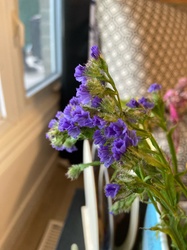
Statice Identification Guide
Identify statice (sea lavender) by its papery, long-lasting flowers in flat-topped clusters on winged stems above a basal rosette.
Read the full Statice encyclopedia entry →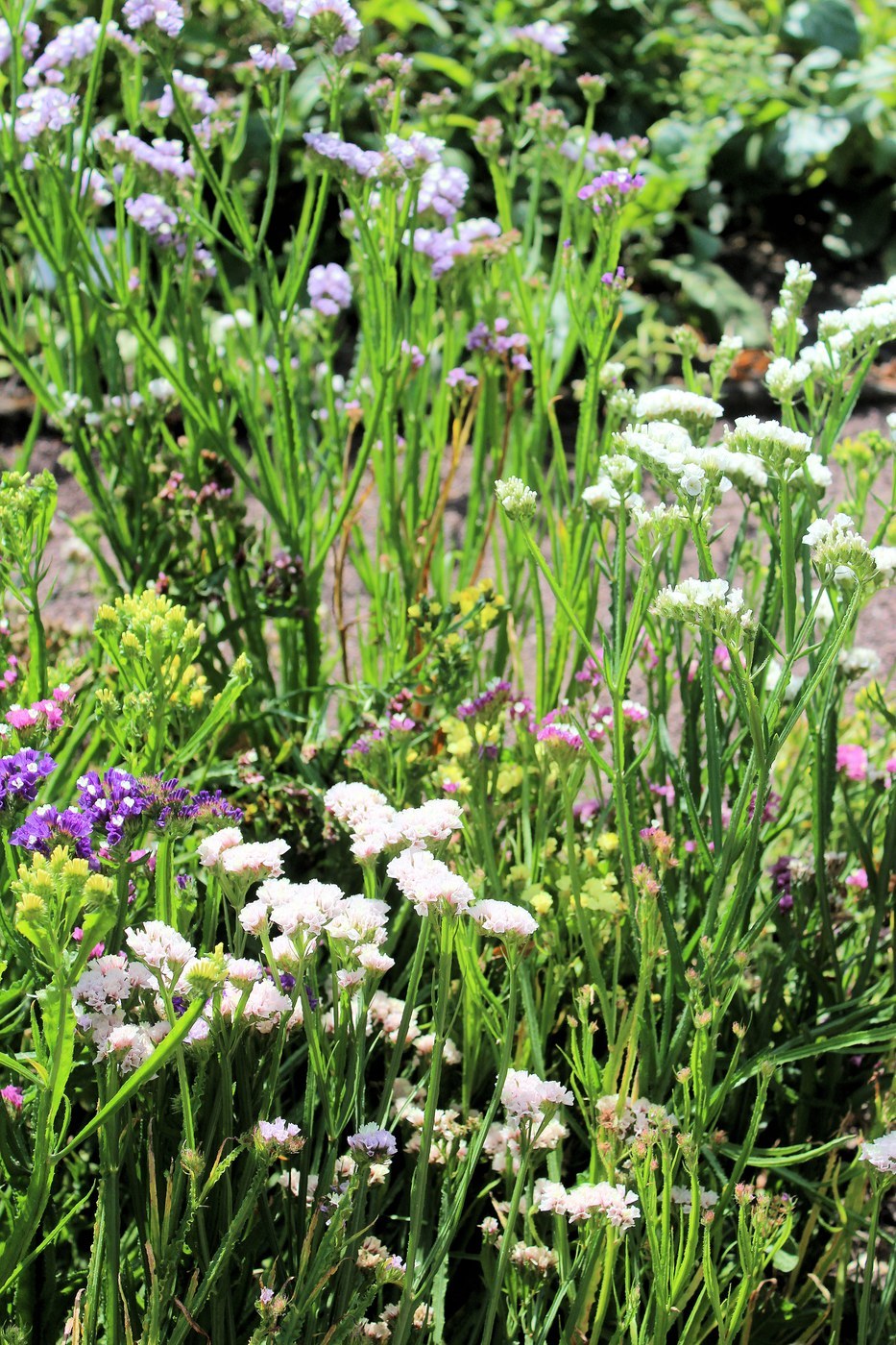
Key Identifying Features
Statice (Limonium, also called sea lavender) is recognized by its stiff, papery, everlasting flowers clustered along branched, often winged stems, rising from a flat rosette of leaves. The flowers feel dry and crisp even when fresh, which makes statice a classic everlasting/dried flower.
- Papery, crisp flowers in dense, flat-topped or branched clusters
- Winged or angular flower stems in many species
- Basal rosette of broad leaves, stems nearly leafless
- Colors stay vivid when dried
Leaves & Stems
Leaves form a basal rosette and are broad, oblong to spoon-shaped (spatulate), leathery, with smooth or slightly wavy margins. The flowering stems rise well above the leaves and are stiff, often conspicuously winged or ridged (especially in Limonium sinuatum), branching into flat-topped sprays. The stems carry few or no true leaves. Plants form low clumps; many are coastal and salt-tolerant.
Flowers & Fruit
The true flowers are small and tubular, but the showy part is the papery, persistent calyx that surrounds each one — this is what gives the lasting color and crisp texture. Flowers are arranged in dense one-sided clusters along the branch tops, forming flat or winged sprays. Colors include purple, blue, violet, pink, white, yellow, and apricot, often with a contrasting white inner flower. Bloom is summer to early autumn. Because the calyx is dry and papery, the color holds for months — the defining trait.
How to Tell It Apart from Look-Alikes
- Baby's breath: Soft, rounded airy cloud of tiny soft flowers; statice is stiff, papery, and flat-clustered with winged stems.
- Lavender (true Lavandula): Aromatic, with narrow grey leaves up the stem and soft tubular flowers in spikes; statice has a basal leaf rosette, no strong scent, and papery flowers.
- Sea holly (Eryngium): Spiny, metallic-blue thistle-like; not papery.
The papery everlasting flowers + winged stems + basal rosette confirm statice.
Where You'll Find It
Wild Limonium species grow on salt marshes, sea cliffs, and coastal flats, tolerating salt spray and poor soil — hence "sea lavender." Garden and florist statice is grown in cutting gardens and borders in full sun and well-drained soil, and is one of the most popular flowers for drying and everlasting arrangements.
Quick ID Checklist
- Stiff, papery, crisp flowers even when fresh
- Flowers in dense flat-topped or branched clusters
- Winged or angular flower stems
- Basal rosette of broad, leathery leaves
- Stems mostly leafless
- Often coastal/salt-tolerant; colors hold when dried
Frequently asked questions
Why do statice flowers feel papery?
The colorful part is actually the dry, papery calyx surrounding each small true flower. This crisp texture is why statice holds its color for months and is prized as an everlasting dried flower.
Is statice the same as lavender?
No. Statice is called 'sea lavender' but belongs to the genus Limonium, unrelated to true lavender (Lavandula). Lavender is aromatic with grey leaves up the stem; statice has a basal leaf rosette, papery flowers, and little scent.
What do the winged stems tell me?
The flat, winged or ridged flowering stems, especially in Limonium sinuatum, are a strong ID feature that separates statice from soft-stemmed fillers like baby's breath.
Where does wild statice grow?
Many Limonium species grow on salt marshes, coastal flats, and sea cliffs, tolerating salt spray — which is why the plant is commonly called sea lavender.
Statice identified by the community
Recent Statice specimens identified with Plant Identifier.