
String Of Hearts Identification Guide
How to recognize Ceropegia woodii by its heart-shaped, marbled leaves on thread-thin trailing vines, plus the tubers and odd lantern flowers that confirm the ID.
Read the full String Of Hearts encyclopedia entry →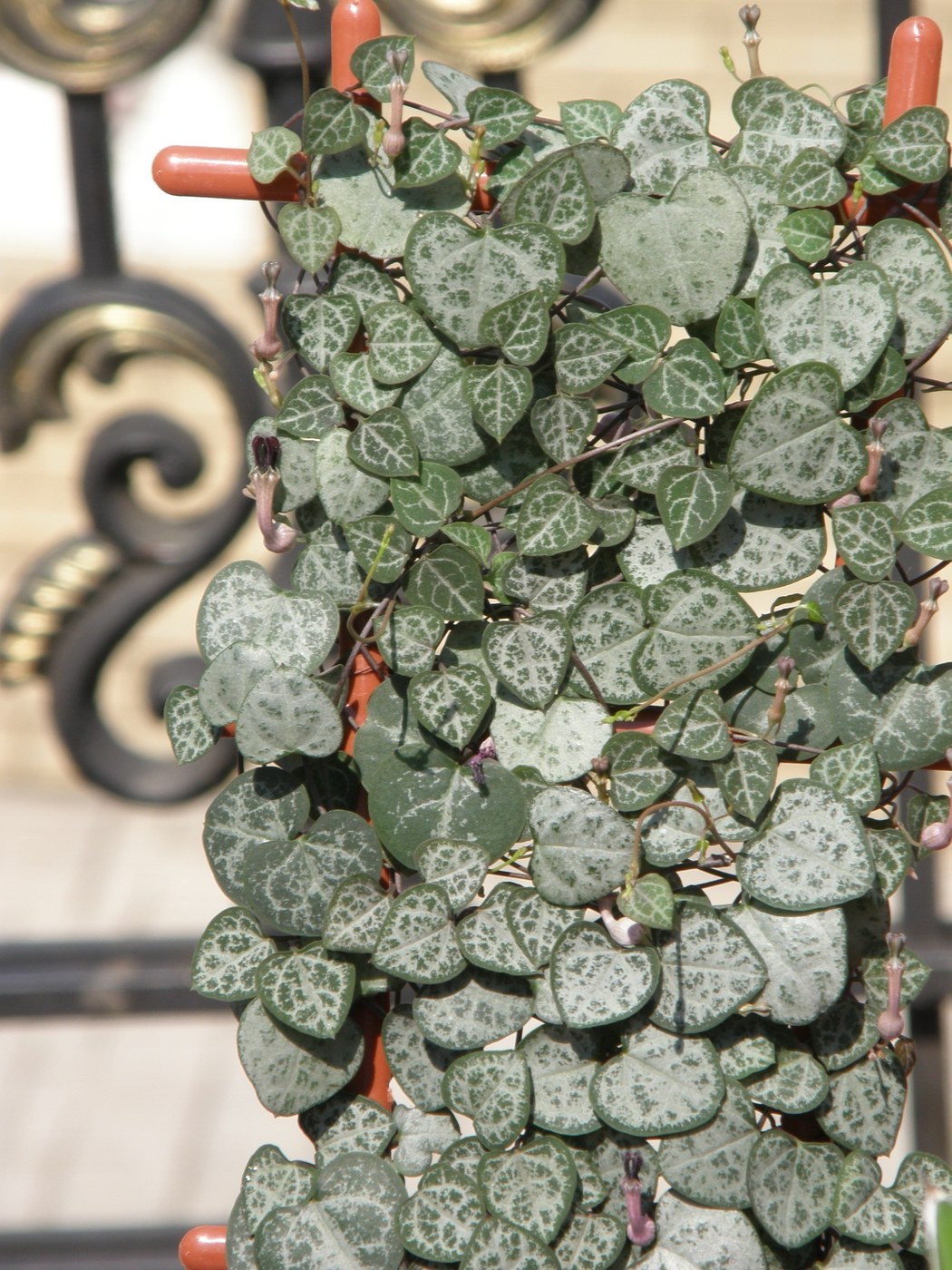
Key Identifying Features
String of Hearts (Ceropegia woodii, syn. Ceropegia linearis subsp. woodii) is a trailing succulent vine from southern Africa, instantly recognized by its small heart-shaped leaves spaced along wiry, purple-tinged stems that cascade in long curtains.
- Leaves typically 1-2 cm wide, opposite, and shaped like a valentine heart
- Upper surface dark green marbled with silver-grey; underside flushed purple to maroon
- Stems thread-thin, almost string-like, often trailing 1-2 m or more
- Forms small grey tubers ("beads") at nodes along the vine
Leaves & Stems
The leaves are fleshy and slightly succulent, holding water for this drought-adapted plant. They sit in opposite pairs at evenly spaced nodes. The marbling pattern is variable but usually shows a network of silvery veining over deep green, with the contrast strongest in bright light. In low light leaves space out and lose silver.
Stems are round, smooth, and purplish, very fine in diameter. Where a node touches soil or hangs in humid air, the plant produces aerial bead-like tubers that can root into new plants. These tubers are a reliable diagnostic feature.
Flowers & Fruit
Blooms are bizarre and unmistakable: small vase- or lantern-shaped flowers about 2 cm long, pinkish-white at the swollen base and topped by maroon, hair-fringed lobes that fuse into a tiny cage. They function as a temporary insect trap for pollination. Flowering occurs mainly in summer and autumn. Seed pods are slender, paired horns that release silky parachute seeds.
How to Tell It Apart from Look-Alikes
- String of Pearls / Beads (Curio/Senecio) has round or bean-shaped leaves, NOT hearts, and thicker green stems.
- String of Turtles (Peperomia prostrata) has rounder leaves with turtle-shell patterning and is non-succulent in habit; leaves are not heart-shaped.
- Variegated String of Hearts is the same species with cream-and-pink margins; the heart shape and tubers still confirm Ceropegia woodii.
- The combination of heart leaves + purple thread stems + bead tubers is unique to this plant.
Where You'll Find It
A popular houseplant worldwide, grown in hanging pots on shelves and windowsills. In its native range (South Africa, Eswatini, Zimbabwe) it grows in rocky, partly shaded ground, often draping over stones. Indoors it wants bright, indirect light to keep its markings.
Quick ID Checklist
- Heart-shaped leaves 1-2 cm wide
- Silver marbling on top, purple underside
- Thin, purplish, string-like trailing stems
- Grey bead-like tubers at nodes
- Lantern-shaped maroon-and-pink flowers in summer
Frequently asked questions
How can I be sure it's String of Hearts and not String of Pearls?
Look at leaf shape: String of Hearts has flat heart-shaped leaves with silver marbling on thin purple stems, while String of Pearls has round, pea-like green leaves. They are different genera entirely.
What are the little round balls growing on the vines?
Those are aerial tubers (sometimes called beads or bulbils) that form at the nodes. They are a normal, diagnostic feature and can be planted to propagate new plants.
Why do my leaves look more green than silver?
Marbling intensity depends on light. In bright, indirect light the silver pattern and purple undersides are vivid; in low light the leaves space out, turn plainer green, and the silver fades.
Are the strange caged flowers normal?
Yes. The lantern-shaped maroon-tipped flowers are a hallmark of the genus Ceropegia and temporarily trap small flies for pollination before releasing them.