
Sweet Alyssum Identification Guide
A practical guide to recognizing Sweet Alyssum by its low carpet of tiny four-petaled flowers, honey scent, and narrow gray-green leaves.
Read the full Sweet Alyssum encyclopedia entry →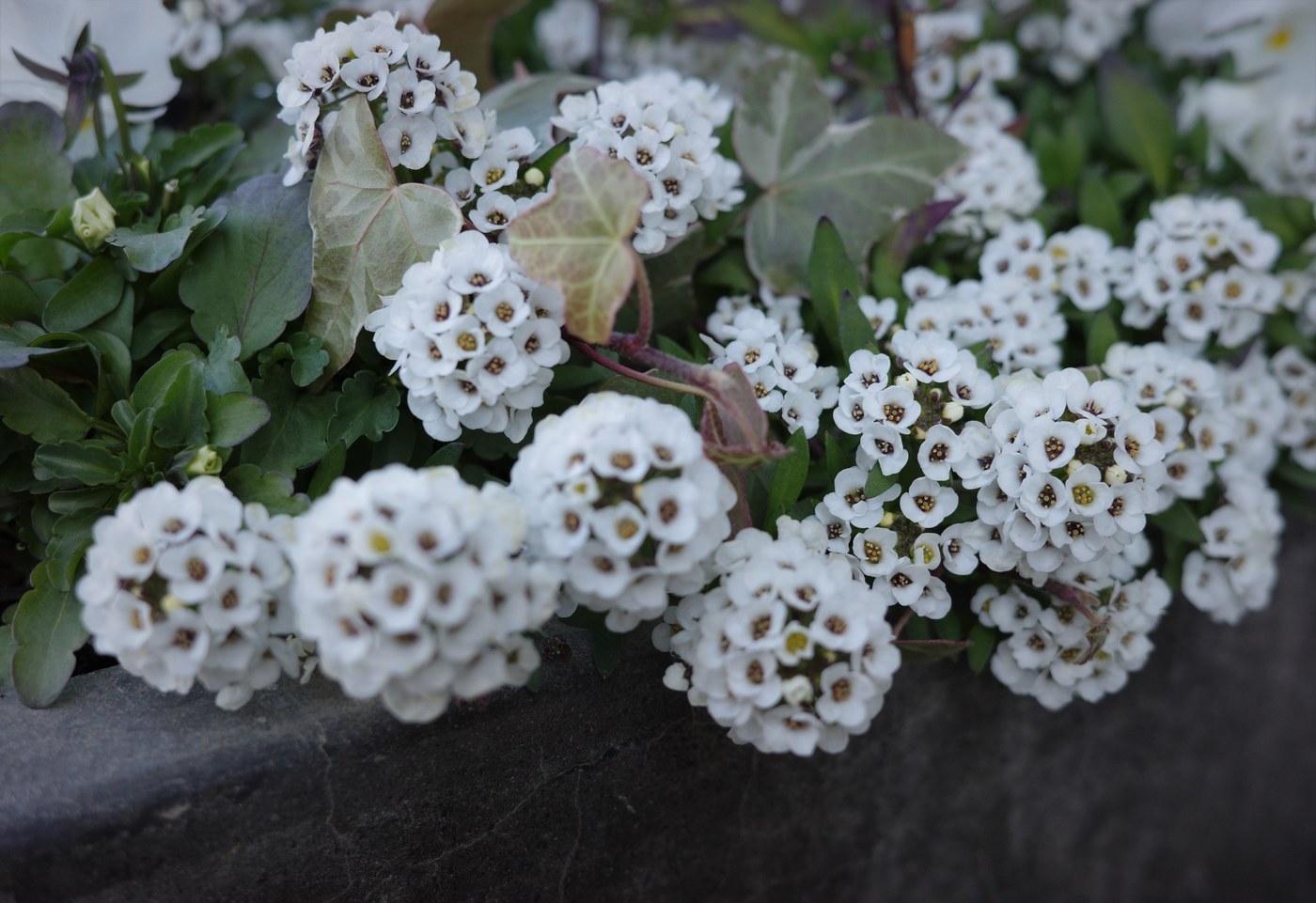
Key Identifying Features
Sweet Alyssum (Lobularia maritima) is a low, spreading annual or short-lived perennial in the mustard family (Brassicaceae). The fastest way to recognize it is the dense, dome-like mat of hundreds of minute flowers combined with a distinct sweet honey fragrance that carries on warm air.
- Mounding, sprawling habit, usually 2-8 in (5-20 cm) tall and twice as wide
- Tiny flowers, each only 2-4 mm across, packed into rounded clusters
- Each flower has 4 petals arranged in a cross — the classic mustard-family signature
- Colors: most often white, also lavender, purple, pink, and apricot in cultivars
- Strong, pleasant honey scent
Leaves & Stems
The leaves are narrow, lance-shaped to linear, 1-2 in (2.5-5 cm) long, with smooth (untoothed) margins. They are gray-green and covered in fine appressed hairs, giving a slightly silvery, matte look. Leaves alternate along thin, much-branched stems that root readily where they touch soil, helping the plant form a continuous groundcover.
Flowers & Fruit
Flowers are borne in tight terminal racemes that elongate as the plant blooms. Look closely for 6 stamens (four long, two short) — another mustard hallmark. After flowering, alyssum forms small, flattened, rounded silicles (seed pods) notched at the tip, each holding one or two seeds. It blooms heavily in cool spring and fall weather, often pausing in mid-summer heat.
How to Tell It Apart from Look-Alikes
- Candytuft (Iberis): larger flowers with two petals noticeably bigger than the others (asymmetric); alyssum flowers are tiny and symmetric.
- Basket-of-gold (Aurinia saxatilis): confusingly also called "alyssum" but has bright yellow flowers and broader silvery leaves on a coarser plant.
- Baby's breath (Gypsophila): airy and tall with 5-petaled flowers, not 4, and no honey scent.
The combination of tiny 4-petaled flowers, honey scent, gray-green hairy leaves, and a flat groundcovering habit is diagnostic.
Where You'll Find It
Sweet alyssum is a popular edging, container, and rock-garden plant worldwide. It thrives in full sun and well-drained soil, tolerates coastal salt spray (its native habitat is Mediterranean seashores), and frequently self-seeds into sidewalk cracks, gravel paths, and disturbed ground where it can naturalize.
Quick ID Checklist
- Low mounding mat, under 8 in tall
- Hundreds of tiny 4-petaled flowers in rounded clusters
- Honey/sweet fragrance
- Narrow gray-green hairy leaves with smooth edges
- Small notched seed pods after bloom
- Blooms strongest in cool spring/fall weather
Frequently asked questions
Why does my alyssum smell like honey?
Sweet alyssum naturally produces a sweet, honey-like fragrance from its tiny flowers — it's one of the most reliable ID clues and is why pollinators flock to it.
Is white alyssum the same plant as yellow 'alyssum'?
No. True sweet alyssum (Lobularia maritima) has tiny white, lavender, or pink flowers. The yellow plant sold as 'alyssum' is usually basket-of-gold (Aurinia saxatilis), a different genus.
How can I confirm it's in the mustard family?
Look at a single flower with a hand lens: four petals in a cross shape and six stamens (four tall, two short). After bloom it forms small flat notched seed pods — all classic Brassicaceae traits.
Why did my alyssum stop blooming in summer?
It is a cool-season bloomer. Heat often pauses flowering; shearing it back lightly and waiting for cooler weather usually triggers a fresh flush in fall.